

Europe's scorched landscapes seen from space after summer heatwaves
BBC Verify examines the impact of drought and extreme heat on western European rivers, fields and mountains.
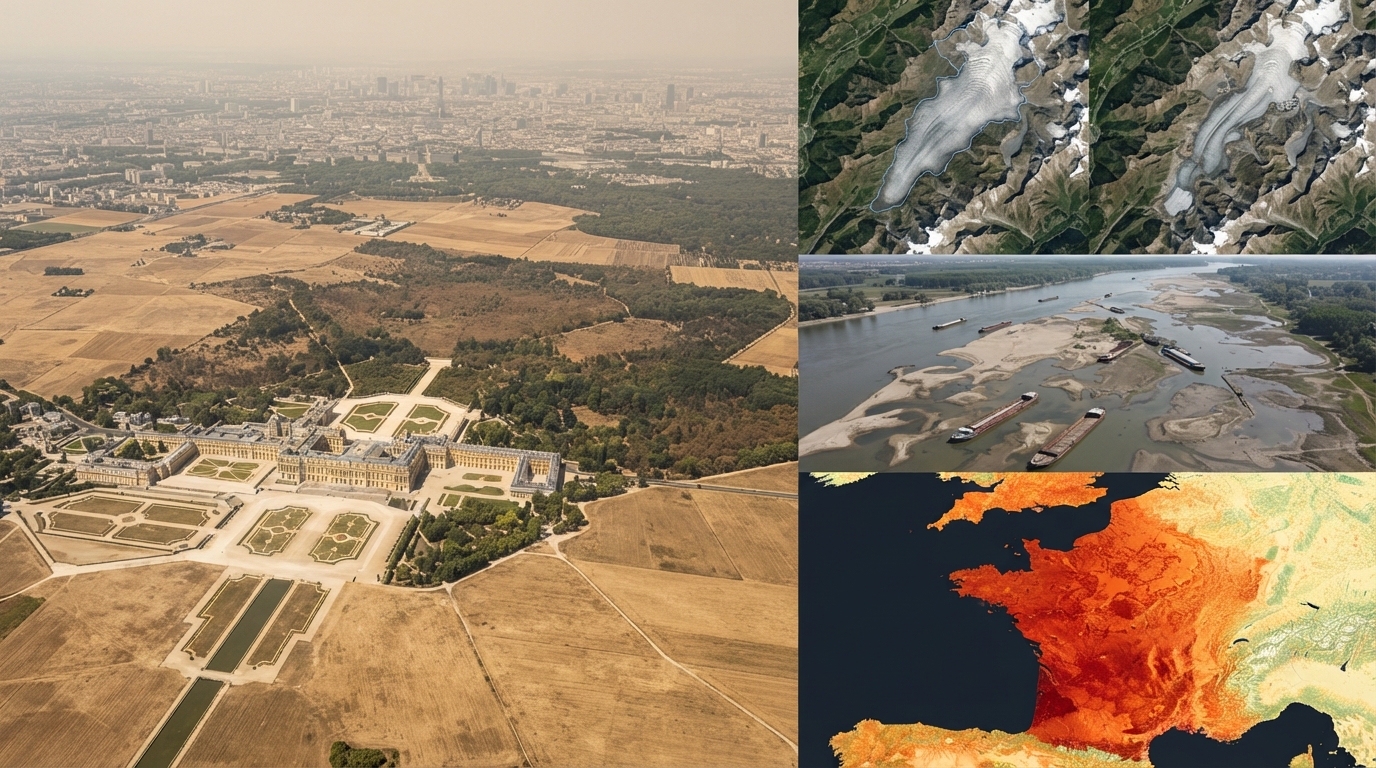
Europe's landscapes bear the scars of summer heatwaves, visible from space. Satellite imagery reveals the profound impact of extreme temperatures across western Europe since May, with BBC Verify's analysis showing shrunken glaciers, wildfire-scorched earth, parched green fields, and diminished river levels.
Even iconic landmarks have been affected. The Palace of Versailles, south of Paris, now appears as an isolated cluster of trees amidst vast brown fields in these images.
Copernicus, the EU's climate monitoring service, has confirmed that western Europe experienced its hottest June-to-July period on record. The Met Office attributes the immediate cause of the heatwaves to persistent high-pressure systems, which brought clear, sunny skies and allowed temperatures to climb. However, climate change, primarily driven by the burning of fossil fuels, has been steadily increasing average temperatures for decades, making such intense and frequent hot spells far more probable.
We've examined how the sweltering conditions have left their mark across the continent.
The Danube, Europe's second-longest river, has seen its water levels drop to a 30-year low in several countries. This has led to remarkable discoveries on the riverbed, including mammoth bones in Bulgaria and a sunken World War II warship in Serbia, which has emerged from the depths. In Hungary and Romania, nuclear power stations along the river have been forced to shut down or operate at reduced capacity due to the inability to use river water for cooling. Meanwhile, on the Rhine, cargo vessels have been stranded and river cruises canceled.
Even the snow-capped Alps have not been spared. Ongoing measurements suggest this summer could be one of the worst on record for melting Alpine glaciers, with over a month of the season still remaining. A mild winter resulted in less snow cover than usual by late April, and an unusually early heatwave the following month accelerated snowmelt. This exposed the underlying ice, making glaciers more susceptible to rapid melting during subsequent heatwaves. Satellite imagery indicates that the front of Switzerland's Rhône Glacier has retreated by 50m (160ft) or more since this time last year. In a stable climate, glaciers would typically maintain a relatively consistent size over the long term.
Dr. Lander van Tricht, a glaciologist at the Swiss Federal Institute of Technology, noted that recent years have seen "much less snow in winter and much, much more melt in summer" due to climate change. He warned that if this trend continues, "the future looks very dramatic for the Alps."
Wildfires have also reshaped parts of western Europe this summer. France has experienced its worst year on record, with over 90,000 hectares (900 sq km or 350 sq miles) burned, according to the European Forest Fire Information System. The largest fire, in the Gironde region near Bordeaux, consumed approximately 42,000 hectares – an area roughly the size of the Isle of Wight. This year's severity is partly due to exceptionally dry land. Dr. Douglas Kelley of the UK Centre for Ecology and Hydrology stated that extreme wildfires are becoming "more and more frequent" as climate change creates ideal conditions, with higher temperatures rapidly drying out vegetation and soils.
Even zoomed-out satellite imagery of western France reveals a striking increase in land browning compared to last year. To assess the unusual nature of 2026, we used the Normalised Difference Vegetation Index (NDVI), which uses satellite data to gauge vegetation health and greenness. Lower readings indicate sparser or stressed vegetation. This summer's NDVI fell below a five-year benchmark (2021-2025) across approximately 70% of France, nearly half of the UK, and about 40% of western Germany.
Prof. Andrew Challinor from the University of Leeds commented that the images are "consistent with widespread water stress," which "does not bode well" given that much of Europe's land is agricultural, potentially impacting the industry and food production. In the most severely affected areas, soil moisture is lower than on about 98% of comparable historical dates, according to Prof. Luis Samaniego from the Helmholtz Centre for Environmental Research. He cautioned that even if rain returns, some agricultural damage may already be irreversible.