

Survey: One in three respondents spends more time than necessary on social networks
Survey: One in three respondents spends more time than necessary on social networks
The "Opinions" sociological research center of the "Yuksalish" movement, in cooperation with the Institute of Social and Economic Initiatives, conducted a survey on the use of social networks.
A total of 1,371 respondents from 14 regions of Uzbekistan participated in the survey themed "Life in the Era of Social Networks." The study examined the purposes of using social networks, the time allocated to them, and their impact on study, work, and sleep.
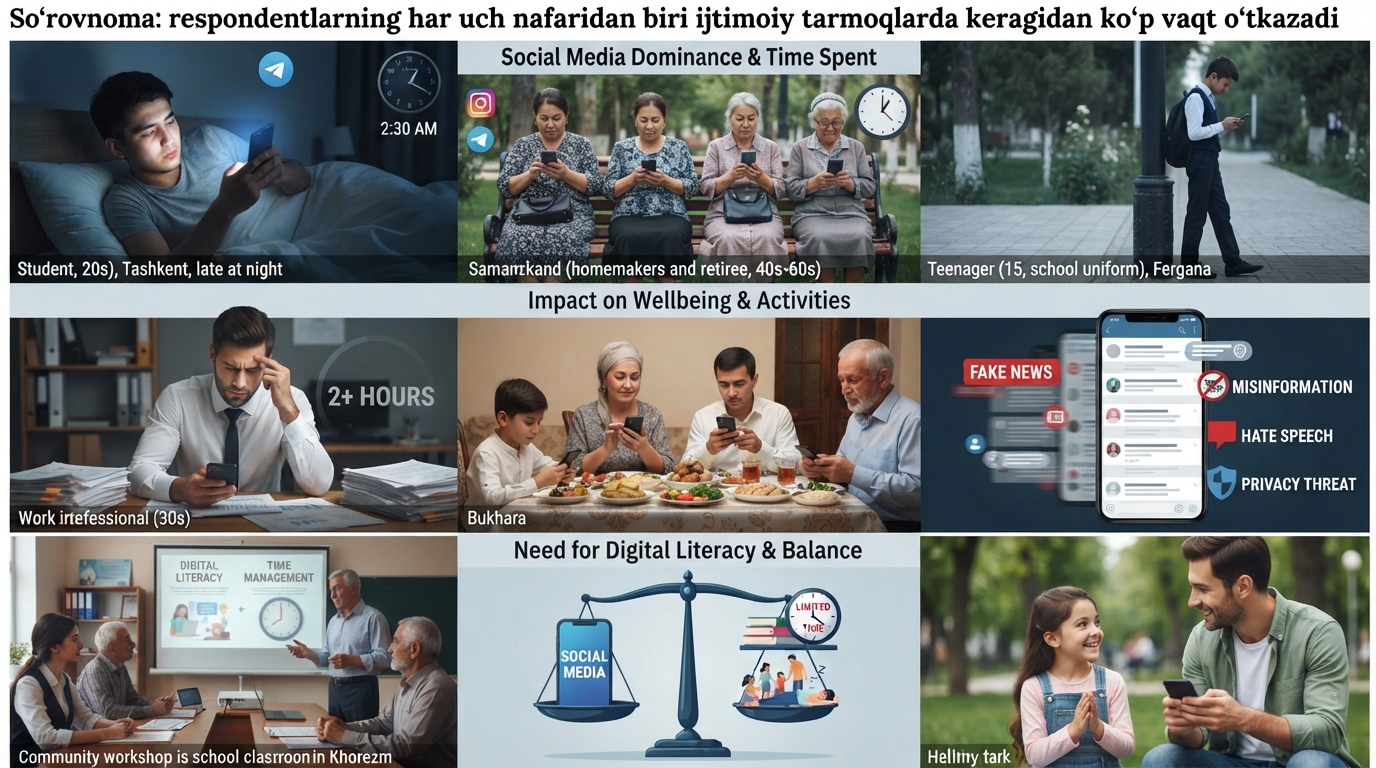
According to the survey results, 62.2 percent of respondents, or 853 people, said that using social networks affects their sleep. Meanwhile, 58.1 percent of participants aged 18 and older noted that social networks interfere with their work or daily tasks to some extent.
Among respondents aged 13–17, the share of those who noticed the impact of social networks on their sleep was 74.4 percent. Nearly three-quarters of the participants in this age group stated that social networks also interfere with their studies or homework.
The parents of 66.7 percent of the teenagers constantly monitor their use of social networks, while the parents of 28.2 percent do so sometimes. Additionally, 5.1 percent of the teenagers stated that their parents do not monitor them in this regard.
Of the respondents, 37.3 percent, or 512 people, spend more than two hours a day on social networks on work or study days. Meanwhile, 12.4 percent of the participants, or 170 people, stated that they use them for more than four hours a day.
On weekends, the share of those who allocate more than four hours to social networks was 19.7 percent, or 270 people.
Fifty-seven percent of the participants consider the time they spend on social networks to be moderate. However, 33.4 percent, or 458 people, admitted that they spend more time on them than necessary.
Among those who tried to reduce their time spent on social networks, 511 succeeded, while 327 failed. Twenty-eight percent of the respondents stated that they do not feel the need to reduce their time.
According to the survey results, the share of those who spend more than two hours a day on social networks was 54 percent among retired respondents. This figure was 43.7 percent among participants engaged in housework, 32.7 percent among students, and 27.3 percent among school pupils.
Telegram was the most used platform in the survey. It was chosen by 88.9 percent of the respondents, or 1,219 people. Instagram followed in the next positions with 73.5 percent, and YouTube with 61.8 percent. Meanwhile, 24.7 percent of the participants, or 338 people, stated that they use Facebook.
Of the respondents, 69.9 percent, or 958 people, use social networks to communicate with friends and family members. Following news was chosen by 64 percent, obtaining education by 43.8 percent, entertainment content by 42.2 percent, and income and professional goals by 40.6 percent of the participants.
Among the problems associated with using social networks, respondents most frequently noted spending excessive time. This option was chosen by 30.1 percent of the participants, or 413 people.
Fake or unreliable information was considered the most concerning problem by 18.6 percent of the respondents, while fraud and the leakage of personal data were cited by 13.2 percent.
Additionally, 6.9 percent of the participants pointed to the impact on sleep and health, another 6.9 percent to the reduction of communication between family members, and 4.2 percent to insults and harassment. Meanwhile, 8.5 percent of the respondents believed that using social networks does not cause any problems.
Based on the survey results, the "Yuksalish" movement recommended developing systematic programs for the conscious, safe, and moderate use of social networks.
At the same time, it was proposed to establish practical training sessions in educational institutions and neighborhoods on time management, media literacy, personal data protection, detecting fake information, and the conscious use of social networks.