

Strong El Niño: Is the world facing record heat?
The intensifying El Niño phenomenon could lead to new temperature records in 2026–2027, heavy rainfall in some regions, and drought in others. Climatologist Daniel Swain states that the scale of this occurrence will differ significantly from those previously observed.
Strong El Niño: Is the world facing record-breaking heat?
Daniel Swain, who researches record-breaking fires, floods, droughts, heatwaves, and storms, expressed his concerns about the current El Niño in an interview with Inside Climate News.
According to the study mentioned in the article, this El Niño could be the strongest in a thousand years.
Tropical oceans absorb most of the sun's heat. Currents then carry some of it into the deeper layers of the water.
Swain compared this process to a battery that stores energy. He explained that some of the heat accumulated in the ocean is released into the atmosphere during El Niño and spreads across the globe. Such an event usually occurs once every two to seven years.
The scientist says the problem is not limited to just one El Niño: more and more heat is accumulating in the Pacific Ocean. Therefore, the next event could trigger another rise in global temperatures.
Swain explained that previously, scientists measured how much higher the water temperature was than average in a specific area of the tropical Pacific. However, due to the overall warming of the oceans, the average temperature used for comparison is also changing.
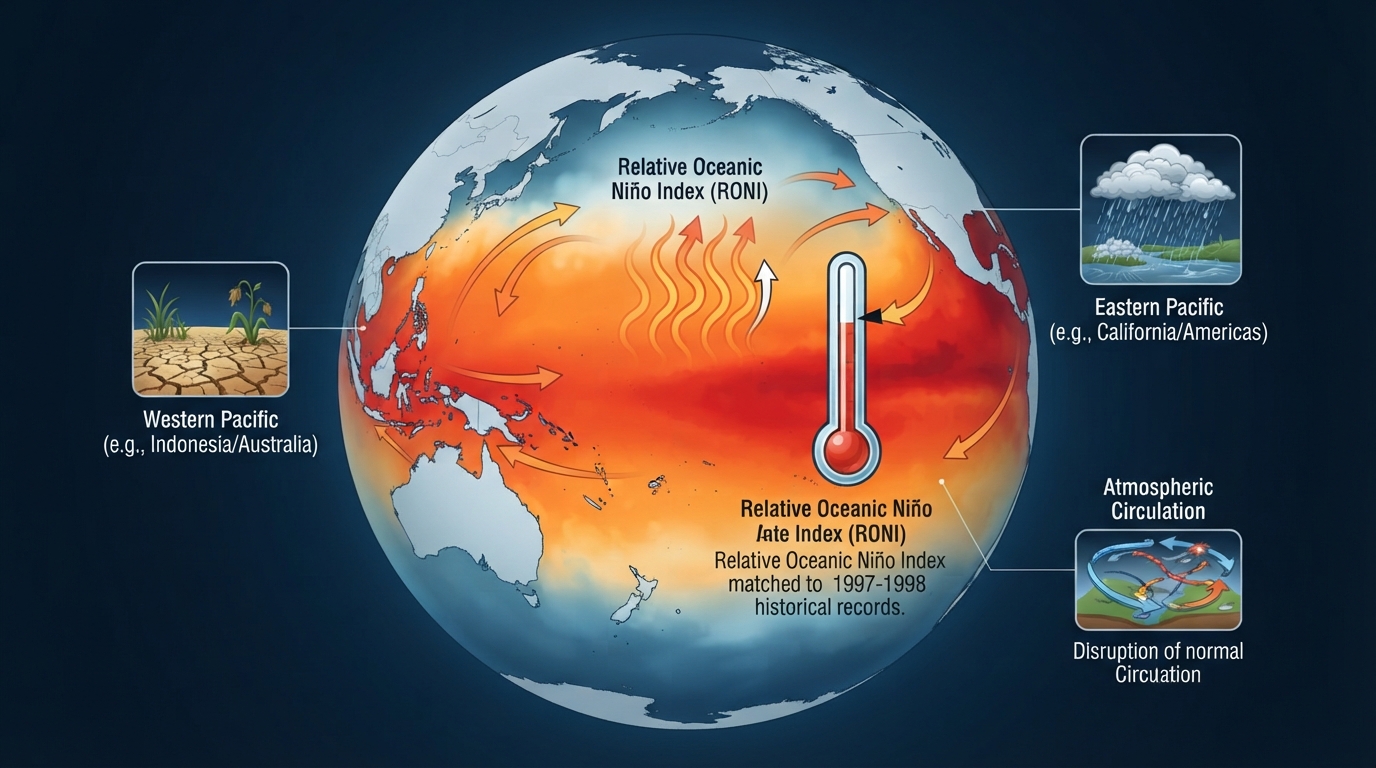
To take this into account, the US National Oceanic and Atmospheric Administration (NOAA) is using the Relative Oceanic Niño Index (RONI).
It helps assess how much more the eastern tropical Pacific has warmed compared to other tropical ocean regions. The difference in temperatures is important for understanding changes in strong atmospheric air currents and storm tracks.
This is useful, for example, in assessing how much precipitation California will receive in winter or the likelihood of drought in Indonesia.
The article notes that as of August 24, the RONI index equaled the level of 1997–1998 and reached the highest value in the history of observations for the end of August.