

Starting from 2027, the procedure for approving water and sewerage tariffs in Uzbekistan will change
Starting from 2027, drinking water and sewerage tariffs will be approved by the Interdepartmental Tariff Commission. The procedure for debt collection will also change.
The procedure for approving water and sewerage tariffs in Uzbekistan to change from 2027
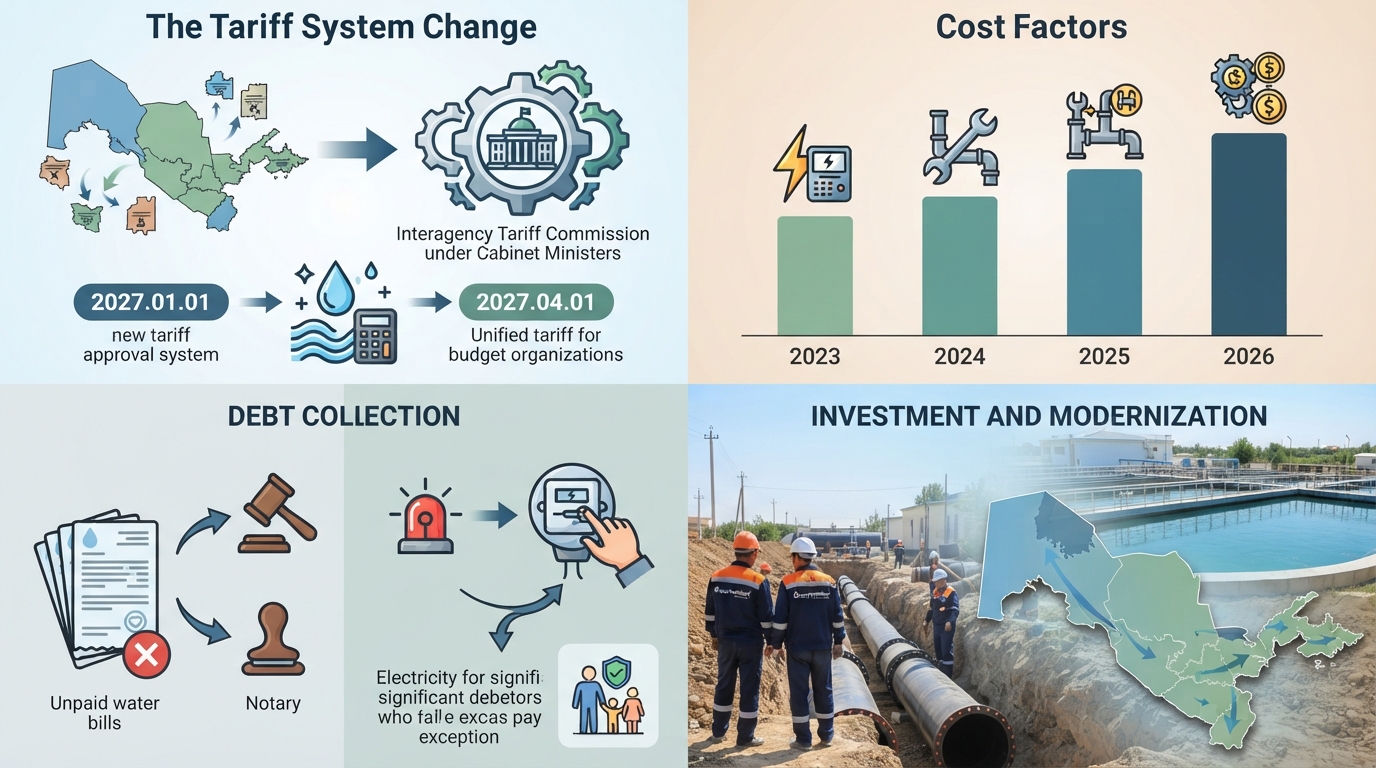
From January 1, 2027, the authority to approve tariffs for drinking water supply and sewerage services in Uzbekistan will be transferred to the Interdepartmental Tariff Commission under the Cabinet of Ministers. The new procedure envisages the use of unified economically justified criteria instead of setting prices separately in each region. This was announced at a press conference held with the participation of representatives of "Uzsuvtaminot" JSC. It also touched upon the financial status of enterprises in the sphere, consumer debt, and expected changes in the water supply system.
Another innovation is planned to be introduced from April 1, 2027. According to it, a single water tariff is expected to be established for budgetary organizations.
Rising costs are affecting water supply prices
As explained by "Uzsuvtaminot", the prime cost of services is influenced by electricity prices, infrastructure repair costs, staff salaries, and expenses related to servicing attracted loans.
In this context, the gradual increase in electricity prices was also one of the factors. From October 1, 2023, the electricity tariff was raised from 450 sums to 900 sums, to 1,000 sums from May 1, 2025, and reached 1,100 sums from June 1, 2026. Thus, electricity expenses increased by 2.4 times over three years.
Nationwide, the average tariff for drinking water for the population is 3,765 sums per cubic meter, and 4,217 sums including VAT. The price of sewerage services averages 2,008 sums.
As of October 27, new tariffs have been approved at six enterprises in the sector. In the Andijan region, the price per cubic meter of water increased from 1,650 sums to 2,500 sums, in the Navoiy region from 3,500 sums to 4,200 sums, and in the Samarkand region from 2,800 sums to 3,600 sums.
In the Surkhandarya region, the tariff rose from 5,300 sums to 6,800 sums, and in the Tashkent region from 2,600 sums to 3,100 sums. For the "Chimgan-Charvak" main water supply enterprise, the tariff changed from 1,500 sums to 1,700 sums.
Consumer debt exceeded 542 billion sums
According to the company, as of October 1, 2026, consumer debt to the enterprises of the "Uzsuvtaminot" system reached 542.6 billion sums. Of this, 430.7 billion sums account for the population, while the debt of legal entities amounts to 111.8 billion sums.
The largest portion of the debt was recorded in the city of Tashkent — 92.9 billion sums. The debt amounted to 74.1 billion sums in the Andijan region, 61.6 billion sums in the Tashkent region, and 57 billion sums in the Fergana region.
In order to recover unpaid bills, 167,783 applications were sent to notary offices and courts this year. Following the reviews, 114,305 execution writs and court orders were issued. Of these, 110,563 were submitted to the Bureau of Compulsory Enforcement.
Debts to be recovered via notary or court
Starting from 2027, the mechanism for recovering debts for water supply and sewerage services is planned to change. Depending on the amount of debt, the relevant processes will be carried out through notary offices or courts.
If the amount of debt does not exceed 1,000 times the base calculating amount (BCA), it will be recovered through a notary. The issue of indebtedness above the specified threshold will be sent to court for consideration.
If a consumer fails to fulfill their obligations even after an executive document has been drawn up, the legislation provides for the possibility of restricting electricity payments in accordance with established procedure.
However, this new measure will not be applied to families included in the Unified Register of Social Protection. Furthermore, restrictions will not be introduced immediately upon the occurrence of debt: in accordance with the established procedure, the consumer will be given time to pay off the debt.
Tariff policy in the sector planned to be updated
The expected changes are related to the tasks specified in Presidential Decree No. UP-140 dated July 24, 2026. The document provides for measures to improve the tariff regulation system, strengthen the financial stability of enterprises, and enhance service quality.
In particular, it is planned to shorten the timeframe for reviewing tariffs in cases where energy resource prices change. It is also envisaged to increase the transparency of decisions regarding tariffs, notify the population in advance, and direct funds toward the repair and modernization of water networks.
The transition to a new tariff regulation system is expected to allow the application of unified criteria when approving prices and to increase the financial stability of water supply enterprises.