

Side effect
The Invisible Enemy of Power Plants: Why Dirty Water Costs Central Asia Millions
Side effect
The reliability of Central Asian power systems is usually evaluated by the installed capacity of power plants, the condition of turbines, the degree of power grid wear, and fuel availability. But a significant share of technological constraints is formed in an infrastructure that rarely enters the focus of public discussion. We are talking about cooling systems that reject heat from steam turbine condensers, heat exchangers, and auxiliary equipment. Even a modern power plant with a high efficiency ratio depends on the chemical composition of water, the rate of mineral scale formation, and the condition of internal piping surfaces. For Kazakhstan, Uzbekistan, and Kyrgyzstan, this topic is particularly important due to growing energy consumption, limited water resources, and the aging of a portion of generating capacity.
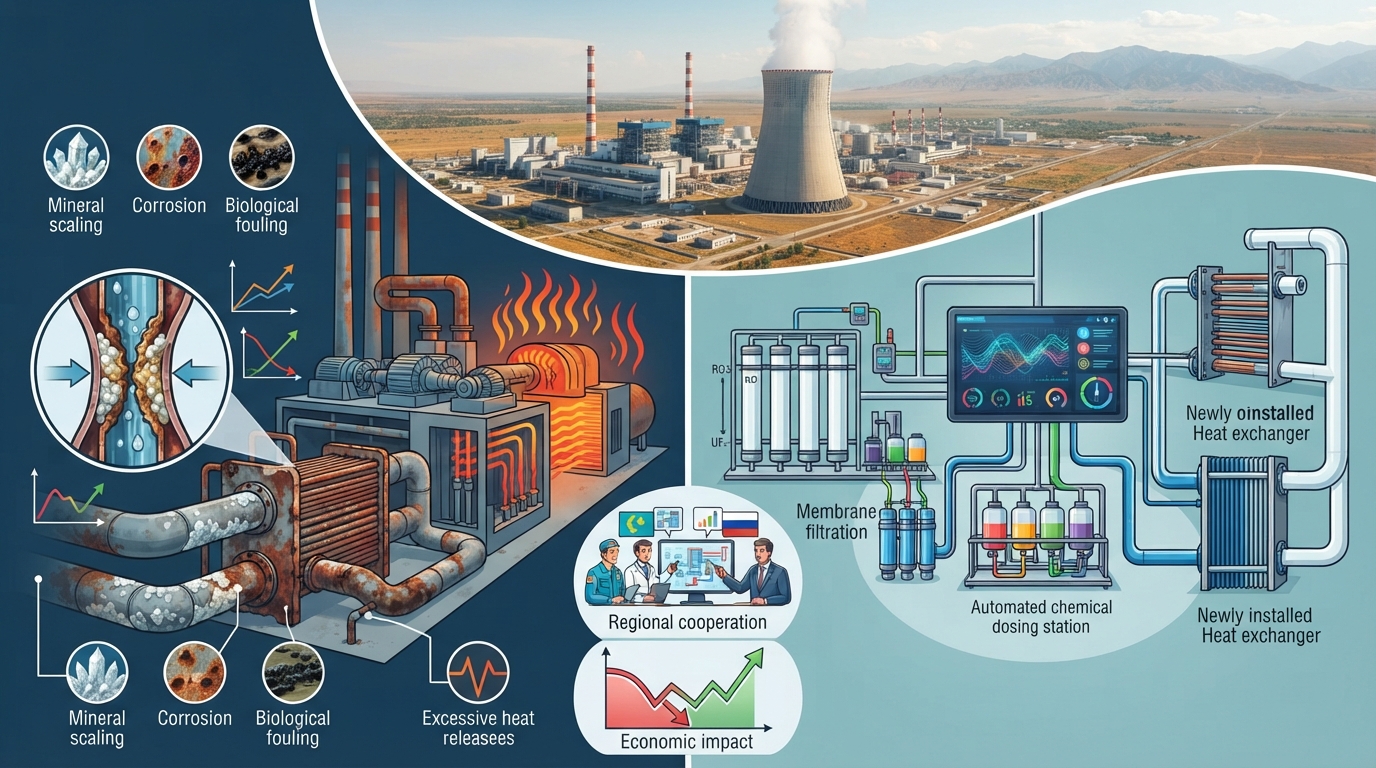
Increased mineralization of recycled water, corrosion, and biological fouling gradually impair heat transfer, increase auxiliary power consumption, and raise the risk of unscheduled shutdowns. At the same time, the financial consequences of such processes are often bundled into general operating expenses, making it difficult to assess their true scale.
The physical essence of the problem is related to the specifics of the power plant thermal cycle. In traditional steam turbine units, only a fraction of fuel energy is converted into electricity, while a significant volume of residual heat must be rejected through condensing equipment. Depending on technology and operating mode, the electrical efficiency of thermal units can range roughly between 33 and 45%, while modern combined-cycle units can exceed 60%. Cooling water maintains the required pressure in the condenser, which directly affects turbine efficiency. If the cooling medium temperature rises or heat transfer deteriorates, condenser pressure increases, and the useful work of the steam cycle is reduced. Even small changes in these parameters can lead to noticeable annual output losses on large power units.
The gradual accumulation of calcium carbonate, magnesium salts, silicon compounds, and corrosion products poses a particular threat. The thermal conductivity of such deposits is significantly lower than that of metal, so even a relatively thin layer of sediment creates additional thermal resistance. At the same time, deposits reduce the flow cross-section of pipes, increase hydraulic resistance, and raise the load on circulating pumps. Thus, a disruption of the water-chemistry regime simultaneously impacts generation efficiency, auxiliary system power consumption, and equipment service life.
Historically, the industrial water supply systems of Central Asia were formed within a unified Soviet power grid, where the design of large power plants was conducted taking into account regional water sources and centralized technical standards. The Ekibastuz power facilities of Kazakhstan, the thermal stations of the Tashkent industrial region, and the large generating enterprises of the Fergana Valley were created under a significantly different consumption structure. A large portion of the equipment was designed for multi-decade operation with regular capital overhauls and scheduled chemical cleanings.
After the collapse of the USSR, economic opportunities for modernizing power infrastructure in the region's states developed unevenly. As a result, at certain enterprises, the updating of turbines, boilers, and control systems proceeded faster than the reconstruction of auxiliary water management facilities. Such asymmetry is typical of many industrial economies, as investments in primary generating equipment yield a more obvious production result. Meanwhile, the technical condition of cooling towers, circulating pumps, filters, and chemical dosing systems directly determines the operating stability of modernized power units. The situation is further complicated by changes in raw water quality due to industrial water use, agricultural runoff, and seasonal fluctuations in river flows. Therefore, maintaining the original design parameters without revising water treatment parameters can accelerate the wear of even relatively new equipment.
The most large-scale economic consequences of such constraints potentially arise in Kazakhstan, where a significant portion of electricity is generated by thermal power plants. Ekibastuz GRES-1 has an installed capacity of 4,000 MW, and the design capacity of Ekibastuz GRES-2 is 2,000 MW. For facilities of this scale, even a small drop in efficiency translates into a substantial volume of lost electricity generation. A nominal 1% reduction in a station's available capacity with an installed capacity of 4,000 MW corresponds to 40 MW. If such a constraint persists over 7,000 hours, estimated losses could reach 280 million kWh. This example does not reflect the actual losses of a specific station, but it demonstrates the economic sensitivity of large generation facilities to technological deviations.
The state of water supply in the industrial centers of the Karaganda and Pavlodar regions, where energy enterprises interact with metallurgical and chemical plants, is of additional importance. The use of recycled water loops reduces fresh water intake, but it is accompanied by the gradual concentration of dissolved salts. The higher the cycles of concentration, the smaller the required makeup water volume, all else being equal, but the stricter the requirements for preventing scale formation. Therefore, improving water use efficiency requires precise chemical parameter management, rather than a simple reduction in blowdown.
For Uzbekistan, the problem has a somewhat different economic configuration, associated with a high role for gas-fired thermal generation and growing water use constraints. The development of modern combined-cycle capacity increases fuel-to-electricity conversion efficiency, but it does not eliminate the need for reliable cooling of steam cycle condensers. The most serious risks arise in hot-climate areas, where summer air temperatures simultaneously increase load on the power grid and worsen heat dissipation conditions. In open-loop cooling systems, a significant portion of heat is removed through water evaporation in cooling towers. At the same time, dissolved minerals remain in the circulating loop, gradually increasing salt concentration. If the cycles of concentration reach four, under a simplified water balance, the blowdown volume accounts for roughly one-third of evaporative losses. Increasing the cycles of concentration to six allows this figure to be reduced to approximately one-fifth, though actual values depend on additional losses and operating modes. Water savings prove significant, but the likelihood of scale formation and corrosion damage simultaneously grows. For Uzbekistan's energy enterprises, this means viewing chemical water treatment as part of a strategy to enhance gas generation efficiency. Similar technological tasks arise at industrial enterprises operating large refrigeration and heat-exchange complexes.
A separate group of risks stems from microbiological fouling, which can develop even under a relatively favorable mineral water composition. Biofilms composed of microorganisms, organic matter, and their metabolic products form in circulating systems. Such formations impair heat transfer, create conditions for localized corrosion, and complicate the effective treatment of metal surfaces. Biological processes proceed especially actively at elevated temperatures and in the presence of nutrients in makeup water. The problem is complicated by the fact that standard conductivity and hardness metrics do not allow for a reliable assessment of the equipment's microbiological state. Control requires specialized analytical methods, regular biological activity evaluations, and properly organized biocide application. At the same time, excessive use of oxidizing agents can exacerbate corrosion in certain materials and create additional environmental constraints. Consequently, managing biological fouling requires harmonizing chemical treatment, hydraulic regimes, and sanitary requirements. In international practice, such systems are also evaluated from the perspective of preventing the spread of Legionella via cooling tower aerosols. For Central Asia, where the modernization of industrial water supply is often accompanied by an increasing share of recycled water use, the importance of microbiological control will consistently rise.
Russian industry possesses expertise in water treatment, chemical conditioning, membrane technologies, and automated chemical control, which can be utilized in joint energy projects. The economic significance of such cooperation is determined not only by equipment costs, but also by the opportunity to increase the actual output of existing power plants without constructing additional generating capacity.
Russian technological solutions are of interest primarily because they allow for the integration of several water treatment methods into a single system. Chemical conditioning programs provide for the use of corrosion inhibitors, antiscalants, dispersants, and biocides selected based on the chemical composition of a specific source. Membrane technologies, including ultrafiltration and reverse osmosis, enable the removal of suspended solids and dissolved salts, though they require water pretreatment and concentrate management. For large energy facilities, a combination of mechanical filtration, partial softening, automatic chemical dosing, and continuous conductivity measurement can be economically justified. Russian enterprises, including NPO LIT, NPK Mediana-Filter, and manufacturers of specialized water-treatment chemicals, have experience developing individual components of such complexes.
However, the presence of technological expertise alone does not guarantee the success of a specific project. Source water composition, temperature, materials used, cooling tower characteristics, and allowable discharge parameters require individual engineering calculations. Establishing service support directly in Kazakhstan, Kyrgyzstan, and Uzbekistan could be an important advantage of joint projects. Such a model reduces enterprise dependence on long-distance supply chains for consumables and allows for faster adjustments to the water-chemistry regime when operating conditions change.
The economic efficiency of modernization is determined by the ratio of initial investments, operating expenses, and prevented production losses. For example, for a hypothetical 500 MW power plant, recovering one percentage point of available capacity is equivalent to an additional 5 MW. If this reserve is utilized over 6,000 hours, potential additional generation would amount to 30 million kWh. At an assumed electricity cost of 25 tenge per kWh, the monetary value of such a volume reaches 750 million tenge annually. This sum is not net profit, as fuel, variable costs, actual station load, and the ability to sell additional power must be taken into account. Nevertheless, the calculation demonstrates why relatively small investments in auxiliary infrastructure can carry major economic weight. An additional effect is generated by reducing chemical washes, extending intervals between overhauls, and decreasing expenses on replacing damaged heat exchanger tubes. In water-scarce regions, these advantages are joined by lower costs for water intake, makeup treatment, and wastewater treatment. However, technology selection must factor in the cost of chemicals, membranes, electricity, and waste disposal. Therefore, no universal solution exists for all Central Asian power plants.
The prospects for Russian and Central Asian industrial cooperation in this domain extend beyond conventional equipment supplies. Kazakhstan has an industrial base for manufacturing tanks, pipeline valves, pump units, and certain instrumentation components. Uzbekistan possesses a developing machinery and chemical sector capable of participating in the localization of specific water treatment elements. Kyrgyzstan is primarily of interest in the thermal power, industrial water supply, and municipal energy modernization segments, although its cooling water consumption scales differ from the large thermal systems of neighboring states. Joint projects can be built around the allocation of manufacturing functions, engineering design, and long-term equipment maintenance. At the same time, the compatibility of Russian technological solutions with existing national standards and environmental requirements is particularly crucial. The shared historical engineering tradition and the prevalence of Soviet-era equipment simplify inspections of aging facilities, but they do not replace modern testing. An additional direction involves implementing digital monitoring systems that correlate water chemical metrics with condensation temperature, cooling flow rate, and actual turbine efficiency. On this basis, maintenance gradually transitions from fixed schedule procedures to condition-based diagnostics. The economic value of such a transition lies in the ability to identify heat transfer degradation before emergency capacity restrictions occur.
The strategic importance of water treatment is especially evident when comparing Central Asia's energy and climate constraints. Growth in population, industrial production, and electricity consumption increases the demand for reliable generation, whereas competition for water resources limits the expansion of traditional cooling systems. Changes in seasonal river runoff and higher summer temperatures may further complicate the operation of thermal power plants. At the same time, building new generation facilities requires significant capital investments and long implementation timelines, whereas modernizing existing auxiliary infrastructure often yields results much faster. However, its effectiveness is determined not by the formal installation of water treatment equipment, but by the sustained adherence to technological parameters throughout the entire operating cycle. Russian participation in such projects can be economically significant precisely due to a combination of engineering designs, chemical technologies, and practical experience servicing large industrial systems.
For Central Asian states, the ability to build local expertise in industrial water chemistry and heat-exchange equipment diagnostics provides added value. At the same time, dependence on imported chemicals, consumables, and specialized service must be factored into evaluations of long-term cooperation sustainability. The main feature of the issue at hand is that cooling water quality effectively sets the boundary between a power plant's installed capacity and its real ability to produce electricity. It is for this reason that modernizing recycled water supply systems is not a secondary maintenance task, but an independent factor in Central Asia's energy security, industrial efficiency, and rational water resource management.