

About water on occasion
When rivers stop feeding: how the water crisis threatens millions of Central Asia residents
About Water and More
Water scarcity is gradually ceasing to be merely an environmental problem and is turning into one of the key factors of economic and political stability in Central Asia.
Kazakhstan, Kyrgyzstan, Tajikistan, Uzbekistan, and Turkmenistan possess significant natural resources, but their economic systems have historically developed under conditions of uneven distribution of fresh water. The main water reserves are concentrated in the mountainous areas of Kyrgyzstan and Tajikistan, while the largest consumers are located mainly in the lower reaches of transboundary rivers. Such geography forms a structural dependence between states that cannot be eliminated solely through national infrastructure projects.
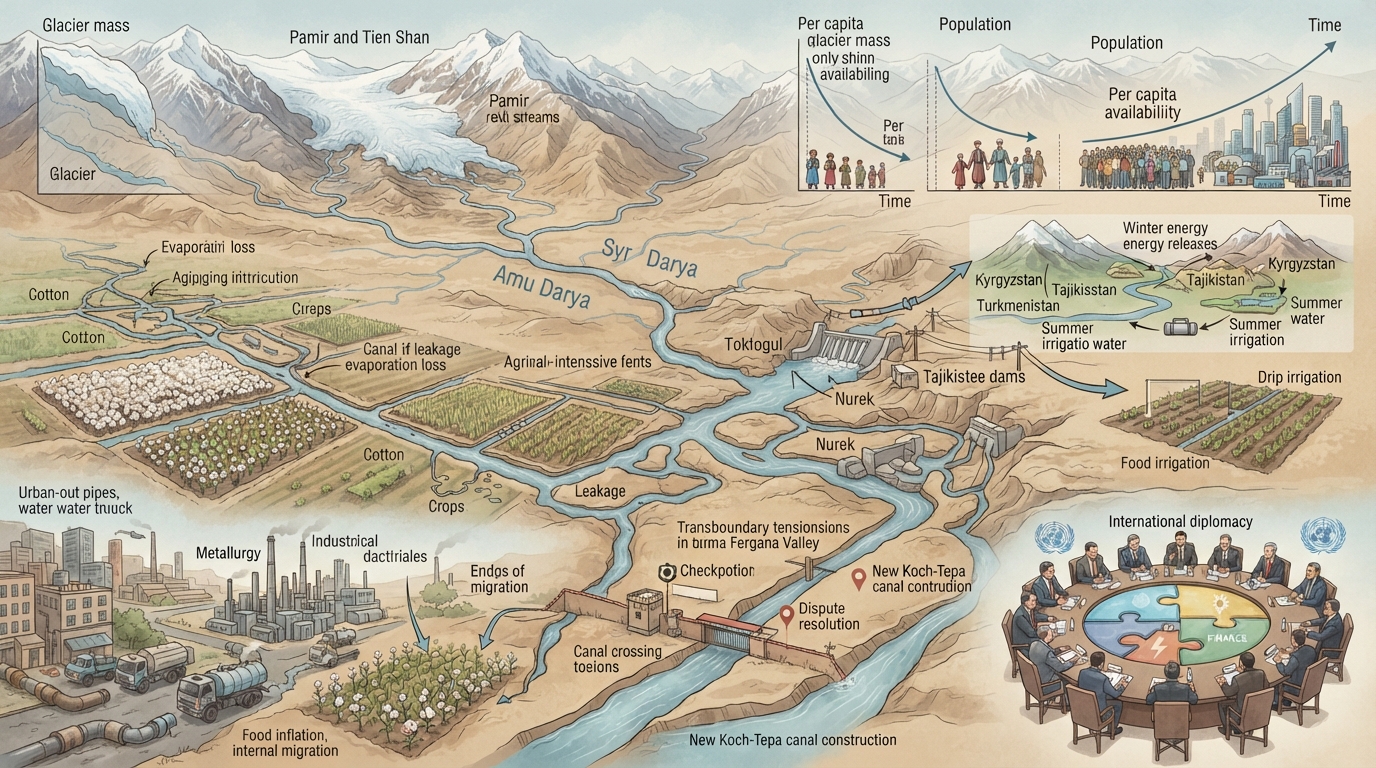
Additional pressure is created by rising temperatures, shrinking glaciers, population growth, and the expansion of agricultural production. Over a quarter of a century, the region's population has grown from approximately 56 million to more than 84 million people, noticeably increasing the burden on water management systems. At the same time, economic growth is accompanied by rising electricity consumption, urban expansion, and the development of water-intensive industries. As a result, water availability is becoming a bottleneck for investment activity, food security, and industrial development. The main difference between the current crisis and previous droughts lies in the simultaneous impact of climate, demographic, and infrastructural factors.
Central Asia's hydrographic system is primarily defined by the Amu Darya and Syr Darya river basins, which provide water supply to millions of people and a significant portion of irrigated land. The length of the Amu Darya is about 2,500 kilometers, and the Syr Darya is 3,019 kilometers. There are approximately 89,000 watercourses of various sizes in the region, but the main economic load falls on a relatively small number of large river systems. Their feed is directly linked to the Pamir and Tien Shan glaciers, which serve as natural reservoirs of fresh water. According to regional estimates, Kyrgyzstan accounts for about 45% of Central Asia's glaciers, with the reduction of ice reserves having already acquired significant proportions. The peculiarity of glacier melting is that at the first stage it can increase river runoff, creating the impression of a temporary improvement in water availability. However, as the ice mass decreases, the ability of mountain systems to maintain a stable flow during dry periods weakens. This is particularly dangerous for agriculture, as the peak demand for irrigation occurs in the summer months. According to forecasts cited in expert materials, by the middle of the century, the flow of the main river basins could decrease by about 15%, although the specific consequences will vary by territory.
The economic significance of the water crisis is especially noticeable when comparing demographic indicators with the population's water resource supply. According to presented estimates, over four decades this indicator dropped from 8,400 to approximately 2,500 cubic meters per person per year. This dynamic is explained not only by changes in natural runoff, but also by a significant increase in the number of consumers. International practice considers a level below 1,700 cubic meters to be a sign of water stress, and below 1,000 cubic meters — a severe deficit.
At the same time, regional average indicators conceal large differences between mountainous areas and densely populated agricultural territories. The Fergana Valley is particularly vulnerable, where high population density is combined with intensive farming and a complex system of interstate water distribution. According to estimates by the Eurasian Development Bank, in 2024 nearly 10 million residents of Central Asia lacked access to safe sources of water supply. At the same time, the deterioration of individual elements of the water supply and sewage infrastructure reached 80%, and losses in distribution systems were estimated at up to 55%. Consequently, the real shortage of usable water is determined not only by natural reserves, but also by the ability of states to deliver the resource to end consumers.
The most serious economic consequences are associated with agriculture, which remains the largest consumer of water in the Amu Darya and Syr Darya basins. Irrigation accounts for around 80–90% of the resources used in the respective river systems. This structure took shape back in the Soviet period, when the large-scale development of cotton growing and irrigation infrastructure was provided for through centralized water distribution. The expansion of cultivated areas occurred mostly without fully accounting for environmental costs, which became one of the reasons for the catastrophic shrinkage of the Aral Sea. After the collapse of the USSR, the states inherited extensive networks of canals, pumping stations, and reservoirs, the operation of which requires significant financial resources. In certain sections of unlined earth canals, transportation losses reach 40% due to seepage and evaporation. Modern drip irrigation technologies are capable of significantly reducing water consumption at the farm level, but the economic effect depends on the crop structure and the total volume of water intake. If an increase in efficiency is accompanied by an expansion of irrigated areas, overall consumption may not decrease. Therefore, technological modernization alone does not guarantee the restoration of the water balance.
The link between water and energy creates another dimension of regional interdependence. Kyrgyzstan and Tajikistan possess significant hydropower potential, while Kazakhstan, Uzbekistan, and Turkmenistan are historically interested primarily in a stable summer flow for agriculture. The Toktogul Reservoir and the Nurek Hydropower Plant perform important regulatory functions while simultaneously generating electricity. A contradiction arises due to the seasonal mismatch of needs: mountain states need increased generation in winter, while downstream countries require water mainly in summer. In the Soviet economic system, this imbalance was compensated by centralized supplies of fuel and electricity. After 1991, the former mechanism lost its unified administrative foundation, making ongoing interstate negotiations necessary. Modern agreements between Kyrgyzstan, Kazakhstan, and Uzbekistan effectively replicate the economic logic of a seasonal exchange of energy and water resources. Winter electricity deliveries make it possible to reduce the need for additional discharges from reservoirs and save part of the reserves for subsequent irrigation. Thus, the reliability of energy supply directly affects the food security of neighboring states.
The political sensitivity of the water issue is particularly noticeable in border areas, where irrigation infrastructure was created prior to modern state borders. Canals, water intake facilities, and distribution hubs often serve settlements located on different sides of international frontiers. In the Fergana Valley, such a configuration complicated relations between Kyrgyzstan, Uzbekistan, and Tajikistan for decades. One of the most famous examples was the dispute over the Kempir-Abad Reservoir, the settlement of which received contractual formalization in 2022. The agreements between Bishkek and Tashkent made it possible to align territorial issues and the regime for the joint use of a strategically important water body.
Another illustrative case was the 2021 clashes near the "Golovnoy" water distribution facility on the Kyrgyz-Tajik border. The signing in 2025 of the state border agreement between Kyrgyzstan and Tajikistan created a new legal framework for regulating such disputes. However, the legal demarcation of territories does not automatically eliminate the problems of technical maintenance of canals, cost distribution, and adherence to agreed water delivery schedules. Consequently, the stability of border relations increasingly depends on the quality of joint infrastructure management.
A separate strategic factor is Afghanistan's construction of the Qosh Tepa Canal, intended to develop irrigated agriculture in the north of the country. The project is capable of changing the established system of Amu Darya flow distribution, especially during periods of seasonal low water. Expert estimates mention a potential water intake of up to 17 billion cubic meters annually, though actual volumes will depend on the completion of construction and operation of the system. The most sensitive consequences are expected for Uzbekistan and Turkmenistan, whose agricultural areas directly depend on water flow from the Amu Darya. Meanwhile, Afghanistan is not part of the established Central Asian system of interstate quotas and water management regulation. Existing regional mechanisms were formed primarily around relations between former Soviet republics and did not account for Kabul's full participation. A fundamentally new situation is emerging where decisions by a state outside the traditional negotiation system can significantly affect the economies of several neighboring countries.
Additional uncertainty is created by climate change, as the reduction of natural flow increases the relative significance of any new large-scale water intake. As a result, Central Asian water diplomacy is gradually stepping beyond the boundaries of the usual regional format.
The consequences of water scarcity are not limited to agricultural losses and interstate relations. Industrial enterprises use large volumes of water for cooling equipment, technological processing of raw materials, and supporting production processes. Metallurgy, the chemical industry, power generation, and certain sectors of the extractive industry are particularly sensitive. The reduction of available resources increases costs for water treatment, reuse, and transportation, directly impacting the cost price of products.
For cities, additional problems include the need to upgrade utility infrastructure and rising costs to maintain the quality of drinking water supply. According to expert forecasts, over the next two decades, total water demand in the region could increase by approximately 23%.
At the same time, declining crop yields could fuel food inflation and reduce the income of the rural population. Given that the agrarian sector provides employment for a significant portion of the region's workforce, the deterioration of water availability creates preconditions for accelerated internal migration. Economic damage in this case spreads through consumer prices, budget expenditures, employment, and foreign trade ties.
The international dimension of the crisis lies in the fact that Central Asia occupies a prominent place in the supply of agricultural products to the markets of Russia, China, and neighboring states. A reduction in the production of vegetables, fruits, and other water-dependent crops could alter the structure of regional trade. Simultaneously, states will have to increase capital investments in water-saving technologies, canal reconstruction, and modern metering systems. These expenses place an additional burden on budgets that are already funding energy, transport, and social infrastructure. Of particular importance is the ability to allocate investments between building new facilities and improving the efficiency of existing systems.
Kazakhstan's initiative to create an international water organization within the UN structure reflects a desire to elevate the issue to a higher institutional level. However, the effectiveness of international mechanisms is determined not by the number of agreements, but by the ability to reconcile the economic interests of the participants. The experience of Central Asia shows that the most durable arrangements arise where water obligations are backed by energy supplies, financial compensation, and mutual interest. Therefore, the future architecture of cooperation will depend primarily on the ability of states to transform the distribution of a scarce resource into a system of measurable mutual commitments.
In the long run, the water crisis is changing the very concept of the economic advantages of Central Asian states. The presence of mineral resources, energy capacity, and labor resources is no longer sufficient for guaranteed industrial growth without a reliable water supply system. Upstream states are acquiring growing importance as flow-forming territories, but simultaneously face risks of shrinking glaciers and instability in hydropower generation. Downstream countries possess larger agricultural and industrial consumers, but bear increased costs of dependence on transboundary water supplies. Climate change amplifies this asymmetry while making mutual economic dependence deeper. Crucially, water scarcity can occur even while relatively significant natural reserves remain, if infrastructure and governance institutions do not match the scale of consumption. Therefore, the main risk lies not in the instantaneous disappearance of water resources, but in the gradual decline of the economic systems' ability to maintain their previous structure of production and settlement. Under such conditions, water becomes a factor determining the cost of investments, the sustainability of public finances, and the nature of international relations. It is precisely the ability to align natural constraints with economic interests that will determine not only the environmental state of Central Asia, but also the limits of its economic development in the coming decades.