

Engineering gap
Central Asia's New Energy Problem: There's Gas Underground, but the Number of Experts Is Decreasing
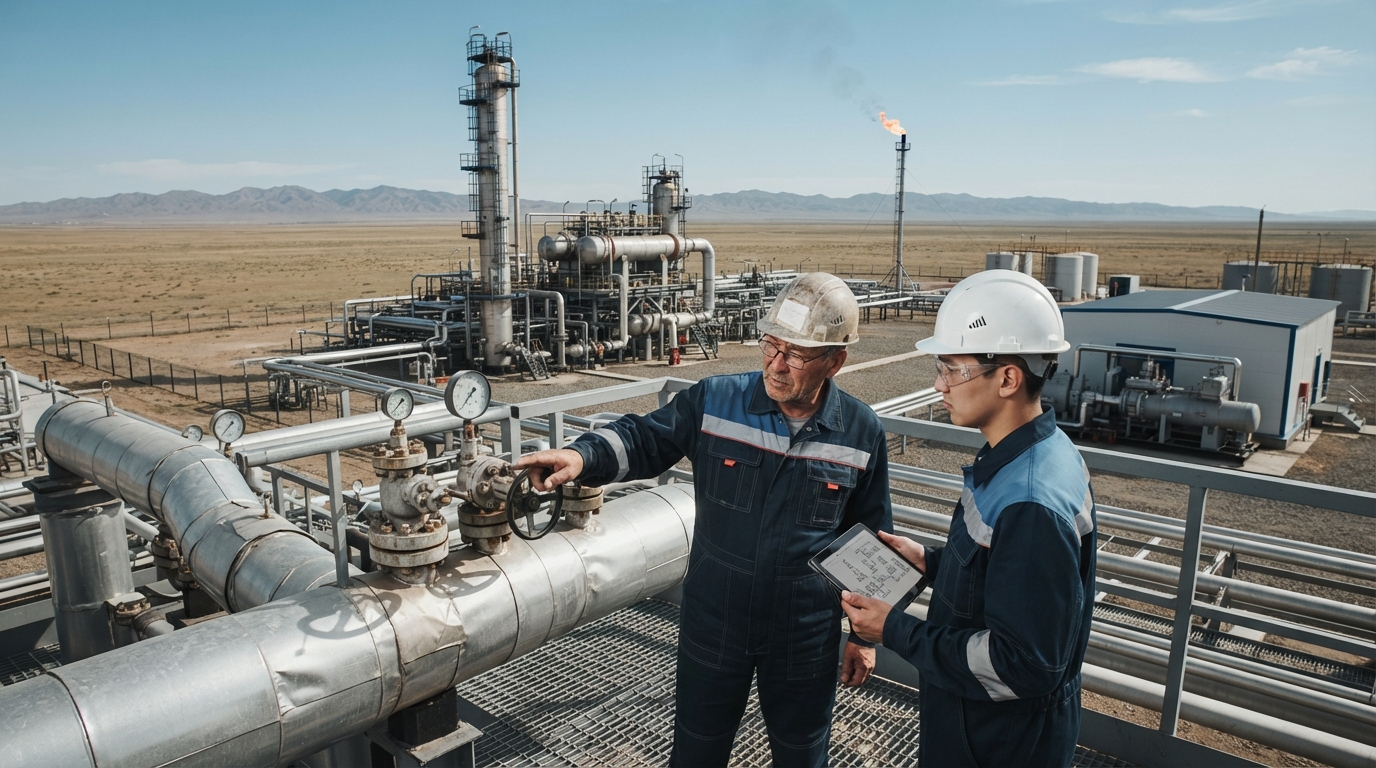
Engineering Shortage: A Challenge for Energy Stability in Central Asia
Central Asia is entering a new phase, where the availability of natural gas resources no longer guarantees energy stability. Despite Kazakhstan's significant reserves, Uzbekistan's status as a major producer, Turkmenistan's colossal resources, and Kyrgyzstan and Tajikistan's interest in developing gas infrastructure, the region faces a paradoxical problem. In the coming years, the main challenge will not be a physical shortage of fuel, but rather a severe shortage of qualified specialists capable of producing, processing, transporting, and safely using this gas.
The gas industry is a field where it is impossible to quickly replace an experienced professional with a recent graduate. Working with wells, compressor stations, gas processing plants, underground storage facilities, and main pipelines requires not only theoretical knowledge but also a deep practical understanding of the processes that takes years to develop. An engineer's error at a gas facility can lead to losses significantly exceeding their annual salary. Thus, the personnel issue is becoming an integral part of the region's energy security.
This problem is particularly pressing as Central Asia is simultaneously undergoing several transformations. The population is growing, cities are expanding, industry demands more energy, new plants are being launched, the petrochemical industry is developing, and electricity consumption is increasing. At the same time, the energy infrastructure itself is becoming increasingly complex. A modern specialist no longer needs to understand only the mechanics or technology of production. The gas industry is actively implementing digital technologies: automated control systems, remote diagnostics, industrial analytics, methane leak detectors, digital twins of equipment, and accident prediction systems. At the same time, environmental requirements are becoming increasingly important. Gas must not only be extracted and transported through a pipeline, but also losses, pressure, quality, composition, temperature, and safety must be monitored at every stage of the supply chain. Recent studies in Uzbekistan clearly indicate a widening gap between the competencies of the traditional oil and gas workforce and the requirements of the energy transformation. In other words, someone with 20 years of industry experience may be unprepared to work with next-generation equipment and technologies.
Another unique feature of Central Asia is that a significant portion of the current engineering culture was formed under the Soviet system. This isn't a disadvantage in itself; on the contrary, the Soviet system provided the region with numerous highly qualified engineers, geologists, technologists, power engineers, and workers. Many modern companies still rely on the knowledge of specialists who began their careers in the 1980s and 1990s. However, time is working against this system. Some experienced workers are approaching retirement, and the mechanism for transferring their knowledge to the younger generation has proven ineffective. Documentation may explain how a compressor operates, but it won't always explain why specific equipment vibrations after 20 years of operation are a harbinger of a future problem. A textbook may explain how a well is constructed, but it won't impart decades of field experience to a young engineer. The energy sector contains a vast amount of so-called tacit knowledge, and this knowledge becomes especially valuable as infrastructure ages.
Kazakhstan has already effectively recognized personnel issues as a separate energy policy objective. In 2025, the country discussed updating professional qualifications for oil and gas transportation and storage, with the participation of representatives from QazaqGaz, KazTransOil, industry bodies, universities, colleges, and the scientific community. The very fact that such a broad range of participants was indicative: the industry is gradually coming to the realization that personnel training cannot remain the exclusive preserve of universities. Gas companies should participate in the development of educational programs, just as industrial plants participate in the training of future operators. Otherwise, universities graduate specialists with diplomas, while enterprises receive individuals who will need to spend several years explaining real-world production processes.
The problem also lies in the structure of professional prestige. It's much easier to attract a young person in Central Asia to IT, banking, telecommunications, or international business than to a gas compressor station in the steppe. The modern economy itself creates competition for the most talented graduates. An engineer who can program industrial equipment, analyze large data sets, and work in English can choose between an oil and gas company, a telecom operator, an international technology concern, or their own IT company. If the energy sector wants to retain such specialists, it will have to compete on more than just salary. A clear career path, a modern corporate culture, and the opportunity to work with cutting-edge equipment and international projects are essential. Otherwise, the energy sector will lose people even before they have acquired industry-specific specialization.
The shortage of highly specialized workers, rather than ordinary workers, is particularly dangerous. Finding someone with a general engineering education is relatively possible. It's significantly more difficult to find a specialist in a specific type of compressor unit, a gas distribution system automation engineer, an industrial safety expert, an underground storage specialist, a pipeline corrosion engineer, a gas processing expert, or a professional capable of simultaneously understanding production technology and digital control systems. Such specialists develop slowly. They can't be trained en masse in a single academic year. Some professions require five years of higher education, followed by several years of work under an experienced mentor, and then years of independent practice. Therefore, a personnel mistake made today may manifest itself in seven to ten years, when the country already needs a specialist who simply cannot be replaced.
There is also a regional factor. Gas fields are often located far from major cities. Hundreds of kilometers can separate a modern university center and a production facility. For a young specialist, the choice of a place to work depends on more than just salary. Housing, healthcare, education for children, transportation, internet access, recreational facilities, and opportunities for career advancement are also important. If an industrial company offers a good salary but sends an engineer to a remote site without adequate social infrastructure, the labor shortage will persist. Therefore, gas policy is gradually becoming a policy of territorial development. A compressor station or gas processing plant requires not only a pipeline and power supply, but also a human environment.
A telling example is Turkmenistan, where the state gas industry conducted specialized retraining for employees during the 2025-2026 academic year. In Mary, 738 employees of oil and gas companies completed training in advanced training, retraining, and certification programs. Special attention was paid to drilling, industrial safety, and the operation of modern equipment. This is an important detail: even a country with colossal gas reserves is forced to continually invest in employee competencies. A resource alone does not create productive capacity. Human capital always lies between the field and the consumer.
There is another paradox. Central Asia has traditionally been a source of labor for other economies, including Russia's energy sector. As early as 2024, a Russian oil company signed an agreement with Uzbekistan on the organized recruitment of skilled workers. This means that the region simultaneously experiences its own need for technical personnel and supplies skilled labor outside the region. In the short term, migration generates income for families and countries. In the long term, the question arises: how many engineers, technicians, and skilled workers is Central Asia willing to export before it begins to experience a shortage of its own specialists?
At the same time, the gas industry is becoming increasingly intertwined with the electric power industry. Gas-fired power plants, gas chemical plants, fertilizer production, petrochemical plants, and heating systems compete for the same resource. An additional billion cubic meters of gas in a country does not automatically mean additional energy for industry. Power plants, pipelines, distribution networks, equipment, operators, and engineers are needed. Any link can become a bottleneck. Therefore, the energy system must be considered as a single entity. A shortage of automation specialists can limit the operation of a gas facility just as much as a shortage of gas itself.
Against this backdrop, cooperation between Central Asia and Russia in personnel training is particularly important. This shouldn't be limited to equipment supplies and construction projects. If a Russian company is involved in modernizing gas infrastructure in Kazakhstan, Uzbekistan, or another country in the region, it makes sense to simultaneously create training programs for local engineers, technologists, and workers. These shouldn't be one-off seminars, but rather a comprehensive system: joint departments, laboratories, industrial training, internships at existing enterprises, mentoring programs, faculty exchanges, and specialist certification. This is a way for the region to more quickly close the talent gap, and for Russian companies, a way to build a sustainable talent base for their own projects.
The most efficient model could be a kind of "Central Asian energy school," uniting universities, colleges, businesses, and technology companies from several countries. Its goal would be not to train abstract engineers, but to develop specific specialists for real-world production tasks. For example, a student should know not only gas physics but also be able to independently service a specific compressor station system within a few years. They must understand not only pipeline theory but also the principles of corrosion diagnostics. They must know not only the basics of automation but also the ability to work with industrial control systems. This approach is more expensive than traditional education at the start, but significantly cheaper than constantly importing specialists.
The most serious mistake is that the personnel shortage is often the last thing to be noticed. First, they build a field, then a pipeline, then a plant, and then they start looking for people. As a result, deadlines are extended, project costs increase, and some equipment has to be serviced by external specialists. An energy project that was supposed to be a source of technological sovereignty ends up dependent on external human capital. This is not a problem in the early stages, but if this dependence becomes permanent, the country loses a significant portion of the economic benefits of its own resources.
Central Asia has enormous energy potential, but now it must learn to turn its geological wealth into an engineering advantage. Gas cannot be considered extracted just because it is located underground. It only becomes an economic resource when there are specialists capable of extracting, refining, transporting, processing, and safely using it. In the 21st century, energy security isn't determined solely by the number of billions of cubic meters in the ground. It's determined by the number of people who understand what to do with those billions of cubic meters. Therefore, the region's main energy question for the next 10-15 years may sound unexpected: not where to find more gas, but where to find another thousand engineers capable of maintaining the existing one.