

You can't argue with physics
How two hydroelectric units caused a major energy upheaval in Central Asia – an energy expert's opinion
## You Can't Fight Physics: Lessons from the Central Asian Blackout
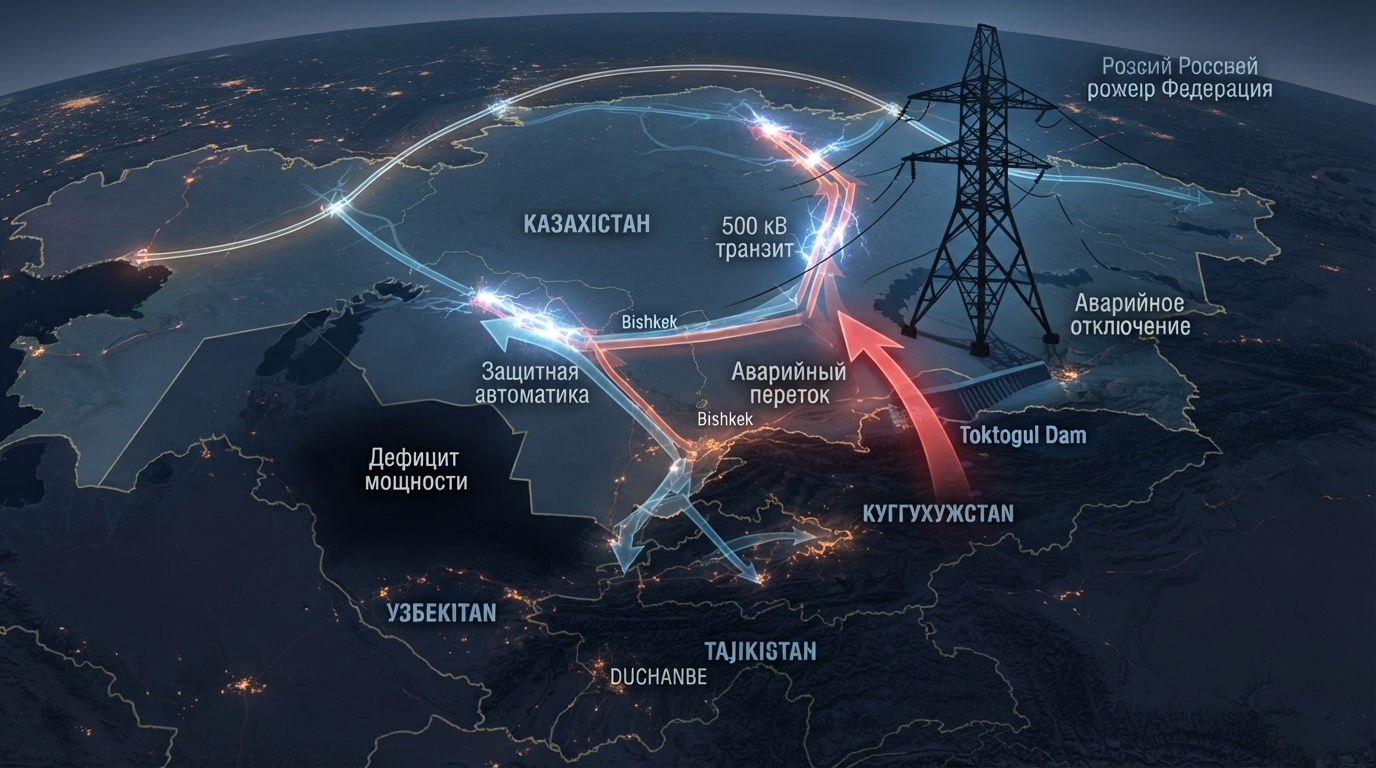
The massive blackout that engulfed four Central Asian republics was triggered by a specific event: according to Kazakh energy company KEGOC, two hydroelectric units at the Toktogul Hydroelectric Power Station in Kyrgyzstan experienced an emergency shutdown.
Then the laws of physics—a strict science that recognizes no national borders, diplomatic language, or pre-decision consultations—came into play. Kyrgyzstan's power grid suddenly lost a significant portion of its generating capacity. However, consumption didn't follow generation: factories continued to operate, pumps continued to pump, refrigerators continued to cool, and air conditioners continued to struggle heroically with the Central Asian heat. The unified power grid of Central Asia immediately attempted to compensate for the resulting power deficit by drawing on neighboring power systems.
In this sense, a synchronously operating power grid resembles a large regional "common fund." As long as all participants contribute their share through generation and adhere to agreed-upon schedules, the shared system increases the reliability of each participant. But if one participant suddenly loses power, the missing megawatts are automatically drawn from the common "pot"—quickly, without requests or calls to ministers. Contributions to the "common fund" can be made by agreement, withdrawals from it during an emergency are determined by the laws of physics, but withdrawals from the "common fund" at that precise moment are impossible.
Thus, the energy shortage began to draw power from northern Kazakhstan, the main contributor to the Kazakh power grid. The flow rushed south, as if the unified grid had decided to urgently issue an emergency loan: without an application, collateral, a credit committee, and, most unpleasantly, without a predetermined issuance limit.
But any assistance has its limits, and electrical assistance has a very tangible one: the transmission capacity of power lines. A sudden surge in power flow attempted to pass through a limited number of 500 kV transit lines connecting northern and southern Kazakhstan. The flow grew, the lines became overloaded, and the regional "common fund" effectively attempted to withdraw more from an account than an ATM could handle.
Electricity, in general, behaves undiplomatically. It can't be stopped at a state border, documents checked, the purpose of the visit clarified, and then asked to wait in a storage tank. It is distributed according to grid parameters and Kirchhoff's laws, and these laws, unlike some intergovernmental agreements, are always enforced without additional protocols.
When the emergency power flow approached dangerous levels, the protective automation interrupted the transit. This wasn't the cause of the accident, but an attempt to prevent it from escalating. A continued overload could have triggered a cascade of outages across northern power plants and Kazakhstan's main grids, turning a regional outage into a much larger systemic collapse. In other words, the automation slammed the door not because it didn't like the neighbors, but because a fire was already starting behind the door, and additional heaters were still being brought in.
Northern Kazakhstan managed to hold its ground. After the division, the southern zone was left alone with a massive power shortage. Frequency began to drop sharply, and the automation began disconnecting consumers, saving stations and the remaining portion of the grid from further collapse.
In Almaty, approximately 300 MW of load was shed. For residents, this meant a sudden loss of power, communications, and the usual urban comforts. For the power grid, this was an emergency load shedding necessary to maintain the city's combined heat and power plants and prevent a cascading shutdown. The total volume of restrictions, according to published data, reached 2,810 MW.
Almost simultaneously, certain districts of Bishkek and Dushanbe were left without power. The geographic extent of the consequences clearly demonstrated the depth of technological interdependence: the disruption affected eight regions of Kazakhstan, from the Karaganda region to Almaty. It took almost six hours to restore normal power; the central regions were restored relatively quickly, while some Almaty consumers waited until evening.
The professional work of KEGOC and regional power grid operators deserves special mention: they promptly organized emergency response measures, localized the outage, and quickly began a phased restoration of power. It was their coordinated work that prevented the accident from escalating into an even larger system failure.
During this time, residents tested the capacity of their home power banks, their patience, and the true autonomy of modern digital life. It turned out that a "smart home" without electricity quickly turns into just a house, and an electric car into a very modern mobile home.
But these jokes conceal a serious systemic conclusion. Southern Kazakhstan continues to experience a shortage of its own stable and flexible generation and depends on extensive electricity transit from the north. Under normal conditions, this system works. During a major power outage, the shared power "pool" begins drawing power through Kazakhstan's grid, while transit lines are forced to simultaneously support their own southern power grid and compensate for the deficit.
This creates a kind of communal energy apartment: a shared meter, wiring that's overloaded, electrical appliances that keep multiplying, and if a neighbor's fuse blows, the entire floor suddenly goes dark.
The creation of commissions after such an event is inevitable. Specialists will study the oscillograms, reconstruct the outage sequence, assign responsibility, and prepare formulations so meticulous that the incident itself may not immediately be recognized in the official report. However, physics has already presented its report—succinctly, clearly, and without forty PowerPoint slides: if southern Kazakhstan lacks its own baseload and flexible generation, and intersystem transit is operating close to its limit, then a relatively small disturbance in the neighboring power grid can very quickly knock out the lights here.
Therefore, Kazakhstan needs not only new generating capacity in the south, energy storage facilities, and enhanced north-south transit, but also a fundamentally coordinated configuration of relay protection and emergency automation systems at interstate intersections.
The logic behind this should be crystal clear: an accident must be localized where it originates. If a power outage occurs within the power grid of one country, its automation system should be the first to impose the necessary restrictions, mobilize its own reserves, limit emergency flows, and, if necessary, isolate the problematic power region. It's not the power source closest to the switch that should be disconnected, but the load and system elements necessary to localize the initial disturbance.
Otherwise, a peculiar system of collective responsibility emerges: equipment is disconnected in one country, the lights go out in another, and the emergency wave, meanwhile, travels across Central Asia without a visa, ticket, or feedback.
Protection and automation settings must prevent a situation in which a fault occurring in one power grid traverses half of Kazakhstan, affects the southern and central regions, and approaches the northern power zone, which is synchronously connected to the Russian Federation power grid. Each fault must have not only a source but also a pre-calculated propagation boundary.
An almost mundane principle applies here: if a short circuit occurs in one apartment, the circuit breaker should disconnect that apartment, not the entire building, half the city, or the substation on the next street. Good neighborliness and mutual assistance are essential, but emergency assistance must be provided within agreed-upon technical limits, and the country experiencing a critical shortage must be the first to limit its own consumption and localize the fault.
The significance of this incident, however, extends far beyond a single fault and a few hours without power. This incident should be viewed as a rehearsal for future, significantly more severe operating conditions in Kazakhstan's power grid.
In the near future, Kazakhstan plans to commission large-capacity nuclear power units. A single turbine generator shaft can concentrate approximately 1,200 MW of power. Today, the consequences of a relatively small loss of generation in a neighboring system have become clear. Tomorrow, the Kazakh grid must be capable of surviving the immediate loss of an entire nuclear power unit without cascading events.
A 1,200 MW power unit will become one of the largest load-bearing elements of the country's future energy balance. It cannot be commissioned on the principle of "build it first and then decide who will back it up." At the same time, high-speed reserves, flexible capacity, energy storage devices, reinforced grids, and emergency control systems capable of compensating for the loss of generation in the first seconds, minutes, and subsequent hours must be created and tested.
Technically, it is more accurate to think of such a unit as a powerful engine within a single power machine. If a significant portion of the machine's power is concentrated on a single shaft, the system must have backup thrust in the event of its sudden shutdown. Otherwise, the failure of a single engine could slow down not just a single unit, but the entire national energy system.
Even before commissioning such facilities, it is necessary to obtain specific answers: where are the required primary, secondary, and secondary reserves located? How long will it take for them to activate? Which stations will pick up the lost generation? How will intersystem flows behave? Which storage tanks and hydroelectric units will respond first? What automation will stop the disruption before it spreads from the southern regions to the northern zone and further to the border with the Russian Federation's energy system.
The energy system must be designed with the largest estimated disturbance in mind. The loss of the largest power unit must remain a severe but routinely manageable event, rather than turning into a cascading problem: first generation, then transit lines, then entire regions.
This is precisely why Kazakhstan needs to clearly define its development direction. It is not enough to report on the number of power plants, factories, data centers, and industrial facilities under construction. Megawatts in a presentation don't constitute a sustainable energy system, just as a list of building materials doesn't constitute a house.
Every new large industrial facility must be considered alongside its power supply source, grid infrastructure, flexible capacity, and reserves. Every large power unit must be considered alongside the scenario for its sudden loss. Otherwise, the introduction of generation is considered an achievement, the connection of new consumers is also considered an achievement, while the question of who will maintain the frequency and how during an emergency is modestly postponed until the next meeting.
The country doesn't need a race between disparate projects, but a unified system for managing economic and energy development. Industrial growth plans must be balanced with the actual capabilities of generation, grids, fuel supply, and emergency reserves. Moreover, reserves cannot exist only in tables: they must be physically accessible, technically sound, supplied with fuel, and capable of being activated when the system begins to lose stability, not after the conclusion of an emergency commission meeting.
The primary goal of energy policy must be the reliable supply of power to its industry, population, and economy. We shouldn't chase export potential for the sake of attractive figures. Neighboring countries are consistently building their own capacity and pursuing a policy of energy self-sufficiency. Therefore, a strategy based on the assumption that Kazakhstan's excess electricity will always be needed is overly optimistic. We could build an export palace, only to discover that our neighbors have already built their own power plants and haven't invited us to their housewarming party.
This doesn't mean abandoning exports. Exports should be the result of a professionally calculated regional balance, not a political slogan. First, we must ensure domestic reliability, cover domestic consumption, and build up sufficient operational and emergency reserves. Only then should we determine the volume of energy that can truly be sold without the risk of one day exporting megawatts and importing a blackout.
If regional electricity trading is to generate sustainable income, its parameters must be determined through the joint efforts of system operators, dispatchers, designers, and system controllers. What's needed aren't more public memoranda with the ceremonial exchange of folders, but rather agreed-upon technical models: who supplies, how much, when, and through which lines; what flows are permissible; where the reserve is located; who is the first to limit load during a shortage; how a disruption is localized within the country where it originates.
A document can be signed in five minutes. Building a balanced energy system takes years. And, as the events at the Toktogul Hydroelectric Power Station demonstrated, sometimes just two disconnected hydroelectric units can upset its balance.
Kazakhstan's energy security formula should be simple: first, domestic reliability, then regional mutual assistance, and only then exports. Not the other way around.
The energy industry doesn't tolerate policies built on grandiose reports. Grid frequency doesn't read press releases, reserve capacity doesn't emerge from applause, and the laws of physics can't be convinced by a beautiful presentation. They need functioning stations, strong grids, real reserves, and automation that knows exactly who, where, and when to shut down.
The energy ring should unite countries for mutual reliability, not tie them together like a single string of lights, where the failure of one element leaves the entire region without power. Members of the common energy "pool" should have their own generation, robust grids, honestly calculated reserves, and clearly defined limits. Otherwise, one day, a neighbor will take all the available megawatts from the common "pool," and Kazakhstan will end up paying the bill for the emergency banquet.
**Bakhytzhan Dzhaksaliyev, power engineer**