

Chinese equipment is rapidly entering Central Asia, which is undergoing a massive infrastructure upgrade. Cities are purchasing buses and electric buses, energy companies are installing solar panels and inverters, industrial enterprises are acquiring machine tools, pumps, compressors, transformers, crushing plants, and automated production lines, and the population is switching to Chinese-made automobiles and electronics.
At the time of contract signing, such equipment seems like a rational choice. It is cheaper than European and Japanese equivalents, is delivered faster, and often includes financing, installation, and personnel training. Chinese manufacturers are willing to customize their products for specific customers and sell small quantities that are uninteresting to global corporations. However, the economic impact is determined not by the day the equipment is commissioned, but by its condition after 7-10 years. A bus, solar power plant, or production line only pays for itself with long-term operation. After the warranty expires, it becomes clear that the buyer has not purchased a single machine, but is dependent on the spare parts catalogs, software, technical documentation, service engineers, and solutions of the original supplier.
For Central Asia, this issue is becoming systemic due to the scale of purchases. China ranks first in foreign trade for Kazakhstan, Kyrgyzstan, Tajikistan, and Uzbekistan, or is among the two largest partners. China's combined trade turnover with the five countries in the region already amounts to tens of billions of dollars annually, and the structure of imports is gradually changing. While clothing, household goods, and inexpensive electronics previously accounted for a significant share, now supplies of transport, power equipment, construction machinery, machine tools, and components are growing.
The automobile markets of Uzbekistan, Kazakhstan, and Kyrgyzstan alone receive tens of thousands of Chinese cars annually. Cities are seeing shipments of hundreds of buses from a single manufacturer. The region's solar generation capacity is increasing by hundreds of megawatts, with a significant portion of the panels, inverters, storage systems, and control electronics manufactured in China. The service life of a solar panel is stated at 25-30 years, a bus at 10-15 years, an industrial machine at 15-25 years, and a transformer at up to 30 years. However, the warranty typically lasts 2-5 years. Therefore, the equipment should operate for most of its lifecycle without the manufacturer's free support.
The main threat isn't that Chinese equipment will necessarily be unreliable. China produces equipment in all price ranges, from the most basic machines to world-class high-tech systems. The problem arises from the procurement method. Government and private customers often compare the purchase price, but rarely consider the cost of ownership. A bus may cost 20-30% less than its competitor, but a lack of spare parts inventory can turn a minor breakdown into a downtime lasting several months. On a $10 million industrial line, the failure of an electronic module costing $5-10,000 can sometimes shut down the entire production line. The company continues to pay salaries, service the loan, and lose orders while the component undergoes approval, production, delivery, and customs clearance. If downtime costs $50,000 per day, a month's delay creates a loss of $1.5 million. Against this backdrop, the initial savings quickly disappear. The most expensive spare part isn't the one with the highest price, but the one without which the entire vehicle doesn't function.
Public transport is particularly vulnerable. City buses are used 12-16 hours a day, travel 60,000-100,000 kilometers per year, operate in temperatures ranging from -30°C to +45°C, and are exposed to dust, overload, poor roads, and irregular maintenance. Over ten years, the vehicle's mileage can reach close to 700,000-900,000 kilometers. During this time, components of the suspension, steering, brake system, door mechanisms, compressors, heaters, air conditioners, electronic units, and body parts will need to be replaced several times. Electric buses and electric vehicles also have a traction battery. After 8-10 years of intensive use, its remaining capacity can drop to 70-80%, and even faster in harsh climates. Battery replacement can cost 25-40% of the price of a new vehicle. If the model is no longer in production, either a new battery pack will need to be adapted or the vehicle, which is still mechanically functional, will need to be retired early.
Solar energy creates a different illusion: panels have no moving parts, so the power plant is perceived as a nearly eternal object. In reality, the panel is just one element of the system. Over 25 years, its output typically declines by 10-20%, but inverters, cooling systems, switchgear, sensors, monitoring servers, and energy storage devices have a shorter lifespan. An inverter may require major repairs or replacement after 8-15 years. The software platform becomes obsolete even faster. The manufacturer changes protocols, stops updating, closes the cloud service, or merges with another company. The power plant physically continues to exist, but the operator loses full monitoring of individual units, remote diagnostics, and the ability to quickly detect production declines. For a 100-megawatt plant, even a 2% loss in output translates to a loss of millions of kilowatt-hours per year. Therefore, the fate of a solar facility depends not only on silicon degradation but also on the availability of electronics engineers, programmers, repair benches, and power module inventories.
Industrial equipment presents an even more complex situation. A single facility may simultaneously operate Chinese crushers, German sensors, Russian electric motors, Turkish pumps, and a local power supply system. While the facility is new, it is serviced by a general contractor. After a few years, technical fragmentation sets in. One manufacturer discontinues production of a controller, another modifies the software, and a third no longer supports the installed drive version. Replacing a single component requires redesigning the entire control system. A technological lock-in occurs: the company formally owns the equipment, but cannot independently change its settings, replace a component with an alternative, or restore the software after a failure. The password to the controller is held by the supplier, the source files are missing, the electrical schematics are incomplete, and the manual is only in Chinese. As a result, even a large plant becomes dependent on a single engineer, who must be flown in from another country.
In ten years, the market will also face the problem of diversity. Central Asia purchases equipment from dozens of Chinese companies, each supplying several model generations. A single city may have three or four brands of buses, and within each batch, engines, gearboxes, electronic units, and body components will vary. To a passenger, all buses look identical, but to a repair shop, they are distinct technical ecosystems. Thousands of parts must be kept in stock. Some parts are used frequently, while others may only be needed once every five years. Inventory hoarding grows, and forecasting accuracy remains low. If a fleet consists of 1,000 standardized buses, the warehouse and staff training pay for themselves. If the same 1,000 vehicles are divided among ten models, maintenance costs skyrocket. A government procurement that saved a few percent through supplier competition can create years of operational chaos.
It's impossible to assume that China will automatically provide the region with parts for the entire service life. Chinese industry is rapidly updating its model ranges. This is an advantage for the mass domestic market: new generations of equipment appear every few years, improving efficiency and digitalization. For a small foreign customer, the speed of renewal becomes a risk. A batch of 200 buses or 50 machine tools may be significant for Central Asia, but insignificant for a plant producing tens of thousands of units. After seven years, it's more profitable for the manufacturer to sell a new model than to continue producing a rare component for an older model. Technically, the part can be manufactured, but the customer will be offered a minimum quantity, a long lead time, and a high price. It will be even more difficult with companies that disappear, change hands, or leave a specific market segment. The reliability of a supplier country doesn't guarantee the immortality of each individual brand.
The answer should not be a campaign against Chinese equipment, but the creation of a domestic after-sales service industry. The region needs independent service centers, component warehouses, power electronics laboratories, battery refurbishment facilities, repair plants, technical documentation translators, and reverse engineering engineers. When purchasing 500 buses, it's reasonable to demand not only a warranty but also a complete documentation package, diagnostic software, training for dozens of local specialists, a minimum five-year supply of critical parts, and a commitment to supply components for 10-15 years. For large energy and industrial facilities, it's necessary to provide source code files, lists of interchangeable components, and rights to local upgrades. The contract should specify not only the price of the equipment but also the deadline for part delivery, the cost of an engineer's visit, the procedure for accessing the software, and liability for terminating support.
Localization should also be understood more broadly than simply assembling ready-made kits. A factory bolting wheels onto an imported bus doesn't solve the problem of ten years of maintenance. A workshop capable of repairing inverters, refurbishing electric motors, producing seals, fabricating housings, reprogramming controllers, and selecting replacements for discontinued components may be more valuable. It's not necessary to manufacture solar panels or traction batteries right away. It's enough to start with parts, consumables, and component repairs, which account for the majority of downtime. A market for such an industry is already emerging. If the accumulated Chinese equipment in the region is worth tens of billions of dollars, even annual maintenance costs of 3-5% create a market worth hundreds of millions, and eventually billions.
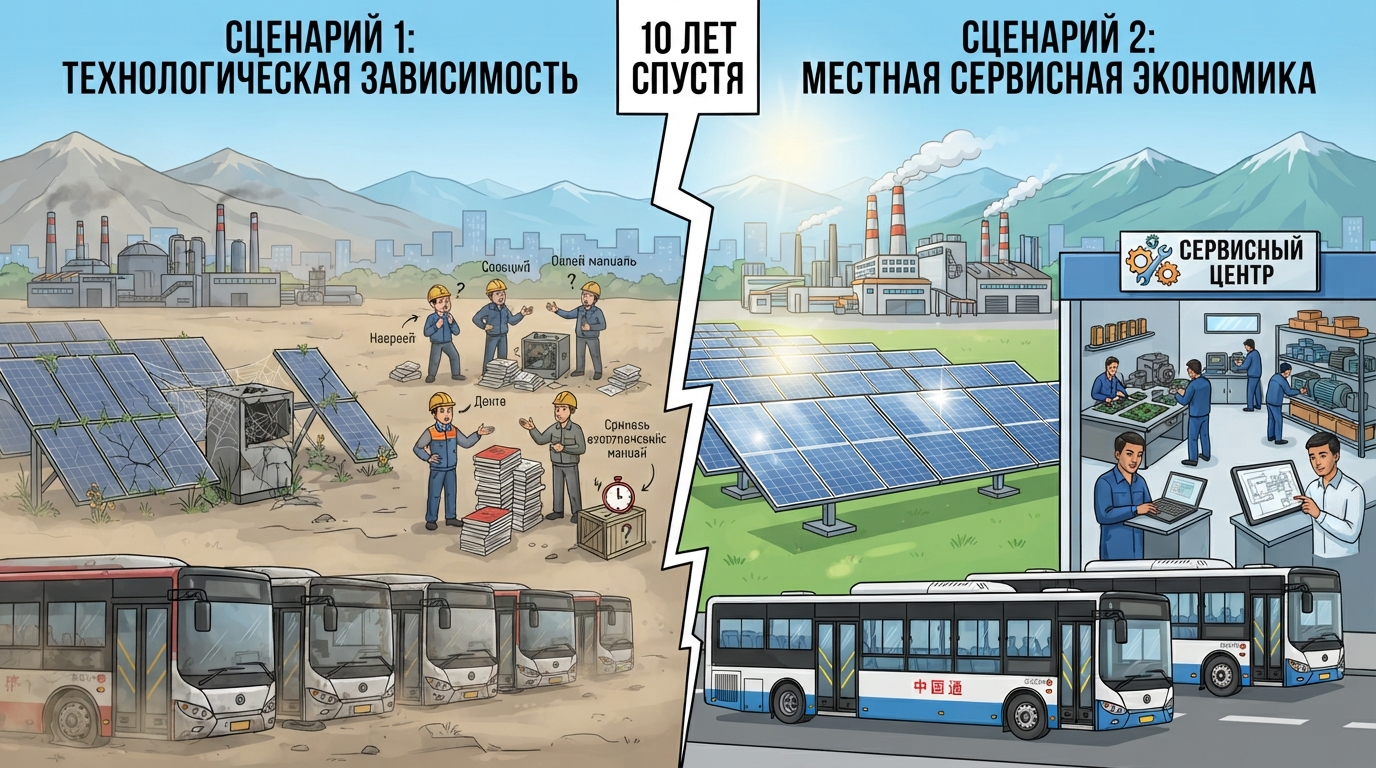
In ten years, Central Asia will see two possible scenarios. In the first, cities will have rows of idling buses, factories will have lines with missing modules, and solar power plants will have outdated control systems. Then, inexpensive equipment will become expensive because it will have to be replaced ahead of schedule. In the second, a local service economy will emerge around Chinese equipment: warehouses, repair facilities, engineering bureaus, training centers, component manufacturing, and a secondary market for refurbished components. In this case, China will remain a crucial supplier, but the dependence will be manageable. The real question is not how many buses, panels, and machine tools the region can buy today. It is who will be able to repair them in 2036. The warranty expires quickly, but the infrastructure must continue to function for decades after it expires.