

Ships capable of powering hundreds of thousands of households to be retrofitted for hydrogen fuel
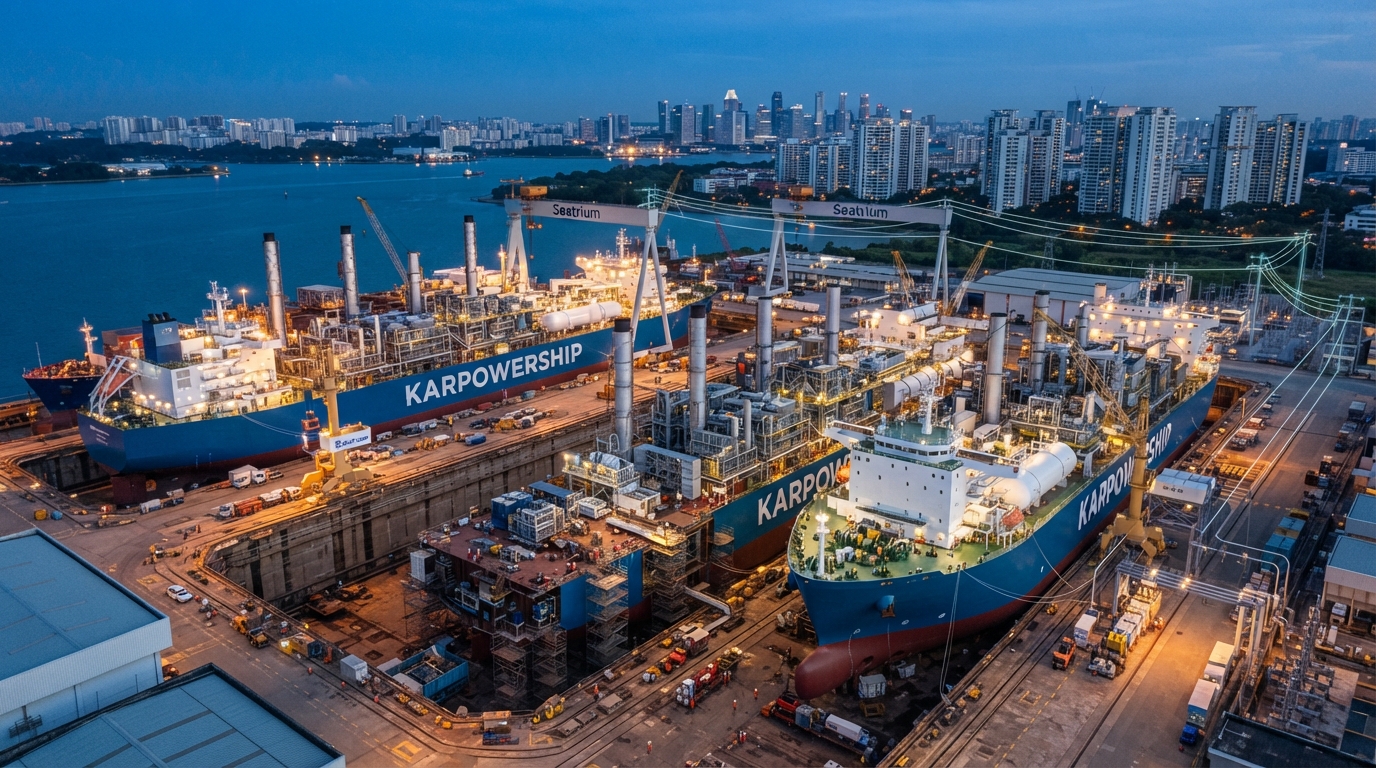
Five floating power plants belonging to the Turkish company Karpowership will undergo large-scale modernization in Singapore. The vessels, each designed for a capacity of up to 600 megawatts, will be adapted to use various fuels, including hydrogen blends. Stationed near the coast, they will supply electricity to the national grids of countries.
Ships capable of lighting hundreds of thousands of homes to be adapted for hydrogen fuel
Karpowership and Singapore's shipbuilding and engineering firm Seatrium have signed a contract to retrofit five Whale Class vessels. The agreement provides for the installation and integration of essential equipment for new-generation floating power units.
Design work has already begun. The first vessel is scheduled to arrive at the Seatrium Tuas Boulevard Yard shipbuilding and repair facility in Singapore in December 2027.
There, specialists will install power equipment, complete the assembly of mechanical systems, and conduct pre-commissioning tests. This work covers preparing the ship's generating units, fuel supply systems, and power transmission systems to operate together.
One of the main reasons for the interest in floating power plants is that they can be dispatched to the required region and commissioned relatively quickly. Building a large power plant on land can take several years. Meanwhile, a vessel equipped with ready-made power units connects directly to coastal electrical infrastructure.
Karpowership prepares its vessels on a "plug and play" principle. The company states that such plants can start generating electricity just 30 days after arriving at their destination. This timeframe applies to commissioning the ready station on site, not to the construction or modernization of the vessel itself.
The Whale Class represents the company's highest-capacity series of floating power plants. Each ship is designed to provide up to 600 megawatts of electric power. Consequently, the total design capacity of the five stations could reach up to 3,000 megawatts, or 3 gigawatts.
To better visualize such a scale of capacity: depending on consumption levels, one such ship can supply electricity to hundreds of thousands of homes. The generated energy is transmitted ashore and delivered to consumers via the main grid.
The design of the new ships also accounts for the possibility of changing fuel types in the future. They will be fitted with multi-fuel power installations adapted to operate on conventional marine fuel, natural gas, and mixtures blended with hydrogen.
This solution should allow the use of various fuels without reconstructing the ship's hull. Compatibility with hydrogen blends creates conditions for altering the stations' operational methods in the future, depending on the development of fuel supplies and relevant infrastructure.