

Is China building two "floating bases" for underwater drones?
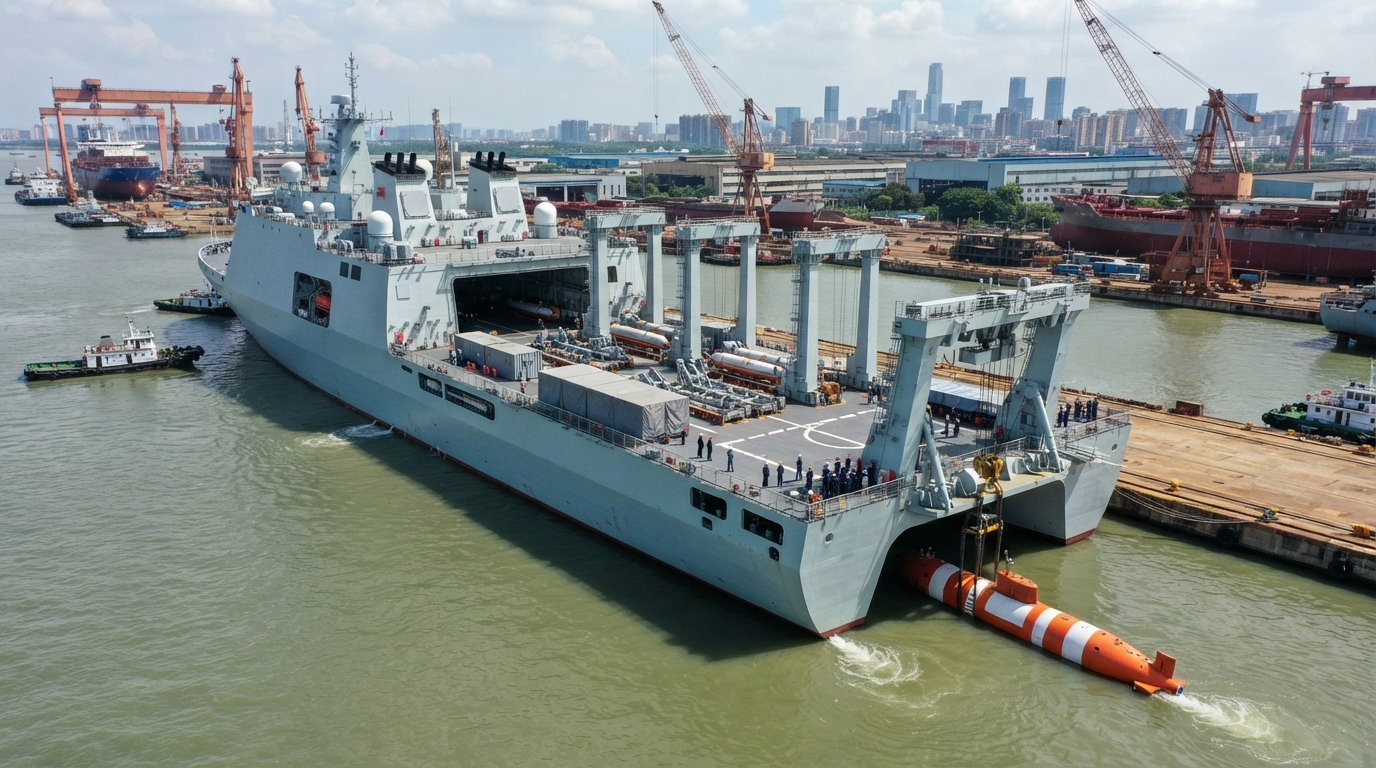
A new ship, presumably designed for transporting and servicing large underwater drones, has been photographed in Guangzhou, China. It resembles a vessel previously observed in Shanghai. The new images indicate that at least two ships with such a role may be under construction in the country.
Is China building two "floating bases" for underwater drones?
According to The War Zone, about a month ago, reports emerged that the construction of an unusual ship at the Changxing Island shipyard in Shanghai was nearing completion. Its design may be adapted for housing, launching, and servicing unmanned underwater vehicles.
A new photo taken in Guangzhou shows a vessel that is visually very similar to the one in Shanghai, but smaller. According to preliminary estimates, it is about one-third smaller than the previous one. There are also some differences in the hull shape.
Six lifting towers are visible on the new ship. The larger ship in Shanghai features six large and six small structures. Both projects feature a flight deck and a hangar behind the forward superstructure, and the placement of the funnels is also similar.
For now, these ships are primarily assessed as experimental platforms. Public information regarding their precise missions and capabilities remains limited.
Such ships could make it possible to transport large underwater drones far from the Chinese coast, launch them, recover them, and perform maintenance. This facilitates the operation of vehicles capable of long-duration autonomous patrols.
Long-range underwater drones can perform tasks such as seabed mapping, minehunting, and detecting submarines and surface targets. In the future, the possibility of using such vehicles to launch cruise missiles or other drones is also being discussed. However, it has not been confirmed that these capabilities exist on the ships in the photos or the vehicles they carry.
The article notes that the expansion of such a fleet could enhance China's ability to conduct operations in far-off regions of the Pacific Ocean. Meanwhile, speculations about potential threats to US facilities remain assessments regarding the future application of these technologies for now.