

SAMA explained why operating kindergartens were included in the privatization program
In Tashkent, kindergarten No. 58 will be sold only after relocating the children to a new building, while in Kashkadarya, the facility is already managed by a private operator. The head of the SAMA explained the conditions for the privatization of operating kindergartens and announced that the lists of properties may be revised taking into account public feedback.
SAMA Clarifies Why Operational Kindergartens Were Included in Privatization Program
Uzbekistan's State Assets Management Agency (SAMA) commented on the inclusion of active kindergartens in the lists of properties subject to privatization. Head of the agency Sokhibjon Murodov announced this on October 8 at a press conference, answering questions from journalists.
A media representative drew attention to public discussions surrounding plans to sell about ten operating kindergartens in the capital's Yakkasaray district and the Kashkadarya region. He asked why active social facilities are being privatized if the agency had previously spoken mainly about the sale of vacant and unused buildings.
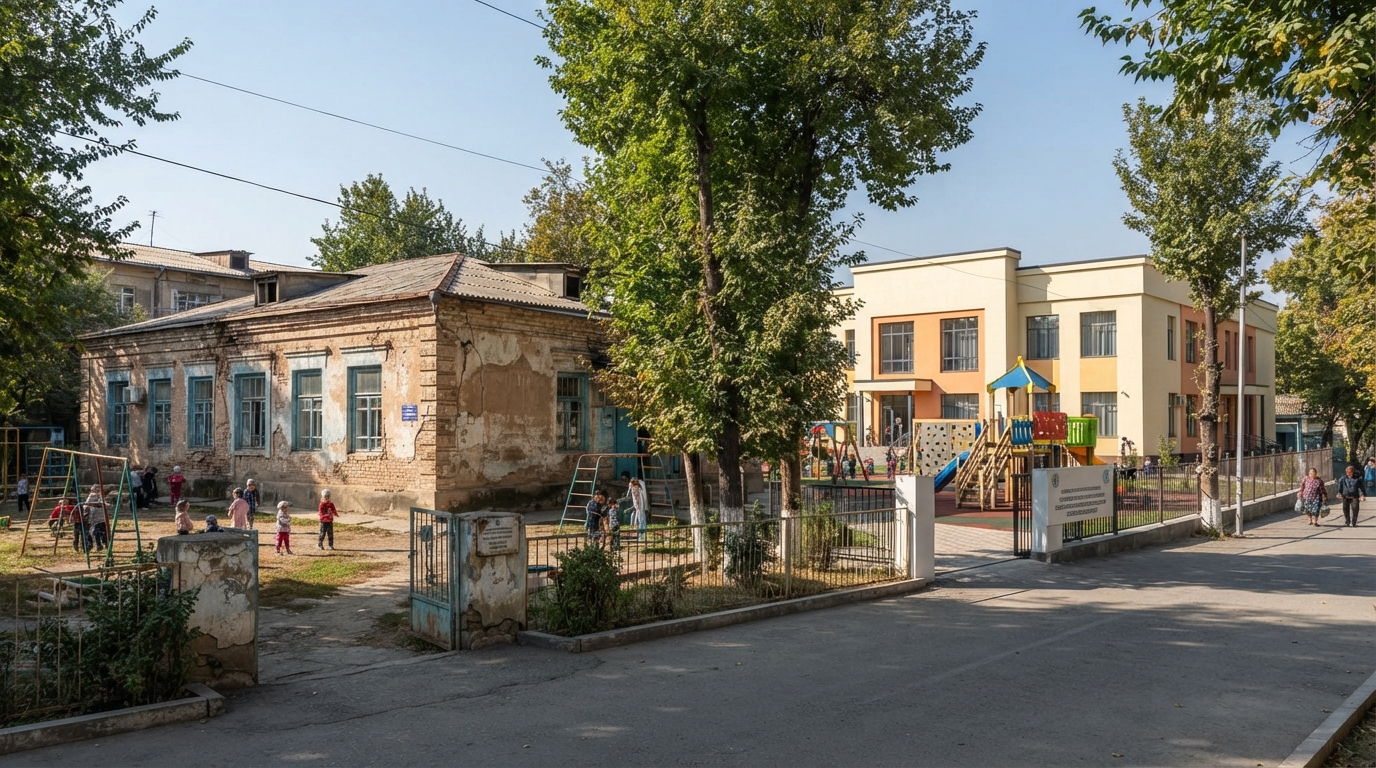
According to Murodov, the building of kindergarten No. 58 on an area of 0.56 hectares, designed for 120 children, was included in the privatization program in the Yakkasaray district of Tashkent.
"If you look at the photos we posted on our website, you will see that this kindergarten is operating. But the building is very old, it doesn't even have a foundation," the head of SAMA stated.
He informed that a new kindergarten for 720 children is being built with budget funds in the same mahalla, where it is planned to transfer the children from the existing institution.
"Although the decision to sell this kindergarten has been made, we have not yet started the procedure of placing it up for auction. For now, our plan is to put the old facility up for sale with the condition of building a private kindergarten on its site after the new kindergarten for 720 children is constructed and the children are transferred there," Murodov explained.
The head of the agency stressed that including real estate in the privatization list does not mean its immediate placement for auction. Before the sale, each property must undergo additional study, taking into account circumstances that may affect its further use.
According to him, in some cases, doubts arising among the public regarding the expediency of privatization prove to be justified.
"If these doubts are confirmed, we have the opportunity to revise the decision. The footnote to the list states that, in agreement with the Presidential Administration, the State Assets Management Agency may remove objects from the list or make changes to it," he noted.
Murodov commented separately on the privatization of a kindergarten in the Kashkadarya region.
He reported that the building is on the balance sheet of a large state enterprise in the oil and gas sector, for which the maintenance of a preschool facility is a non-core activity.
At the same time, the kindergarten is already being operated by a private entrepreneur on a lease basis.
"This is not a state kindergarten. It is already operating in the private sector under lease terms. On the one hand, the entrepreneur pays rent to the state, on the other hand, our oil and gas enterprise annually incurs expenses to maintain this non-core asset," the head of SAMA explained.
According to him, a state kindergarten also operates in this area. The agency intends to offer the property to private investors, but with the mandatory preservation of its intended purpose.
"If the private sector wants to purchase this facility — please, let them buy it. But the condition will be as follows: they must use it as a kindergarten. If they want to engage in another activity there, we will not allow it," Murodov declared.
The head of the agency also spoke about the role of private kindergartens in expanding coverage of preschool education.
According to the data he cited, about ten years ago, this indicator averaged 27-28% across Uzbekistan, and was even lower in certain districts.
Now the coverage has reached 68%, while the authorities plan to bring it up to 70%.
"How did we achieve such coverage? Not all kindergartens were built using budget funds. A significant portion of them are private kindergartens or institutions created on the basis of public-private partnerships," Murodov said.
He also expressed the opinion that in some cases private preschool institutions provide better quality child care and education.
According to the head of SAMA, the state intends to continue creating conditions for the participation of entrepreneurs in the educational sector. In particular, some land plots are being put up for auction with an obligation to build a private school or kindergarten.
According to hokimiyat data reviewed by Gazeta, from 2023 to 2026, preschool education coverage decreased in 11 of the 12 districts of Tashkent. The most noticeable decline is observed in the Sergeli district — from 125.3% to 75.1%, Yakkasaray — from 124% to 96.8%, and Bektemir — from 115% to 74.8%.
Hokim of the capital Shavkat Umurzakov, in an interview with Gazeta, called coverage of at least 90%, and ideally 100%, optimal. However, according to planned targets for 2026, only the Yakkasaray (96.8%) and Mirzo-Ulugbek (92.1%) districts overcome the 90% threshold.
The lowest coverage is expected in the Shaikhantakhur district (57.9%), Yangikhayot (68.1%), and Yunusabad (70.5%).
At the same time, long-term dynamics are mixed: in the Yashnabad district, coverage grew from 48.5% in 2023 to 74.1% in 2026, while in Yakkasaray, despite a decline from its recent peak, it remains above the 2018 level (91.4%).
The hokim of Tashkent stated that he opposes transferring the territories of state schools and kindergartens for PPP projects, including the construction of private educational institutions there. On such plots, he considers it right to build only state educational facilities.
According to data presented during a presentation to the president on October 14, the deficit of school places in Tashkent stands at 141 thousand and could grow to 212 thousand by 2030 due to an increase in the number of schoolchildren. To solve the problem, the authorities plan to create 126 thousand additional places.
Projects for 24 new schools with 38 thousand places and 28 kindergartens with 16 thousand places were presented to the president. Standard designs will include new solutions for inclusive education, child safety, and energy conservation.
Kindergartens in the capital currently lack 65 thousand places. By 2030, the authorities intend to create another 40 thousand and increase preschool education coverage from 79.2% to 92%.