

Safe migration and new opportunities: press conference at Sputnik Uzbekistan
In the multimedia press center of the International Information Agency "Sputnik Uzbekistan", a meeting was held dedicated to improving the mechanisms of organized recruitment of citizens for work in Russia. Elyor Toshtemirov, Deputy Director of the Migration Agency under the Cabinet of Ministers of the Republic of Uzbekistan, answered questions from journalists. – The Russian Federation today remains one of the most important destinations for labor migration, where currently about [...] works
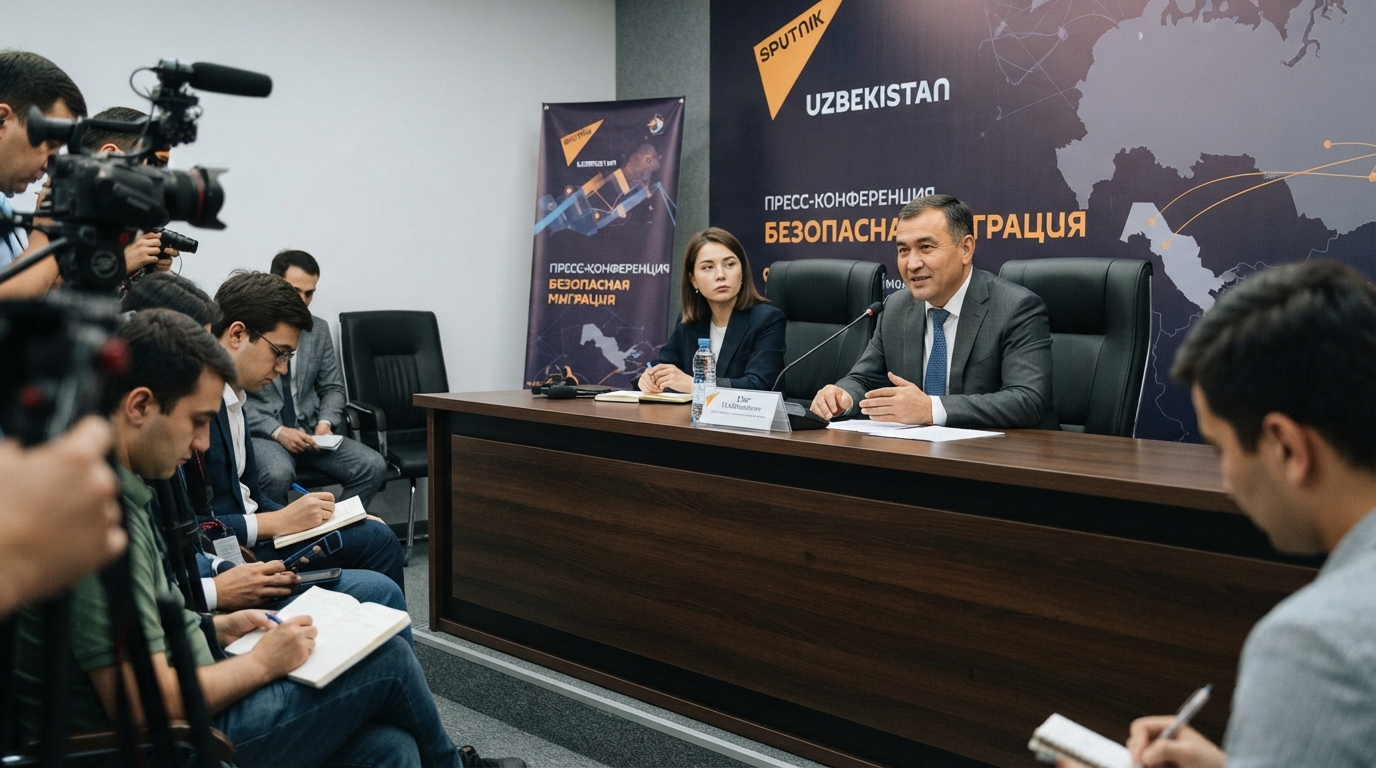
**Safe Migration and New Opportunities: Press Conference at "Sputnik Uzbekistan"**
A meeting dedicated to improving the mechanisms of organized recruitment of citizens for work in Russia was held at the multimedia press center of the International News Agency "Sputnik Uzbekistan". Elyor Toshtemirov, Deputy Director of the Migration Agency under the Cabinet of Ministers of the Republic of Uzbekistan, answered questions from journalists.
"The Russian Federation today remains one of the most important destinations for labor migration, where about 900 thousand of our citizens are currently working on the basis of a work patent. Therefore, it is very important for us to create safe, convenient conditions for our citizens in the Russian Federation. Just a couple of weeks ago, we met with representatives of the diplomatic mission of the Russian Federation in Tashkent, where we discussed the proper organization of organized recruitment mechanisms," noted Elyor Toshtemirov.
General statistics over the last decade demonstrate a twofold decrease in the number of people working abroad — from 2.7 million to 1.3–1.4 million people. This is explained by the creation of new jobs within the country, the seasonal nature of trips, and the diversification of the external labor market.
In addition, Uzbekistan is consistently moving from spontaneous migration to targeted and skilled migration. In the regions of the republic, together with foreign partners, more than 30 targeted training courses for in-demand professions are already operating, such as the training of welders and oil and gas industry specialists in Navoi, Bukhara, and Kokand. The duration of training ranges from three to nine months, and the salary of qualified specialists at facilities in Russia can exceed $2,000.
"We are now actively cooperating with the Professional Education Agency under the Cabinet of Ministers of the Republic of Uzbekistan. There are more than 700 technical colleges in the regions of our country. We offer large Russian companies to create additional targeted training courses for relevant specialists. Together with our Russian colleagues, we recently opened a center for training welders in Navoi. Russian experts and teachers train the guys there for two months. Upon completion of the training course, they get high-paying jobs in the northern regions of the Russian Federation. Also, oil and gas industry specialists are being trained at the Bukhara Oil and Gas College. By the end of this year, we also plan to establish work on training drillers and assistant drillers at the Kokand Oil and Gas College together with Russian colleagues," told Elyor Toshtemirov.
The Migration Agency actively works with Russian departments, including the Ministry of Internal Affairs of Russia and the representation of the "Sakharovo" Multifunctional Migration Center in Tashkent, to simplify all procedures even before the departure of citizens. Plans include introducing the following mechanisms in Uzbekistan:
– background checks for bans. Preliminary identification of entry restrictions to the Russian Federation with the help of representative offices of the Ministry of Internal Affairs and the Passport and Visa Service, to avoid situations where citizens find out about a ban at Russian airports.
– medical examination. Organization of the work of specialized medical centers by analogy with the practice of cooperation with South Korea.
– exams in language and history. A representative office of RUDN University is already operating on the basis of the vocational training center of the Yashnabad district of Tashkent, where the testing capacity has been increased to 100 people a day. By the end of the year, it is planned to open similar sites in Jizzakh (jointly with KFU), Andijan, and Tashkent (jointly with Herzen University).
To date, the Migration Agency cooperates with more than 200 Russian employers as part of organized recruitment. This format guarantees that before departure, a citizen knows the working conditions and salary, and is assigned to a specific employer who is responsible for their safety.
"You probably know that a new migration concept of the Russian Federation has been approved, which implies organized recruitment as one of the main areas for attracting foreign labor resources. Starting next year, separate state enterprises are being created in the Russian Federation that will be responsible for organized recruitment. Upon request of Russian employers, targeted training of personnel will be conducted before departure. A person will know before departure where they are going, where and under what conditions they will work, and how much they will receive for it. Each specialist will be assigned to a specific employer, and the employer will be directly responsible for their fate and their safe working conditions," clarified Elyor Toshtemirov.
At the conclusion of the meeting, the leadership of the Migration Agency strongly recommended that citizens strictly observe the migration legislation of the host country. Due to the emergence of the registry of controlled persons (RKL) in the Russian Federation, any violations, including late renewal of a patent, advance payments, or migration registration, create serious problems. For legally working citizens, a special fund of the Agency provides comprehensive support: from financial assistance and temporary accommodation to legal and medical aid. The main guarantee of safe employment remains preliminary training in an in-demand profession, knowledge of the language, and official documentation.