

I'll run away, I won't look back, I'll go looking for you around the world…
Where do labor migrants go from Uzbekistan?
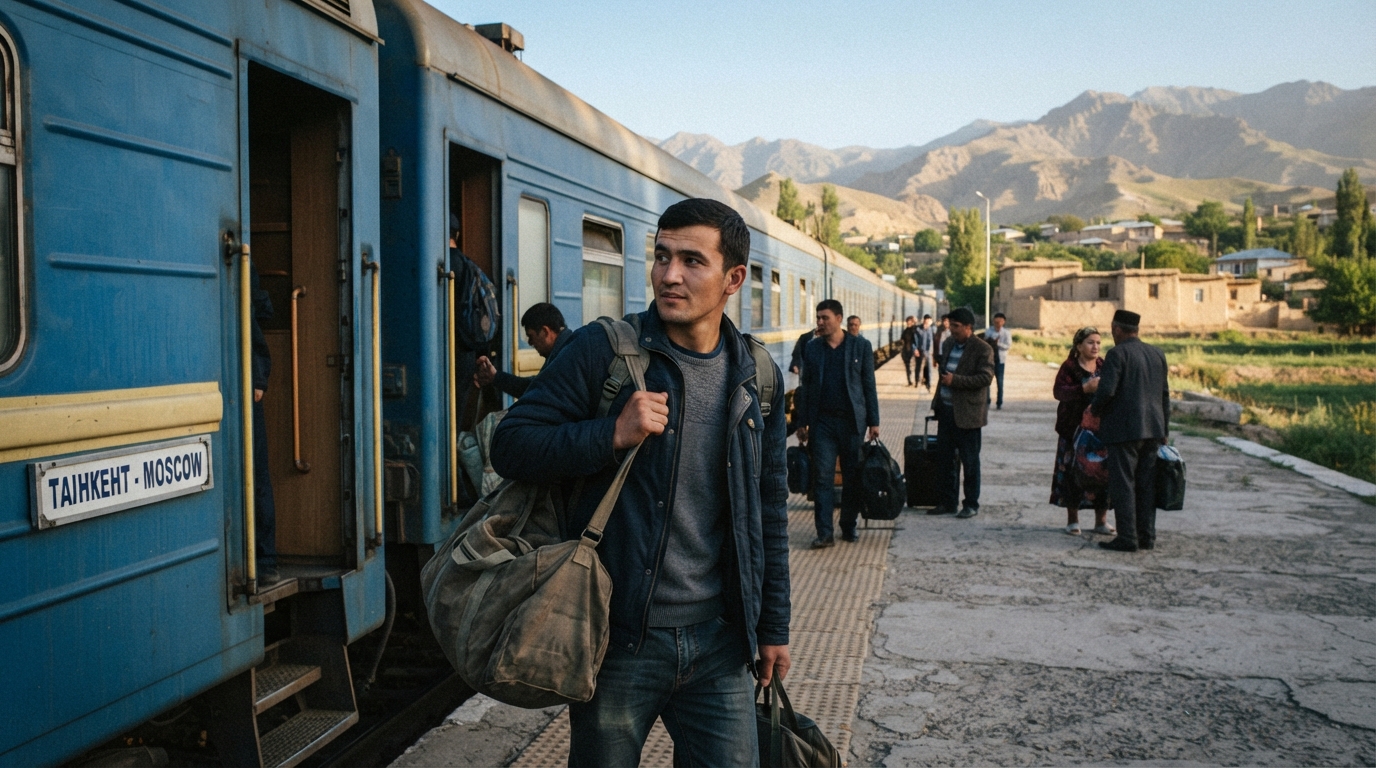
I'll run away, I won't look back, I'll search the world...
According to the census report of the National Statistics Committee of the Republic of Uzbekistan, 5.4% of the country's citizens, or 2.1 million people, reside outside their official place of registration.
Of this number, 78.6% (1.6 million people) are labor migrants. They constitute 8% of Uzbekistan's total employed population. This category includes both those working within the country and those who go abroad to work. Two-thirds of them are men, and 36.7% are women.
Among the remaining migrants not residing at their place of registration, the majority are university students: 15.7%, or 329,200 people. There is a significant gender imbalance in this group: the number of male students is almost four times higher than that of female students.
Labor migration is a key aspect of Uzbekistan's economy, as many citizens seek higher earning opportunities abroad and send money home to their families. Therefore, the Republic of Uzbekistan pursues a policy of support, rather than prohibition, for citizens traveling abroad for work. Almost six years ago, Uzbekistan committed to ensuring safe, orderly, and legal migration. In October 2024, the Migration Agency was established under the Cabinet of Ministers of the Republic of Uzbekistan. The agency's specialists not only deal with the legal regulation of external labor migration but also provide vocational training for those wishing to leave for work, as well as foreign language instruction.
The agency maintains its own statistics on citizens traveling to other countries for long-term stays. As of June 1, 2026, their number stood at 1.9 million. Of these, 1.3 million people left specifically for employment. According to agency experts, this represents 6.3% of Uzbekistan's working-age population. It is important to note that this figure varies significantly across the country's regions. For example, among Tashkent residents, the share of those temporarily emigrating abroad is 3.1%, while in the mountainous Surkhandarya region, the figure is 22.8%—that is, one in five working-age citizens. This difference is due to the uneven economic development of the country's regions.
More than half (51.4%) of all citizens who left Uzbekistan for a long period chose Russia as their temporary place of residence or work: 998,000 people. This is facilitated by lenient immigration laws and a labor shortage in the Russian Federation.
Kazakhstan was the choice of 347,300 Uzbeks who wished to leave the country. Half as many citizens of the Republic of Uzbekistan chose Turkey for residence and employment: 151,200 people.
To more centralize employment issues, the Migration Agency under the Cabinet of Ministers of the Republic of Uzbekistan launched a special electronic platform. More than 2.6 million citizens have registered on it. The portal posts job openings abroad from both the agency itself and private recruiting companies. As of early August of this year, the platform's creator had published 13,300 job postings. Of these, 11,300 (85.2%) were for positions in Russian cities, 926 were in Germany, and 350 were in Japan. Private recruiting agencies posted 16,400 vacancies. Almost half of these were for positions in Israel: 7,200 vacancies. Overall, the geography of employment covers 14 countries.
The salary offered to migrant workers depends on a variety of factors, from macroeconomic factors such as the host country's economic development and type of economic activity to personal factors such as age or education. An analysis of current vacancies revealed that the largest number of vacancies for migrant workers is concentrated in the construction, agriculture, and manufacturing sectors. The minimum wage offered is 52,000 rubles for a farm worker in the Russian Federation. At the current exchange rate, this is equivalent to approximately 7.8 million soums. For comparison, the average nominal wage in Uzbekistan last year was 6.4 million soums.
Significantly higher salaries are offered to migrants in European countries. For example, a factory worker in Germany or a driver with a CE license in Bulgaria are offered 2,500 euros. In national currency, this amounts to 34.5 million soums – 5.4 times the average salary in the Republic of Uzbekistan.