

About 1.4 million Uzbeks work abroad. The geography of labor migration is changing
According to the Migration Agency, about 1.4 million citizens of Uzbekistan work in about 40 countries around the world. About 60 percent of them are in Russia. At the same time, the share of the CIS countries in the geography of labor migration has decreased, while the directions of Europe and East Asia have increased.
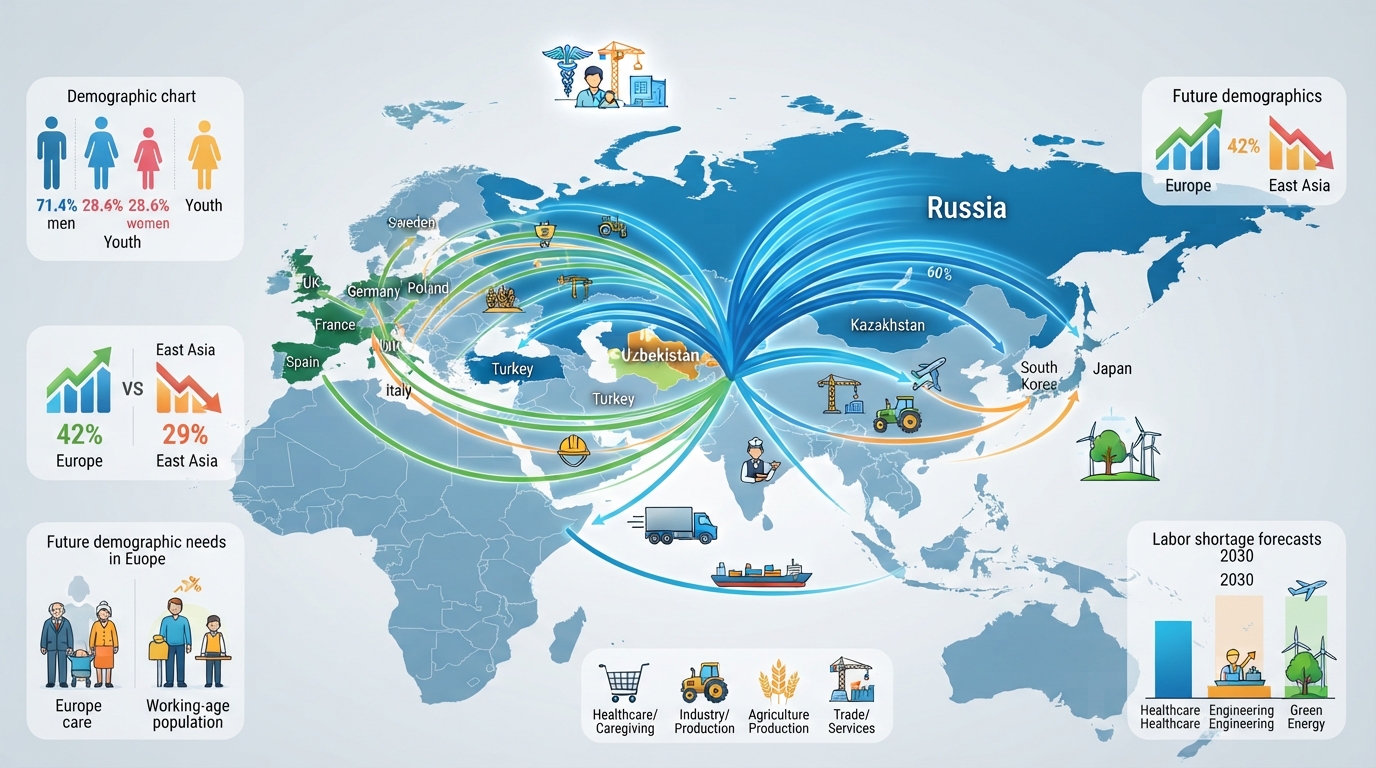
According to the Migration Agency, cited in the Central Bank's review, currently about 1.4 million citizens of Uzbekistan work in about 40 countries of the world.
**Geography and demographic composition of migration:**
* About 60 percent of Uzbek labor migrants abroad work in the Russian Federation.
* 398.9 thousand (28.6%) of labor migrants are women, and 402.1 thousand (28.9%) are young people.
**Changes in labor migration routes:**
According to the Central Bank, the geography of external labor migration is changing. While the direction to the CIS countries decreased by 29 percent, to the European region increased by 42 percent, and to East Asia by 26 percent. This means that citizens of Uzbekistan are now more actively traveling not only to traditional destinations (Russia, Kazakhstan, South Korea, Turkey), but also to European and Asian countries.
**International cooperation:**
The Migration Agency has 48 agreements on organized external labor migration with 23 countries. In 2025-2026, 18 intergovernmental and interdepartmental agreements were concluded with 14 countries. Cooperation has also been established with more than 325 large employers and recruiting companies from 36 countries.
**Prospective partners and new directions:**
The Central Bank has included Germany, Great Britain, Italy, Spain, Sweden, France, Bulgaria, Romania, Slovakia, Slovenia, Serbia, the USA and Japan among the prospective partners. The USA, Italy, Sweden, France and Slovenia have emerged as new destinations for organized migration.
**Employment sectors:**
Within the framework of the partnership, it is planned to attract workers from Uzbekistan to such sectors as trade and services, healthcare and social services, transport and logistics, agriculture, industry and manufacturing, construction, welding and metalworking, woodworking, oil and gas and mining. Since the beginning of 2026, 124.5 thousand citizens have been placed in high-paying jobs abroad.
**Future trends and demographic factors:**
The Central Bank associates the future expansion of labor migration with demographic changes in developed countries. According to estimates, the dynamics of the working-age population in Central Asia can add about 1 percentage point to economic growth annually, while in Northern Europe this factor can reduce economic growth by about 0.7 percentage points. This difference creates an economic basis for expanding labor corridors from Central Asia to Europe and other countries with an aging workforce.
**Labor shortage projections:**
* By 2030, the labor shortage in Europe is expected to reach 7.5-10.5 million people. It is predicted that the demand for specialists will increase in the fields of engineering, high-tech manufacturing, infrastructure construction, transport and logistics, agriculture, medicine, IT, tourism and services.
* In Germany, the lack of an annual inflow of at least 400 thousand skilled migrants could negatively affect the country's GDP growth.
* In Northern European countries, demand for specialists in "green" metallurgy, wind energy and information technology is expected to increase.
* The healthcare and elderly care sectors are noted as one of the most promising areas. In Germany, the number of people in need of care may reach 5.7 million by 2030, which will require about 500,000 additional workers. In the UK, about 90,000 more caregivers may be needed.
* In Japan, a shortage of 6-7 million workers is forecast in the care, agriculture and construction sectors, and in South Korea, a shortage of 1.2-1.5 million workers in shipbuilding, metalworking, electronics and industrial sectors.
* Demand will also grow in the "green" energy sector. In Germany, the shortage of specialists for the installation of solar panels and wind turbines, as well as technicians, mechanics, environmental engineers, and specialists in electrical and autonomous vehicles is estimated at 300,000 people.
**Persian and Arabian Gulf countries:**
The central bank has specifically highlighted the Persian and Arabian Gulf countries. Against the background of economic diversification programs, including the implementation of Vision 2030, an additional demand for 1.5-2 million workers may be created in Saudi Arabia, and about 1 million in the UAE. In Saudi Arabia, high demand is expected for construction and technical specialists, as well as paramedical staff. In the UAE, the demand for qualified personnel for the hotel and restaurant business, tourism, service, aviation and logistics will increase.
**Conclusion:**
According to the Central Bank, in further developing organized labor migration, Uzbekistan should take into account demographic and structural changes in the global labor market and focus on new geographical and professional areas where there is a high demand for labor.
**Previous information:**
Four months ago, at a meeting with the president, the Migration Agency reported that about 1.2 million Uzbek citizens were working abroad. In January 2025, the agency reported a higher figure - more than 1.34 million people. At that time, it was reported that about 600 thousand citizens were working in Russia, and the majority of the rest were working in Kazakhstan and Turkey. Women made up 20 percent of the total number of labor migrants, or about 268 thousand people.