

Rock art dating back to the Mesolithic and Neolithic eras and a Bronze Age settlement have been discovered in Samarkand
In the area of the Nurota mountain range falling within the Koshrabot district of the Samarqand region, rock paintings drawn with ochre dating back to the Mesolithic and Neolithic periods, as well as a Bronze Age settlement, have been discovered. The 60 cm thick cultural layer at the settlement indicates the need for large-scale excavations.
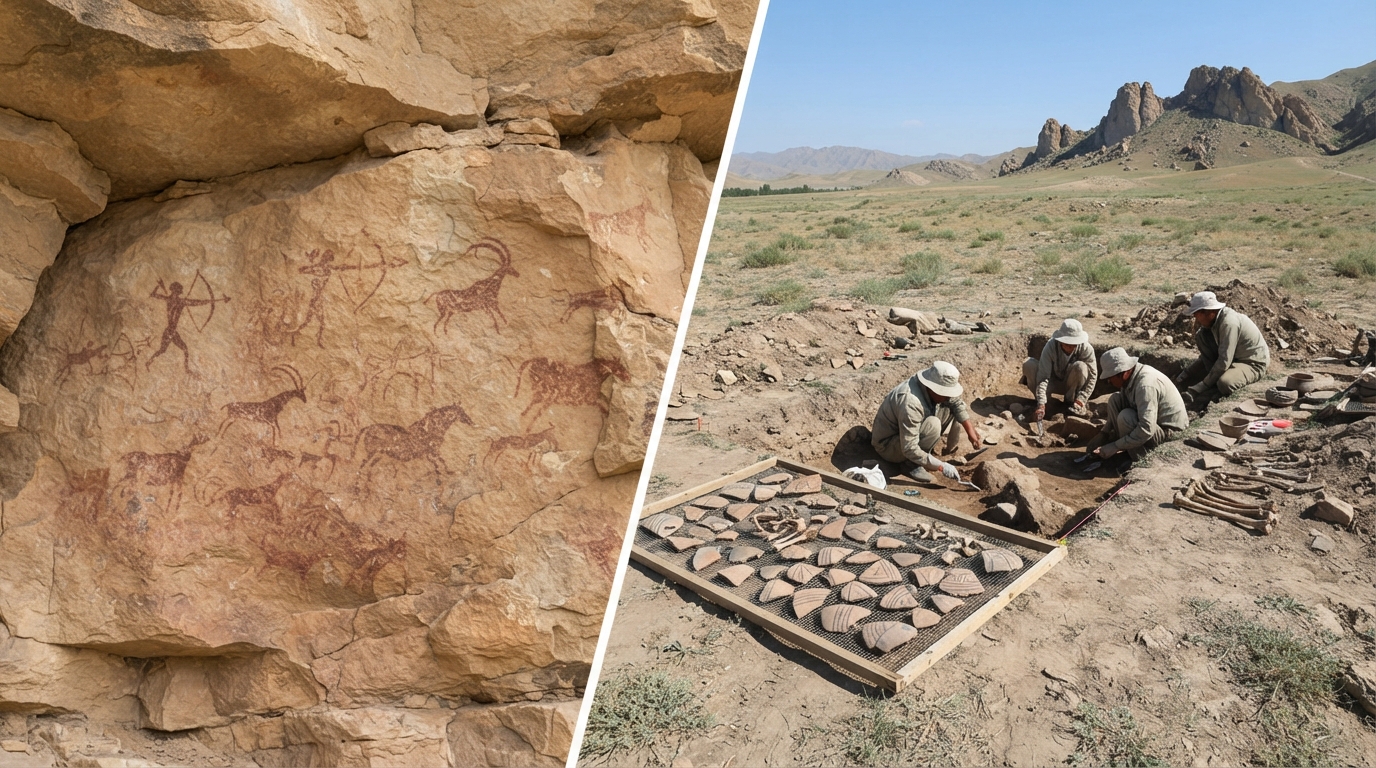
Rock art from the Mesolithic and Neolithic eras, as well as a settlement from the Bronze Age, discovered in Samarkand
During archaeological surveys conducted in the section of the Nurata mountain range belonging to the Kushrabat district of Samarkand region, rock art dating back to the Mesolithic and Neolithic eras, along with a settlement belonging to the Bronze Age, were identified.
In accordance with the Institute's field research plan for 2026, scientific personnel carried out archaeological survey work in the mountain and sub-mountain areas of the Kushrabat district in October.
Rock art was identified on the walls and ceilings of rock shelters in the Egrijarsoy, Khojasoy (Badimin), Galajinsoy, and Sumbulsoy areas belonging to the "Oqchobsoy" neighborhood citizens' assembly (MCA). According to the Institute, these images, painted with natural ochre pigment, date back to approximately the Mesolithic (12th–7th millennia BC) and Neolithic (6th–3rd millennia BC) eras.
Additionally, during surveys conducted in the area of the "Pang'at" MCA, ceramic fragments dating back to the Bronze Age (from the 3rd millennium BC to the beginning of the 1st millennium BC) were discovered and studied at three locations.
At the first location, situated 700–800 meters east of the village of Qumoloqli, a test pit measuring 2×1 meters was excavated. As a result, a Bronze Age settlement with a cultural layer 60 centimeters thick was identified. Numerous ceramic fragments and bone remains were recorded during the excavation.
The Institute highlighted that the archaeological materials discovered at this settlement indicate the necessity of conducting large-scale excavation research.
A comparative analysis of the finds will help study the stages of settlement of the Nurata mountain range areas by ancient populations, as well as the development of cultural ties with tribes and ethnic groups living in other regions. According to the Institute, the research results serve as a basis for drawing new scientific conclusions regarding these processes.
Earlier, the head of a plaster statue was discovered among the remains of an early medieval temple at the Kurgantepe site in the Urgut district of Samarkand region.
Experts noted that the find is of great importance for the study of ancient Sogdian art.