

An ancient tomb was found in Payariq, and a ganch sculpture head was found in Urgut
In the Payariq district of the Samarkand region, an ancient grave that may date back to the late Bronze Age was found, while a stucco statue head was discovered at the Qorgontepa complex in the Urgut district. The British scientific publication Heritage Daily noted that these findings once again demonstrate the rich historical and cultural heritage of Uzbekistan.
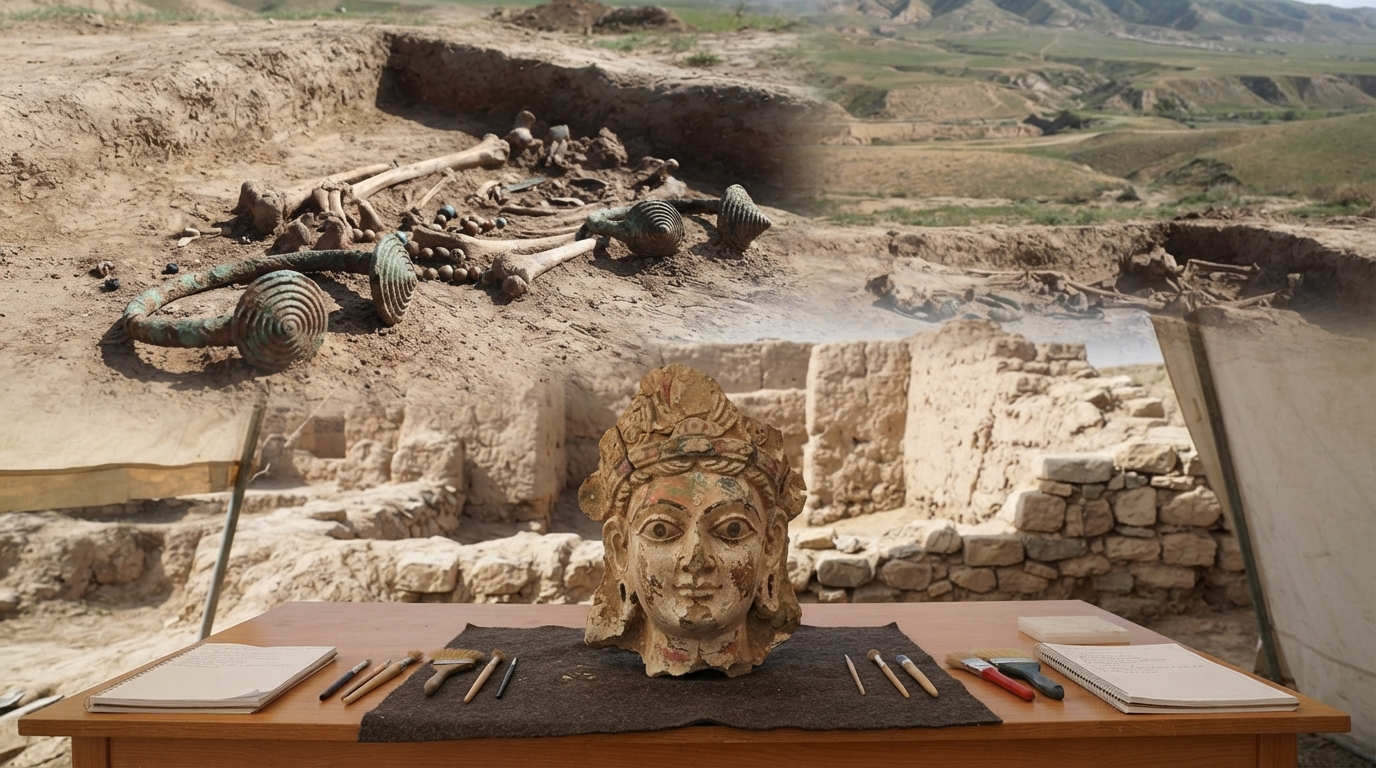
**Ancient tomb found in Payariq, stucco statue head discovered in Urgut**
The British scientific online publication Heritage Daily has published two articles about unique archaeological finds discovered in the Samarkand region.
The publication's article titled **"Bronze ornaments help unlock the mystery of an ancient tomb found in Uzbekistan"** provides information about a tomb accidentally discovered in the Payariq district.
It is noted that during earthworks, a local resident discovered human bones, bronze bracelets, and small beads.
The shape of the bracelets particularly caught the attention of specialists. Their ends are cone-shaped and decorated with spiral patterns.
According to the preliminary assessment of archaeologists, the finds are similar to Late Bronze Age materials previously discovered in the Zarafshan Valley region. On this basis, it is suggested that they may date back to the 13th–10th centuries BC.
The second article by Heritage Daily is dedicated to the research being conducted at the early medieval Qorgontepa archaeological complex in the Urgut district.
During the excavations, archaeologists found the head of a stucco statue among the ruins of an ancient temple.
The iconography of this find is of particular importance to specialists. This is because wall paintings depicting a four-armed deity had previously been discovered at Qorgontepa.
The new find is expected to provide additional information for studying Sogdian art, the religious beliefs of that period, and temple culture.
The British publication pointed out that the ancient tomb in Payariq and the finds in Qorgontepa belong to different historical periods. The former dates back to the Late Bronze Age, while the latter belongs to the early Middle Ages.
According to Heritage Daily's conclusion, the regular discovery of monuments ranging from the Bronze Age to the early Middle Ages on the territory of Uzbekistan shows the great potential for studying the country's rich historical and cultural heritage.