

Bronze Age cemetery discovered in Khorazm
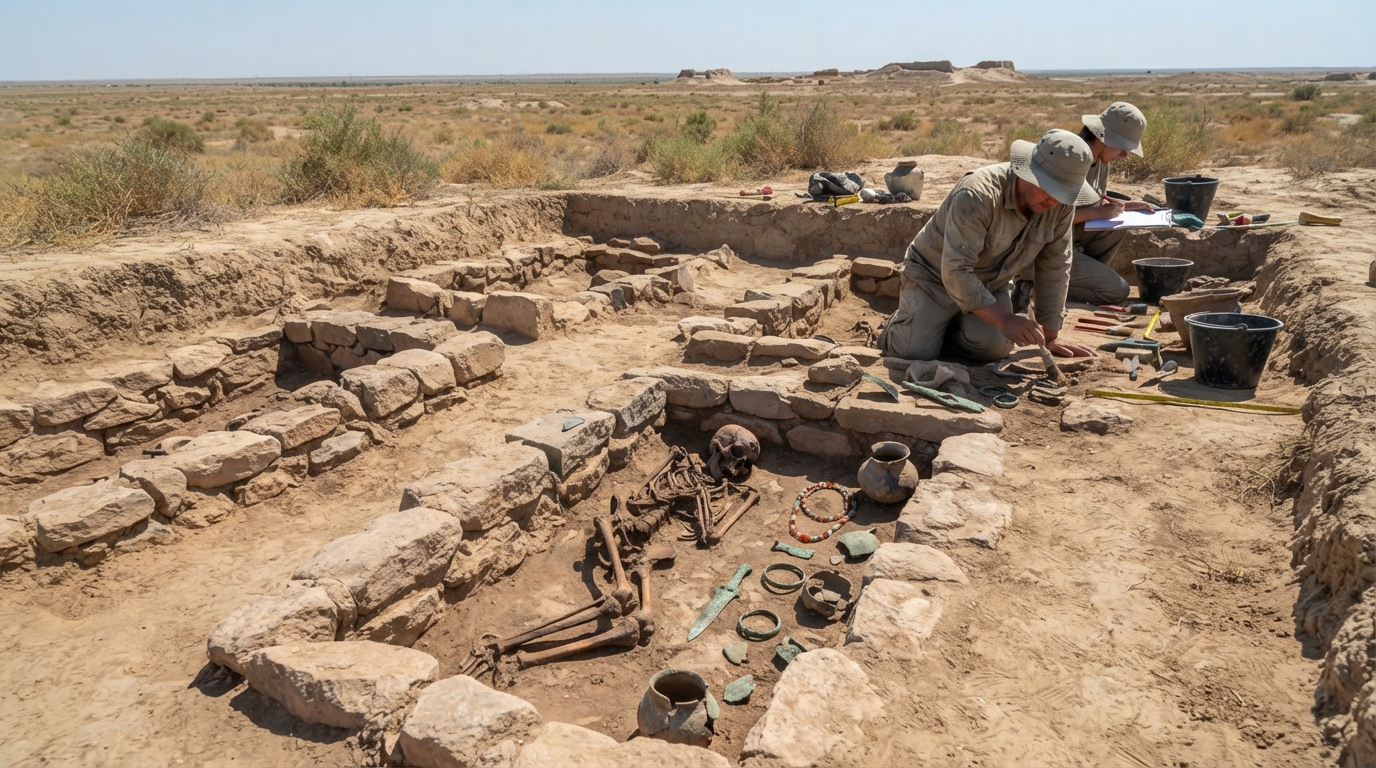
During the excavations, 19 stone box-shaped graves were recorded, inside of which [individuals] were buried in a crouched position
**A Bronze Age cemetery has been discovered in Khorezm**
The archaeological expedition of the Khorezm Mamun Academy has conducted work on an important find in the Tuproqqal’a district. A cemetery previously unknown to science, which according to preliminary conclusions belongs to the Bronze Age, has been discovered in the area.
The structure of the burial facilities at this monument is attracting particular attention from scientists. During the excavations, 19 stone box-shaped graves were recorded, inside of which skeletons buried in a crouched position were found. Various items, including bronze objects and beads, were also excavated from the graves.
The discovered complex is of great importance in studying the ancient history of Khorezm. This is because burial monuments provide important information about the culture, burial rituals, social perceptions of the ancient population of the region, as well as connections between the populations of different areas.
The results of the preliminary analysis of the burial ritual and certain types of finds show some similarities with burial structures discovered in the Syr Darya basin areas of Southern Kazakhstan. Such parallels are of particular scientific interest and may indicate that there were cultural connections and similar traditions among the populations living in different regions of Central Asia during the Bronze Age. At the same time, final conclusions regarding the chronology and cultural affiliation of the monument will be made after a comprehensive study of the archaeological materials.
Currently, Academy specialists are carrying out the initial processing and documentation of the materials obtained during the expedition. In the future, it is planned to conduct a detailed study of the burial structures, anthropological materials, and grave goods, as well as to carry out the necessary laboratory research. The obtained results will make it possible to clarify the date of the monument and determine its place in the system of Bronze Age archaeological cultures in Khorezm and its adjacent territories.
For reference: The Bronze Age in Central Asia lasted approximately from the end of the 3rd millennium BC to the end of the 2nd millennium BC (around 2200–900 BC).