

Uzbekistan uncovers Stone Age artifacts potentially dating back 320,000 years
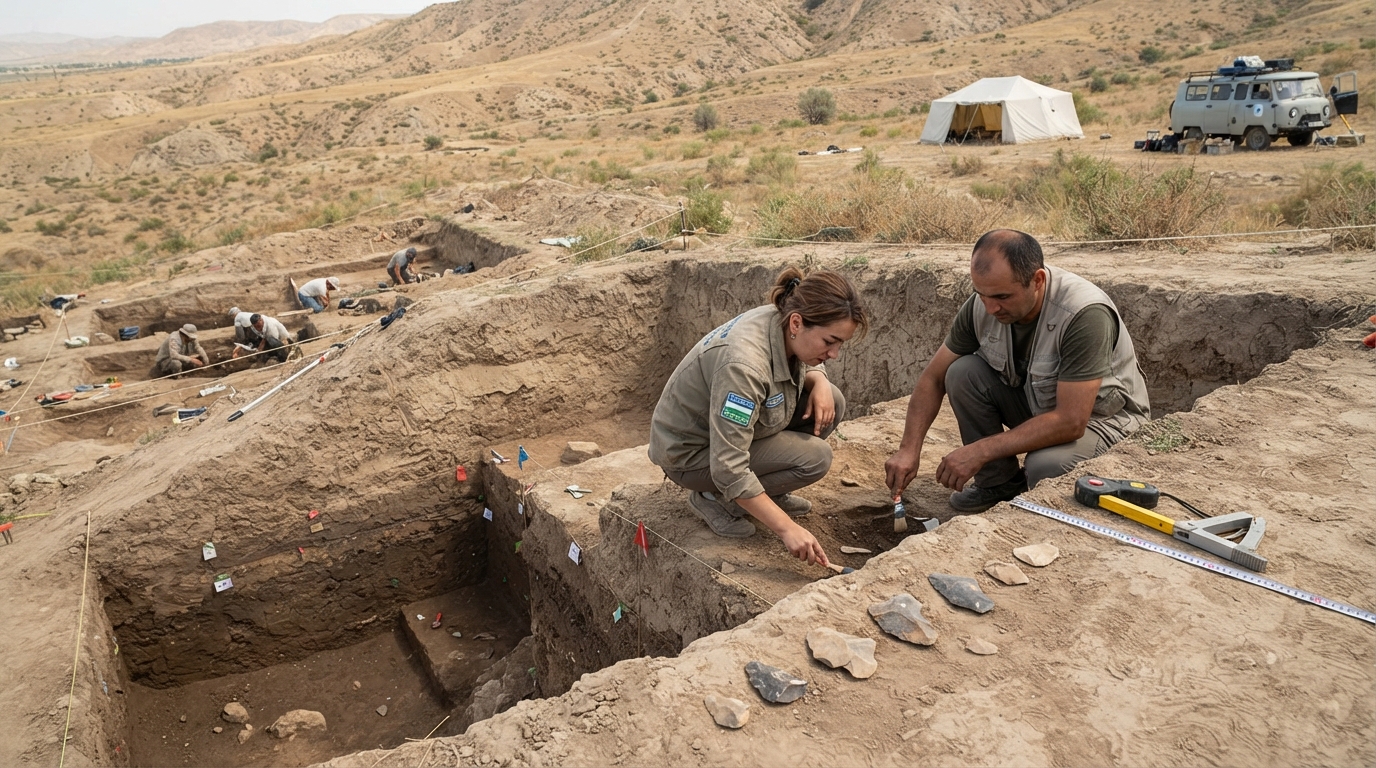
Uzbekistan has unearthed Stone Age artifacts that could be as old as 320,000 years, potentially making the Arktsoy Paleolithic site in the Tashkent Region one of the nation's most ancient archaeological discoveries. Preliminary dating of artifacts from one layer suggests an age of 320,000–280,000 years, though researchers emphasize the need for confirmation through modern absolute-dating methods.
Currently, a collaborative expedition is underway at Arktsoy, involving experts from the Institute of Anthropology of Uzbekistan’s Academy of Sciences and the Institute of Archaeology and Ethnography of the Siberian Branch of the Russian Academy of Sciences. Their work includes excavations and geological observations.
Targeted archaeological investigations at Arktsoy commenced in 2024, with fieldwork conducted jointly by Uzbek and Russian scientific institutions. Excavations are presently active in three distinct areas of the site. Researchers are meticulously examining the geological strata where stone artifacts were found to ascertain their age, stratigraphic position, and archaeological context. This work also aims to reconstruct the various phases of ancient human occupation in the area.
Previous geological surveys had identified several stone artifacts at depths of approximately 20 and 40 meters. However, their precise stratigraphic placement and archaeological context were not adequately documented at the time, making it challenging to reliably assign them to a specific period.
Recent archaeological efforts have corroborated the presence of stone artifacts across different levels of the Arktsoy geological section. Worked stone objects have been identified within the first, second, and third ancient buried-soil layers, indicating that ancient communities may have inhabited the area during multiple distinct periods.
The third buried-soil layer holds particular scientific significance. Initial geological and paleoclimatic comparisons suggest its formation occurred approximately 320,000–280,000 years ago. Should independent laboratory analyses validate these dates, the findings could imply that ancient human communities were already present in the Tashkent oasis and the broader territory of modern-day Uzbekistan during the later stages of the Early Paleolithic.
Researchers believe these discoveries could illuminate the early history of the Paleolithic era in Uzbekistan, the migratory patterns of ancient human populations across Central Asia, and their adaptation to evolving environmental and climatic conditions. The combined study of loess and buried-soil layers with archaeological materials could also help researchers explore the interplay between human activity, climate change, and landscape development.
For now, scientists are characterizing Arktsoy as a potentially significant early Paleolithic site, rather than definitively declaring it Uzbekistan’s oldest archaeological site. If the 320,000–280,000-year chronology is substantiated through absolute dating, Arktsoy could be recognized as the oldest archaeological site currently known in Uzbekistan.
In a separate discovery, archaeologists in southern Uzbekistan previously uncovered a 4,000-year-old skull exhibiting evidence of cranial surgery performed on a five-year-old child. Researchers described this find as one of the earliest known instances of surgical intervention in Asia.