

Scientists decipher petroglyphs in Samarkand region
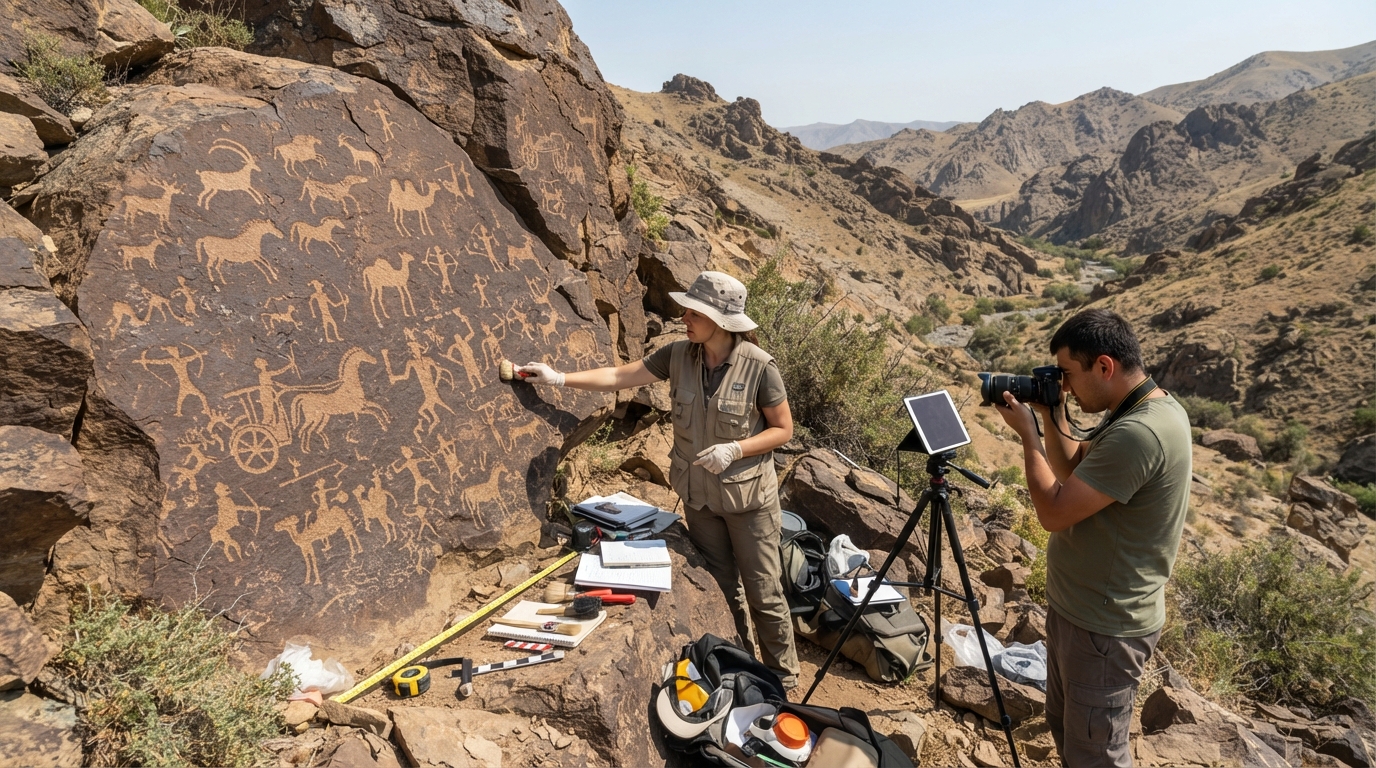
Scientists Decipher Petroglyphs in Samarkand Region
In August and September 2026, the Bulungur District of the Samarkand Region hosted another phase of field research dedicated to the scientific documentation of ancient rock art sites.
The work was carried out within the framework of the international ANR FRONTIER project by specialists from the Ya. Gulyamov Samarkand Archaeological Institute in cooperation with the French Archaeological Mission in Central Asia (MAFAC).
The expedition was a continuation of a series of studies initiated in 2018–2024 and aimed at digitizing and cataloging the region's rock art.
The main site of the 2026 field season was the Yetimsay Gorge in the Gobduntau Massif. Here, researchers succeeded in conducting systematic recording and digital documentation of a previously selected array of rock surfaces.
The expedition yielded the following results:
- 63 rocks and 107 individual surfaces with drawings were documented;
- 761 graphic motifs, including 49 scenes, were entered into the registry;
- about 90% of all discovered drawings consist of zoomorphic images (animal figures);
- other elements include anthropomorphic figures (human images) and various objects.
Analysis of the rock surfaces showed that ancient craftsmen used different techniques to apply the drawings — pecking, dotting, and scratching.
The rock art layers span a wide chronological period. Scientists identified features characteristic of the Bronze Age and the Early Iron Age, including scenes with chariots and images in the Eurasian animal style.
Researchers emphasize that studying rock art remains a challenging task: the drawings often overlap, and stone erosion distorts the images over time.