

New Stone Age sites and about 30 petroglyphs discovered in Jizzakh
New archaeological sites dating back to the Paleolithic and Neolithic periods have been discovered in the Zaamin and Sharof Rashidov districts of Jizzakh. Additionally, about 30 petroglyphs were recorded on 7 shale rock faces along the Ravotsoy River. They date from the Bronze Age to the early Middle Ages.
New Stone Age sites and about 30 petroglyphs discovered in Jizzakh
During archaeological field surveys conducted in the Zaamin and Sharof Rashidov districts of the Jizzakh region, new archaeological sites dating back to the Paleolithic and Neolithic periods, as well as about 30 rock art images, were discovered.
The research was carried out in September by staff from the Cultural Heritage Agency and the Samarkand Institute of Archaeology named after Yahyo Gulyamov.
During the searches conducted in the Zaamin district, a number of new archaeological sites dating back to the Stone Age were recorded. According to preliminary conclusions, sites dating to the Paleolithic period (from 2.5 million years to the 14th millennium BC) were identified in the eastern part of the Achchi village, and sites dating to the Neolithic period (6th-3rd millennia BC) were found in the Peshaghor village. Additionally, findspots belonging to the Neolithic period were also recorded in the western part of the Achchi village and the territory of the Arja village.
It is noted that the discovery of monuments from the Paleolithic and Neolithic periods within a single area indicates that ancient communities may have lived in the Zaamin oasis and this part of the Turkestan mountain range over long historical periods and regularly used the territory.
According to experts, the new discoveries could serve as an important scientific source in studying the distribution, living environment, and economic activities of Stone Age communities in the Turkestan mountain range.
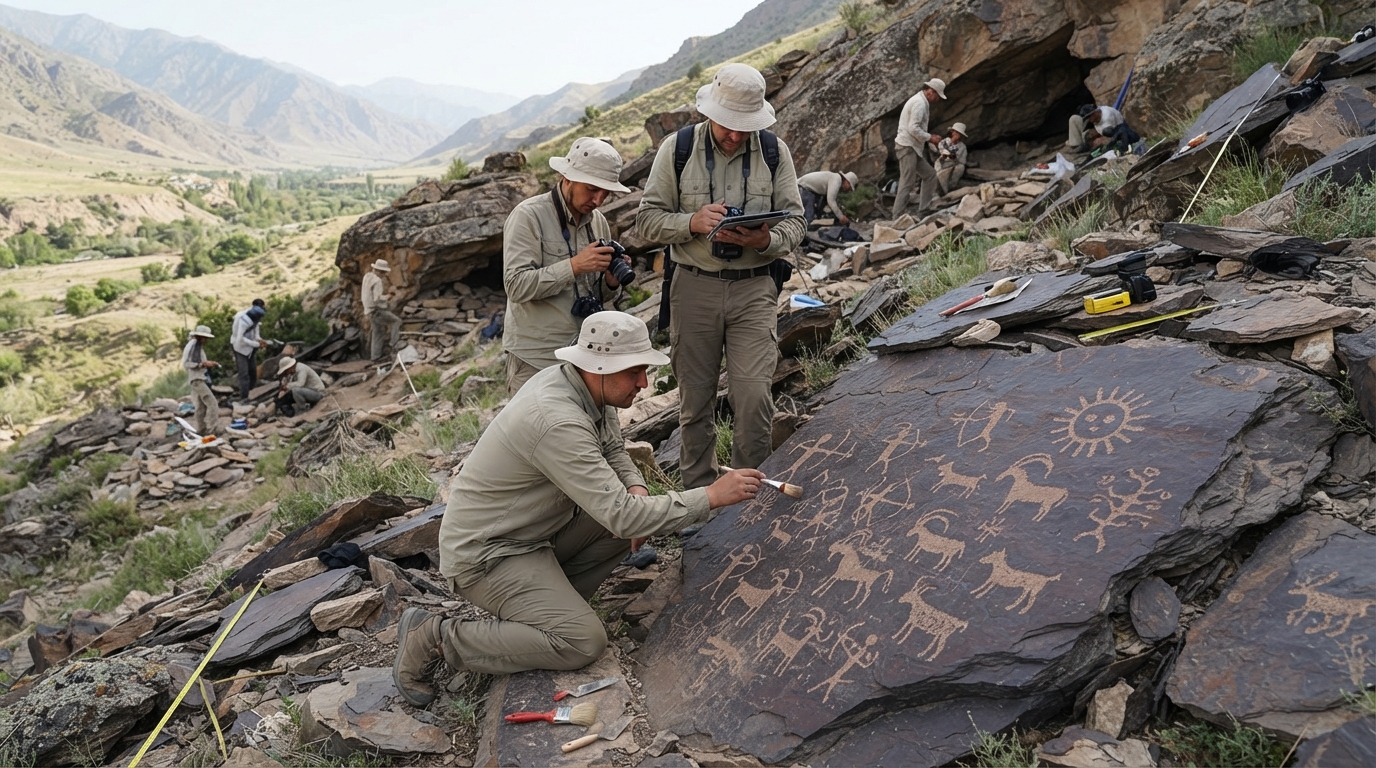
During the field surveys, a new archaeological site was also identified in the Sharof Rashidov district. A complex of rock art images was recorded in the territory of the Ravot village, on the left bank of the Ravotsoy.
About 30 petroglyphs were identified on the surfaces of seven shale rocks. Among them are depictions of a hunter, a mountain goat, cattle, a dog, a sun-like symbol, and a hunter shooting an arrow from a bow.
According to preliminary analysis, these petroglyphs date from the Bronze Age (from the 3rd millennium BC to the beginning of the 1st millennium BC) to the early Middle Ages (5th-11th centuries).
Experts note that the identified sites could provide new scientific data for studying the ancient history of the Jizzakh oasis and the Turkestan mountain range.
In the future, it is planned to conduct large-scale archaeological research at the identified monuments, and to continue the work of periodization and documentation of the finds.
In 2025, new archaeological sites dating to the Paleolithic and Neolithic periods were also identified in the Gallaorol district of the Jizzakh region. In particular, a settlement of primitive humans dating to the Late Paleolithic period was recorded in the western part of the Ogat village. Meanwhile, new settlements belonging to the Neolithic period were identified on the northern foothills of the Qoropchi village and north of the Yonboshtut village.