

Reports of violence against women in Gaza surge, UN agency finds
The UN Population Fund also says there has been a "severe escalation" in the number of early and forced marriages.
Reports of violence against women in Gaza rise sharply, UN agency says
Reports of violence against women and girls in the Gaza Strip, including early and forced marriage, have increased sharply, according to a set of recent reports from the UN Population Fund (UNFPA).
One report, which examines data gathered by 10 organisations, says the prolonged crisis in war-ravaged Gaza has "created conditions in which women and girls face escalating risks of gender-based violence".
It also cautions that there has been a "severe escalation" in early and forced marriage cases in the second quarter of this year. The UN classifies both as forms of gender-based violence (GBV).
A second report, drawing on testimony from 230 women in overcrowded displacement camps in Gaza City and Khan Younis, paints a bleak picture of the violence they have endured or seen.
Some readers may find some of the details in this report distressing
One displaced woman in a school-turned-shelter in Gaza describes how rape victims are often married to their attackers to avoid shame and scandal. "When rape cases are discovered in schools, you find weddings and celebrations at the school the next day," she says.
Another woman recounts how last year, during the famine, "a man married off his 14-year-old daughter in exchange for two bags of flour so he and his [other] children could eat". Six women in different displacement camps described similar exchanges - something that would have been unimaginable before the conflict between Israel and Hamas began in 2023.
Although collecting data to determine exact numbers remains difficult, the UNFPA says reported early and forced marriage cases in the second quarter of this year were up 123% from the first quarter. Early or child marriage involved girls aged 12 to 17.
"The trends are shocking," says Nestor Owomuhangi, the UNFPA representative to Palestine. He says the extreme conditions of the past three years - which have brought tens of thousands of deaths, widespread destruction and repeated displacement in Gaza - have shattered social structures, so "everything is eroded... there is no system".
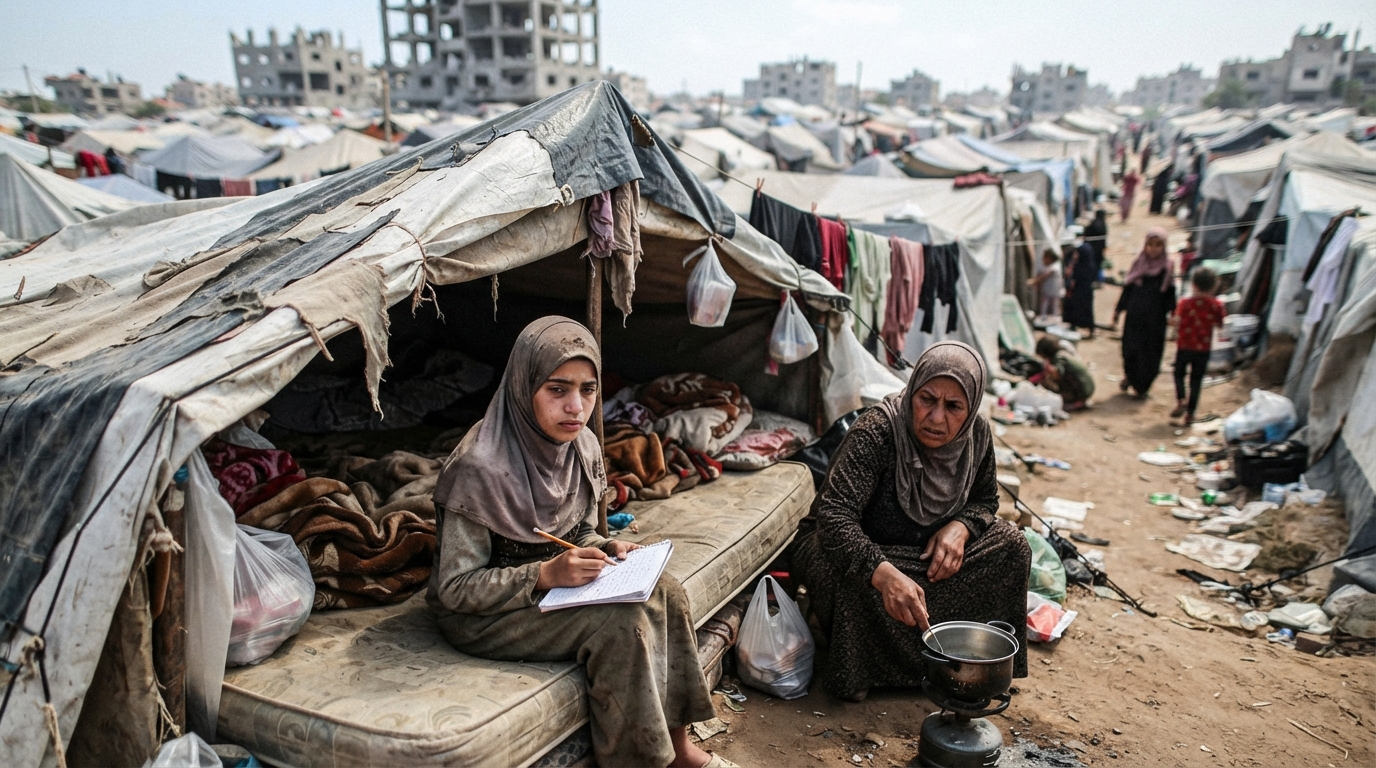
Although food markets have reopened, many people cannot afford what is being sold, and extreme poverty and hunger persist, with dependence on charity. Nearly all of Gaza's more than two million residents have been forced from their homes, with most now living in filthy tent camps or damaged buildings. Public services have largely broken down, and Israeli air strikes have continued despite the ceasefire.
About 1.2 million Palestinians in Gaza are living in tents or makeshift shelters
Before the war, girls in Gaza outnumbered boys and achieved better results at every level of education above primary school. Now, after prolonged school closures, many children have left education. Boys face pressure to take informal jobs to help their families, while girls face greater safety concerns.
Living among strangers, without privacy, in a socially conservative society, families complain of increased sexual harassment and abuse - and many see marrying off their daughters as a way to protect them and preserve modesty. The UNFPA report - based on research conducted in late 2025 and early 2026 - shows that girls orphaned during the war are especially at risk.
One woman in a Gaza City camp interviewed for the report says she attended the wedding of two girls from her family, aged only 14 and 15.
"Their uncles married them off very young. Do you know why? Because their father and mother were martyred, and their uncles wanted to get rid of the responsibility and expenses," the woman said. "By God, they don't understand what marriage or life is."
The Women's Affairs Center in Gaza - a Palestinian NGO working with the UNFPA - and other support organisations have recorded disturbing cases of girls who were married, abused and often became pregnant. They say girls in their early teens are far more likely than adult women to miscarry or give birth to underweight babies.
"We see adolescent pregnancies going through the roof because of child marriage," says Owomuhangi. "A child who is at an age when the body is not fully developed to sustain another body, who is hungry, in unhygienic circumstances, who doesn't know how to take care of the infant, who doesn't even know how to take care of herself, the consequences of that pregnancy are always really, really bad."
The UN and most humanitarian groups define marriages of girls under 18 as early marriage. Even before the war, this was more common among Palestinians in Hamas-run Gaza than in the occupied West Bank, though it had been falling.
Gaza law permits exceptions to the minimum marriage age of 17 with parental consent and a judge's approval. Court officials can authorise marriages for girls as young as 14 years and seven months old, although a local Sharia expert told us that "legal safeguards" had been removed when Islamic courts - which handle family matters for Muslims - were shut for much of the war.
About 700,000 children missed formal in-person schooling for almost three years
The BBC has spoken to several families in which bereaved relatives were married. Zuhair, 25, says his uncles urged him to marry a 16-year-old girl from his extended family after her father - her only guardian - was killed in an Israeli air strike.
When asked why he agreed to proceed, he said: "One of the reasons that led me to marry her was that there was no one to take care of her. That's the first point."
"If it were not for the war, she would still be a young girl spoiled by her father. She would be going to school," Zuhair adds. "She still has a child's mindset, not a mature mindset. She misses school, her family, friends. She even misses simply sitting at home."
A couple says they allowed their 17-year-old son to marry his 16-year-old cousin after their older son and the girl's father were killed. The teenager is now pregnant and will not return to school. "She needs to care for her child," her father-in-law says, "her education would be in vain."
Aid agencies say the risks to women could be significantly reduced if humanitarian conditions improved
Sexual violence in Gaza remains severely under-reported, largely because of fear of stigma and retaliation. UN safety checks have identified particular dangers for women and girls at night, leading them to avoid camp toilets and bathrooms.
The latest analysis report from the UNFPA-led task force said incidents of sexual violence, including rape and sexual assault, "have become critical in Gaza". They made up 2.7% of all reported GBV incidents from April to June 2026 - up from 2.1% in the previous quarter; in absolute terms, this was a 61% increase in cases.
The increase is being linked to efforts to raise awareness and improve confidential reporting channels. Demographic data showed that most survivors were women aged 18-59, followed by adolescent girls at 8% and adult men at 5%.
Widows, and women whose husbands are detained or missing, face a higher risk of sexual abuse and exploitation. Nearly one in four households is now reportedly headed by a woman - twice the share before the war.
"One widow was looking for a tent, and a [camp] representative told her, "I'll give you a tent, we'll put you in our camp, and you can come stay with me tonight," recalls a woman in Gaza City, interviewed for the UNFPA report.
Aid agencies say the dangers for women in Gaza could be eased substantially by better humanitarian conditions. They are calling for Israel to allow higher-quality shelters into the territory, along with equipment to improve latrines, sanitation and lighting. Israel restricts items it considers potentially dual-use for military purposes.
Work is under way to improve education and healthcare, along with longer-term plans for campaigns against domestic violence and child marriage. Although so many lives in Gaza have already been permanently altered, women say they hope for a future in which they at least feel safer.