

Ranking by size
Why Kazakhstan's Ministry of Labor is looking for "second" and "third" class people
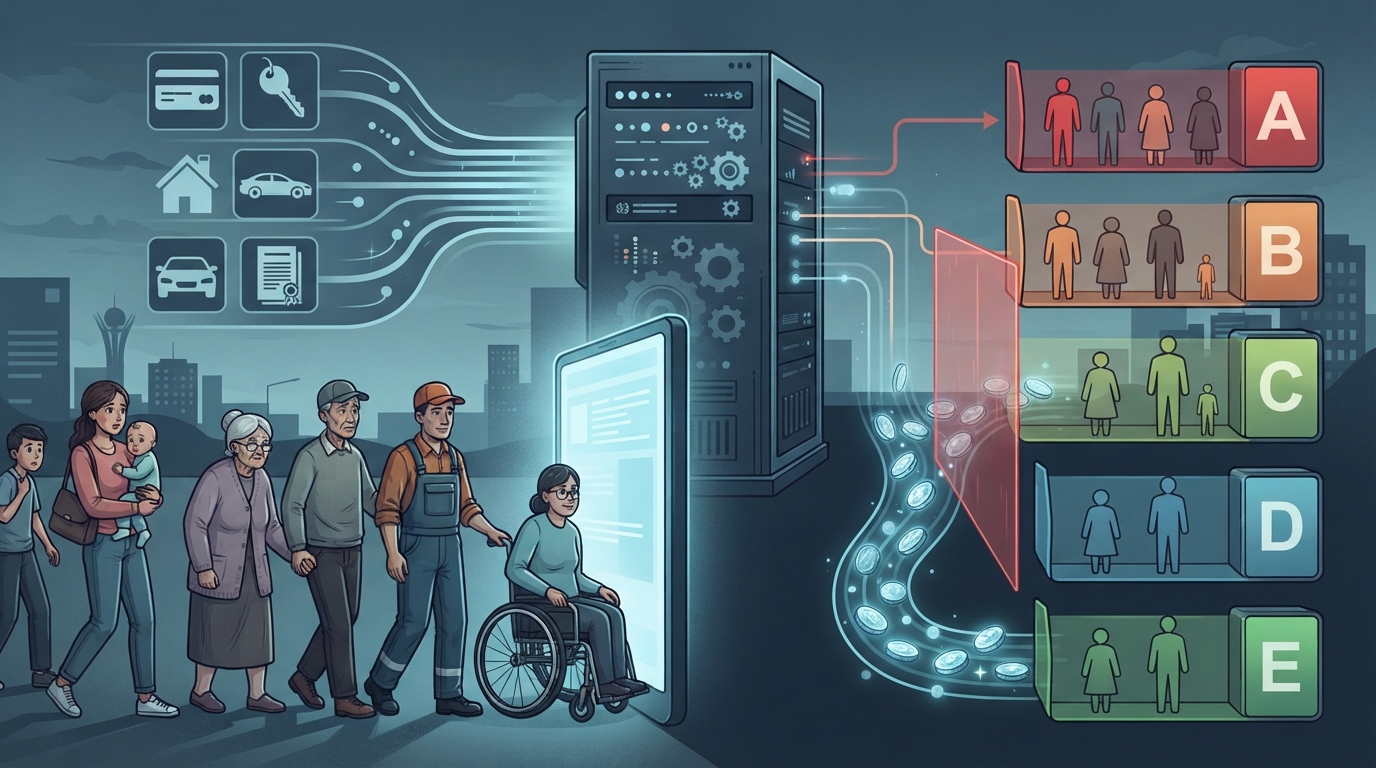
Line Up by Rank
Starting in 2027, millions of Kazakhstanis could suddenly find themselves without state support. The authorities have decided to delegate the distribution of social assistance to an algorithm that will divide citizens into different well-being categories.
Since October 1, Kazakhstanis have been receiving notifications about changes to the terms of social payments. The new rules will take effect on January 1, 2027. The state has decreed that 14 out of 39 types of benefits will now be granted only based on need. The authorities explain this as a pursuit of fairness.
The main selection tool is the so-called "Digital Family Card." This is a special database that gathers information from various state systems. The algorithm analyzes the income, loans, housing, and cars of all adult family members. Based on this data, each family is automatically assigned a certain number of points. As a result, people are distributed into five well-being categories — from letter "A" to letter "E."
Most notably, according to a special order from the Ministry of Labor, category "A" includes wealthy people with multiple apartments and successful businesses... while category "B" represents the typical middle class, who have steady jobs and a single home, but no savings to speak of. And it is precisely these two groups, according to the authors of the reform, that will be denied those fourteen types of assistance.
Consequently, a strange paradox arises that has outraged society. Category "B," which includes ordinary people with mortgages and personal loans, has been equated with affluent citizens. Yet, these are the very people who pay a significant portion of their salaries every month in taxes and contributions to the social insurance fund. But the algorithm deems them too wealthy to be helped in a difficult moment. The state is effectively punishing them for legal employment.
Moreover, the restrictions do not only apply to childbirth or large family benefits. The list of benefits to be canceled for the "rich" includes disability allowances, survivor benefits, and even funeral payouts. The algorithm will coldly assess wealth even in moments of severe grief or the death of loved ones. This raises a natural question among citizens: is there even a shred of human decency left in the state system?!
Another hidden trap of the digital system is the assessment of the income of all adults in the household. If a woman goes on maternity leave and her husband earns a good official salary, the system deprives her of personal support. The responsibility for her maintenance is simply shifted onto relatives, depriving the woman of financial independence. In essence, this is an attempt to shift the state's responsibility onto the shoulders of the citizens themselves. And this is happening at the very time when the state itself speaks of high levels of household debt.
The situation with maternity benefits clearly shows how the system breaks basic principles of fairness. Journalist Tamara Vaal openly shared her personal story, which reflects the problems of the entire middle class. She said she had always worked officially and made substantial contributions, but the state set an artificial ceiling on payouts. Instead of the calculated 300,000 tenge she was entitled to, she received only about 80,000. Because of this, she had to return to work right from her maternity ward bed — because the mortgage won't pay itself.
Now, with the introduction of the need-based criterion, the situation will worsen even further. Already reduced payments could be canceled altogether if the digital algorithm deems the family sufficiently well-off.
Why then should Kazakhstanis start families, work officially, and pay high taxes if they are left with nothing during vulnerable periods? This is a direct destruction of the motivation for honest labor, pushing people to drive their incomes into the shadow economy. Instead of supporting working citizens, the system itself encourages the dependency it supposedly tries to fight.
This is the main legal and logical error of the authors of the new reform. The Ministry of Labor has deliberately lumped together two completely different sources of funding. We have money from the republican budget, which is distributed as aid to the poorest. And we have the State Social Insurance Fund (SSIF), where people themselves transfer a portion of their salaries. These are the personal insurance savings of citizens, not state money.
When a person loses their job, goes on maternity leave, or becomes disabled, they should receive their own insurance savings. Denying them this under the pretext of owning an apartment or a car is a direct violation of the financial contract between the citizen and the state. It turns out that people chip into a common piggy bank, and then an algorithm decides to exclude them from it. The authorities use the term "targeting" as a convenient shield to justify seizing other people's funds.
At the same time, despite the rules of the game already being announced, the very methodology for calculating vulnerability is still under development. People are already receiving notifications and reading about the upcoming changes in the media, but they cannot find out which specific category they will be assigned to. Citizens are not given the opportunity to check exactly why they were awarded or docked points.
This information vacuum makes society nervous and leads people to imagine the worst-case scenarios. No one knows exactly how the state machine will evaluate their life tomorrow.
Yet, the Ministry of Labor of Kazakhstan chooses a tactic of evading direct answers in this situation. While the country actively discusses the loss of benefits, the department publishes only dry press releases about conducting "internal training seminars." Local officials are taught "sensitivity" toward citizens, but no one is speaking openly with the citizens themselves. The lack of a simple public benefits calculator and clear explanations only fuels panic among the population.
In the middle of the year, Minister of National Economy Alibek Kuantyrov announced that starting in 2027, the government plans to cut social spending by 860 billion tenge. The budget cannot cope with the load, and therefore the Ministry of Finance was tasked with sharply reducing the deficit in the coming years. They decided to extract this huge sum from the pockets of citizens, cutting off payments to those who can still feed themselves. The middle class was simply made the main sponsor of these savings.
By the way, another recent official document also indicates that the state has begun a total purge of social spending. In September, the department proposed taking 70% of pensions and benefits from those living in state-run boarding houses and nursing homes. The explanation was: "these people are already fully supported by the state, why duplicate their payments?". This shows that officials are meticulously searching for any opportunity to save money — and no one will escape this filter.
It is worth noting that the assessment methodology relied upon by Kazakhstan's "Digital Family Card" is not a national invention. It was developed with the participation of UN agencies and is known globally as "proxy means testing." Initially, this tool was created as a rescue radar for the poorest. It was supposed to find "invisible" people in databases so that the state could proactively offer them support. That is, the system was originally designed to expand the coverage of aid, not to trim the lists.
But the financial bloc of the Government of the Republic of Kazakhstan managed to turn this humanitarian idea in a completely different direction. A mechanism created to find those in need was turned into a harsh sieve for filtering out taxpayers. Now, the algorithm searches the data not for those who need help, but for those at whose expense budget billions can be saved. Helping the poor has been replaced by economizing on the working population.
The recommendations of the World Bank, published in 2023, also played a role in this story. International experts pointed out to Kazakhstan that too many non-poor families receive social benefits simply because they had a child, and advised correcting the situation. The government took these words as official permission to cut payments: if a reputable institution advises reducing spending, then they can boldly cross out millions of people.
However, firstly, international analysts think in economic categories that do not translate well to local realities. In their understanding, a family with two stable salaries and an apartment falls out of the risk zone. But they do not take into account that in Kazakhstan, this very apartment is usually bought on a high-interest mortgage, and after paying all debts and basic expenses, such a middle-class family has little disposable income left.
Secondly, an important point — the World Bank proposed this solution in order to redistribute the freed-up 177 billion tenge to poverty reduction programs. In our case, this is nowhere to be seen.
But the state will still use the recommendations of international institutions as a convenient cover for unpopular decisions. After all, it is much easier to say that "we are bringing the system in line with world standards" than to honestly admit to a lack of money. However, citizens sense this substitution of meaning because their expenses do not align with official statements. In an attempt to save budget indicators, the authorities are causing serious damage to the trust of their own citizens.
Alternatives That Were Ignored
Officials can argue for a long time that "they had no other choice," but global experience suggests otherwise. Means testing is used in many countries, but it is by no means necessary to turn it into a complex rating on which a person's very right to a benefit depends. It is especially strange to do this in "digital Kazakhstan," where the state talks every day about implementing AI in all areas and has long been able to see citizens' official incomes, property, and other data.
There are much clearer models that allow for helping the poor more without turning basic social guarantees into a reward for scoring the right number of points. The most telling example is Mongolia, which already tried to do approximately what Kazakhstan is heading toward now.
In Mongolia, they also decided to distribute child benefits based on an assessment of the family's financial situation. Income, property, and other data were taken into account. But the system made mistakes: similar families received different results, information in state databases turned out to be outdated, and the people themselves did not understand why some were entitled to money and others were not. In 2023, the authorities decided to keep the payment for only 91% of children, but just a few months later they abandoned this model and extended the benefit to everyone again.
Lithuania solved the same problem much more simply: every child receives a basic benefit, and families in need receive additional assistance on top of it.
That is, the state does not take away the payment from a family just because they earn more or own their own home. It preserves the basic guarantee, and in cases of low income, large families, or a child's disability, it pays more. Moreover, when assessing need there, a portion of labor income is not taken into account, so that an official salary increase does not immediately lead to the loss of all support.
Estonia's experience shows that even a developed digital state is by no means obliged to reduce all social rights to a single well-being rating.
Similarly, child benefits in Estonia are paid regardless of the parents' income. At the same time, other payments are calculated on their own grounds: parental compensation depends on previous earnings, disability support depends on the disability itself, and aid to low-income families depends on income. That is, completely different life situations are not forced through a single common scale of "how well you live."
Kazakhstan could have followed the same path: preserve basic payments for childbirth, disability, or loss of a breadwinner, and use the "Digital Family Card" to automatically assign additional money to those who are truly struggling. Then categories C, D, and E would receive more, but a family in category B would not have to prove to the state that an apartment, a car, or a normal salary does not make them rich yet.
The experience of Poland is also interesting; they tried to introduce complex rules for child benefits but stopped in time.
Initially, a portion of child benefits there depended on family income. Nevertheless, the Poles calculated that maintaining databases, algorithms, and inspectors cost the budget too much. As a result, in 2019, they introduced an equal benefit for every child without any conditions. The money for this was found not in the pockets of parents, but through a tough fight against the shadow economy and closing tax loopholes for big business.
Our government should also look for the missing funds not from mothers and disabled people, but elsewhere. In particular, huge reserves are hidden in reducing the expenses of state-owned companies, which still continue to receive generous injections. But the choice of a point system instead of progressive economic solutions once again shows the authorities' reluctance to look for complex paths. And the ministry's silence is a clear sign that officials themselves fear the controversial nature of the chosen solution and the undermining of faith in fairness.