

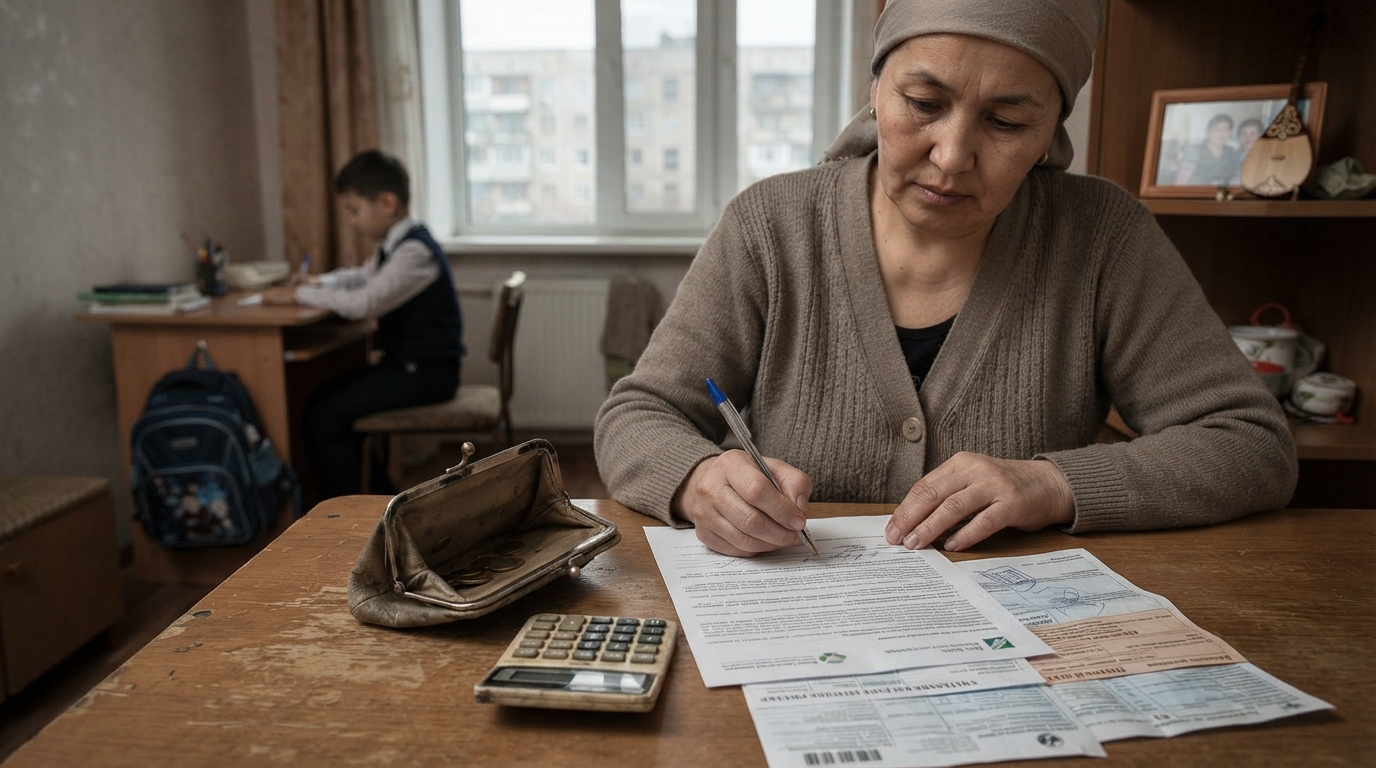
**A Life in Debt**
Two decades ago, it was hard to imagine that loans would become as integral a part of everyday life as a salary or utility bills. Today, the average Kazakhstani buys groceries, pays for medical treatment, pays for their children's education, makes repairs, and often repays old loans with new ones—all with credit. If funds are insufficient even for daily needs, the pawnshop is always an option. These are no longer isolated cases of financial irresponsibility, but a new socioeconomic reality. The main product of the modern economy is no longer oil, metal, or even information, but debt.
**Kazakhstan is entering an era of debt capitalism**
According to the Bureau of National Statistics, the total debt of Kazakhstani households to financial institutions has reached almost 25 trillion tenge. Meanwhile, the Agency for Regulation and Development of the Financial Market reports that the pawnshop portfolio alone has grown to 417 billion tenge, an increase of 158 billion tenge over the past year. Even more telling is the size of their profits: 54.7 billion tenge in the first quarter of 2026 alone, almost six times more than two years ago.
Can this be considered a success for the financial sector? For banks and pawnshop owners, certainly. But for Kazakhstani society as a whole, it's more of a warning sign. When financial institutions post record profits, and more and more families are forced to borrow to cover current expenses, it's no longer a question of the development of the financial system. It's a question of credit beginning to function as a form of social policy.
For most of the 20th century, welfare states (in both developed capitalist and socialist countries) were built on a simple idea: if a citizen faces life risks—illness, unemployment, old age, lack of funds for children's education—the state is obligated to provide a minimum level of social protection. However, the last four decades of neoliberal reforms have radically altered the very philosophy of public policy.
Instead of expanding public benefits, people have been offered greater access to financial services; Instead of guaranteed social rights, people are being offered groceries on credit. Progressive policies of income redistribution and the social "pie" have been replaced by the postmodernist concept of "financial inclusion." While the state once helped individuals escape poverty, today it increasingly helps them secure new loans. Thus, imperceptibly, the welfare state is transforming into a state of universal credit.
**Financial Colonization of Everyday Life**
The financialization of the economy is driving changes not only in the economy but also in social relations. Modern capitalism has long exploited individuals beyond the workplace. Employees receive their wages on a bank card; buy a phone on an installment plan; take out a mortgage; take out a consumer loan; pay for their child's education; buy medication; pawn gold. Each such transaction becomes a source of profit for the financial sector. While industrial capitalism derived profit primarily through the exploitation of labor, financial capitalism increasingly derives it through debt servicing.
In other words, modern individuals no longer work solely for their employers. He also works for the bank. Now it's becoming clear why the "most advanced financial system" in Eurasia was created – Kazakhstani salaries, which are far from meeting the standards of an "upper-middle-income country" (according to the World Bank classification), are being expropriated by financial institutions.
Many perceive the growing number of pawnshop clients as a private problem for individual citizens. In fact, pawnshops are a kind of barometer of social well-being. If a person pawns jewelry, household appliances, and other personal items to pay utility bills, buy groceries, or get their child ready for school, this indicates not an expansion of the population's financial resources, but a decline in their socioeconomic well-being. Increasing pawnshop profits are not an indicator of economic health. They indicate that the incomes of an increasing number of Kazakhstani families are insufficient even to apply for loans from traditional banks.
Official statistics regularly report on Kazakhstan's economic growth, using indicators such as GDP, exports, and foreign exchange reserves. At the same time, however, the household debt burden, the scale of consumer lending, financial sector profits, and wealth inequality are growing. This means that economic growth increasingly reflects changes in the quality of life of most citizens. A paradox arises: the more favorable the macroeconomic indicators, the more actively the population borrows for everyday expenses. This contradiction cannot be explained by a lack of financial literacy; it is a consequence of the development model itself.
Economic policy has traditionally focused on three goals: low inflation; a stable banking system; and financial stability. All of these objectives are undoubtedly important. However, a fundamental question arises: what exactly is meant by financial stability? If banks are increasing their profits year after year, while the population is simultaneously accumulating record debt, can such a system be considered sustainable? If pawnshops are experiencing a real boom, while the real incomes of many families are stagnating, does this mean that financial policy is effective?
Financial stability cannot be measured solely by the strength of bank balance sheets. It must be assessed through the socioeconomic well-being of households and the well-being of the country's citizens. Today, it seems that protecting the interests of financial capital remains the primary priority, while the debt sustainability of families is a secondary concern.
**The Neoliberal Trap**
For decades, neoliberal economic theory has convinced us that the free market can independently solve virtually any social problem. It was assumed that economic growth would automatically increase incomes, and financial liberalization would ensure broad access to capital. Reality shows a different picture. Growing lending is increasingly offsetting the stagnation of our compatriots' incomes. Debt is beginning to replace wage growth. Credit is replacing social protection. The financial sector is growing faster than industry. An economy is emerging in which banks become the main beneficiaries of virtually any life situation.
The solution does not seem to lie in banning lending. A modern economy cannot exist without a financial system. But the financial sector must serve the development of a productive economy, not become an independent source of rent extraction. This means reconsidering the very philosophy of economic policy. The state must once again become an active participant in development, not just an arbiter of financial markets.
What is needed is an accelerated industrial policy that creates high-quality jobs; state-owned development banks focused on long-term investment; an increase in real incomes; the development of universal healthcare, education, and social support systems; limiting excessive indebtedness and strengthening borrower protection; and a reorientation of the financial system from short-term consumer lending to financing the production sector. In other words, credit must once again become a tool for economic development, not a means of subsistence for the population.
Kazakhstan's real problem is not that citizens borrow too much. The problem is that more and more people are forced to borrow to maintain their standard of living. When a family takes out a loan for a child's education, medical treatment, food, or utilities, it is no longer a matter of personal financial behavior. It is an indicator of the state of the entire socioeconomic model.
Neoliberalism promised society freedom through the market. In practice, it increasingly offers "freedom" through debt bondage. And while the state continues to evaluate the economy based on GDP growth rates, bank profits, and formal financial stability, the key indicator of societal well-being—people's ability to live with dignity, without pledging their future to yet another loan—remains unaddressed. An economy in which debt becomes a new form of social policy ceases to serve people. It begins to serve financial capital.
Kuat Akizhanov