

Protests in Spain over government's handling of Ceuta migrant crisis
Spanish opposition parties accuse Prime Minister Pedro Sánchez of abandoning the residents of Ceuta.
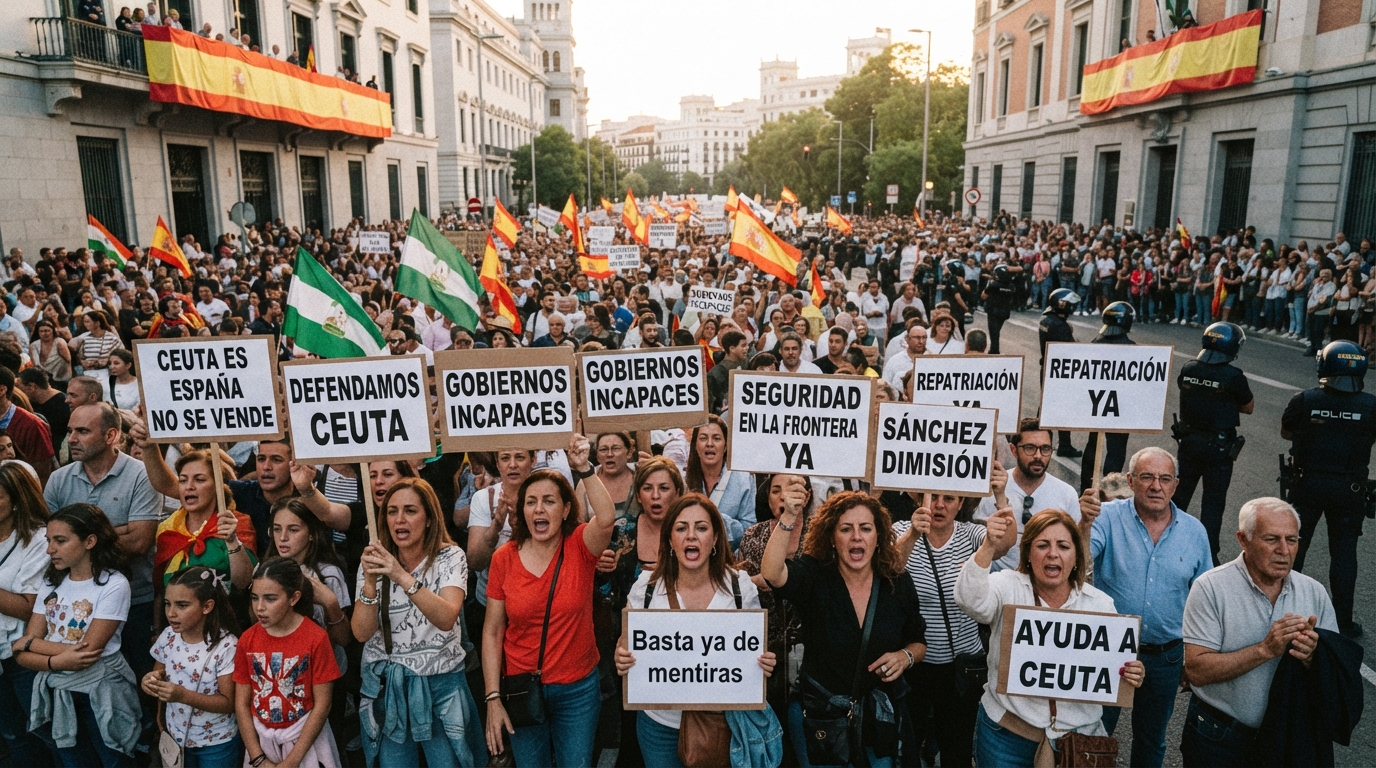
**Spanish Citizens Protest Government's Handling of Ceuta Migrant Influx**
Across Spain, thousands have taken to the streets to protest the government's response to the recent surge of migrants into Ceuta, a Spanish exclave located on the North African coast.
Opposition parties in Spain are accusing Prime Minister Pedro Sánchez of neglecting Ceuta's residents, while the government contends that right-wing parties are exploiting the situation.
A police report released on Wednesday indicated "total permissiveness" from Moroccan security forces during the unprecedented influx, a claim that comes days after Sánchez asserted Morocco was not responsible. Sánchez has attributed the crossings to trafficking gangs and online misinformation. Morocco, however, has denied any involvement in orchestrating the mass crossing.
On July 30 and 31, at least 72,000 migrants crossed from Morocco into Ceuta. While most have since returned, an estimated 5,000 remain, residing in makeshift camps, scattered across the city, or on its beaches. This situation has led to unrest in the autonomous city and a crisis for Sánchez's administration.
Locals have been holding near-daily protests, demanding that migrants be repatriated or redistributed throughout Spain.
Wednesday's rallies were organized by city councils in areas where opposition parties—the conservative Partido Popular (PP) and the far-right Vox party—hold power or significant influence. Demonstrators called for Sánchez's resignation.
PP leader Alberto Núñez Feijóo attended the Madrid rally, where government figures estimate over 50,000 people gathered. He stated, "A Spanish city has been invaded, occupied and, unfortunately, this happened with the knowledge of the Government of Spain."
Vox leader Santiago Abascal, meanwhile, claimed Sánchez was "at the service, like a lackey, of the Moroccan regime."
A significant rally also took place in Ceuta itself, with participants chanting, "Ceuta is not for sale, Ceuta must be defended." David Hernandez, a 45-year-old teacher, told Reuters, "The response has been inadequate, late and, to top it all, has involved a complete dereliction of duty on the part of the government. We cannot be second-class citizens, and our border must not be sidelined."
Pressure on Sánchez's government has intensified following Spanish media reports that a document submitted by the National Police's National Immigration and Borders Centre (CENIF) to the National Court suggested the involvement of Moroccan gendarmes in the migrant crossings. The police report alleged that the Moroccan police deployment near the border "was clearly smaller than usual" and cited migrants who described a "passive attitude" during the crossings. However, the report did not explicitly accuse Morocco of orchestrating the influx.
**Sexual Assaults Reported in Ceuta Amid Migrant Crisis**
Prosecutors have reported that sexual assaults are occurring almost daily in Ceuta, five weeks after over 70,000 migrants crossed the Spanish border from Morocco, with nearly 10,000 still remaining in the Spanish enclave.
Morocco has a long-standing claim over Ceuta and its sister autonomous city, Melilla, which have historically been points of contention in diplomatic relations between the two nations.
In August, numerous social media posts emerged portraying the border fence between Morocco and Ceuta as safe and easily traversable, despite the mayor's figures indicating that at least 100 people died attempting to swim around the fence.
Spanish fact-checking website Maldita reported that prior to July 30, when the influx began, messages circulated on Moroccan social media encouraging people to attempt the crossing, following a June ruling by Spain's Supreme Court.
Reports also indicate that Morocco has detained dozens of migrants attempting to cross into Ceuta. Spain's Prime Minister has attributed the mass crossings to traffickers.