

Sexual assaults happening almost every day in Ceuta, prosecutors say
Most migrants have returned to neighbouring Morocco, but as many as 5,000 remain in the Spanish exclave.
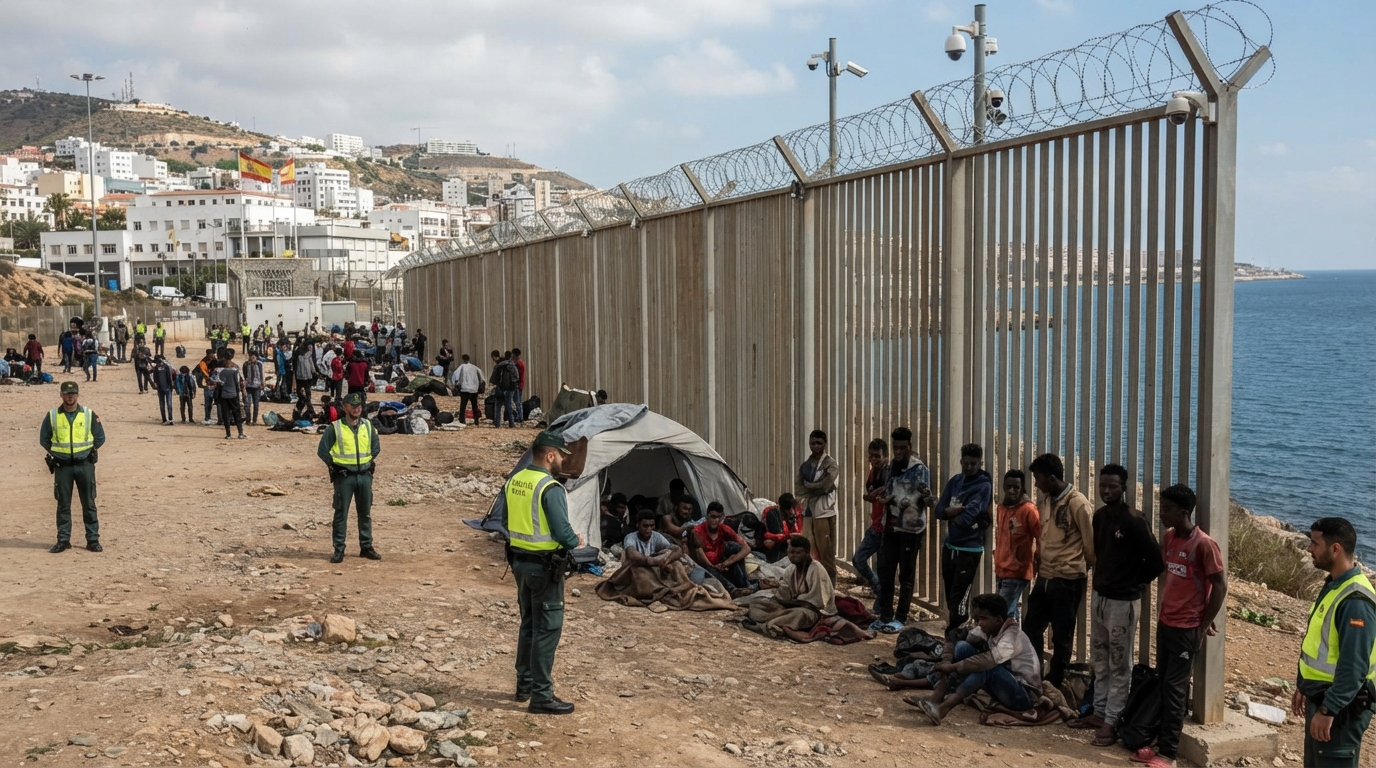
Prosecutors in Ceuta report that sexual assaults are occurring almost daily in the Spanish exclave, where an estimated 5,000 migrants who entered from Morocco are believed to remain.
Since the significant influx of migrants into Ceuta at the end of July, Spanish prosecutors have documented 23 sexual assaults, with nine of these cases involving children. Ceuta's chief prosecutor, Silvia Rojas, stated that this figure translates to nearly one incident per day.
Rojas informed El País newspaper that migrant girls are "particularly vulnerable because of their irregular status in the territory."
On July 30 and 31, at least 72,000 migrants crossed from Morocco into Ceuta. While most have since returned, approximately 5,000 are still present, leading to unrest in the autonomous North African city and a crisis for Spanish Prime Minister Pedro Sánchez.
Recent days have seen outbreaks of violence as tensions escalate between migrants and local residents. Sánchez convened his second national security meeting in a week on Tuesday to address the situation.
According to Rojas, between 1,400 and 1,600 of the estimated 5,000 migrants remaining in Ceuta are children.
Efe news agency reports that among the suspected attackers are four Moroccans, three Spaniards, and one Belgian. Rojas noted that many victims do not report assaults, either due to fear or their "current situation in Ceuta."
The Spanish Society of Epidemiology has cautioned that violence against women "cannot be considered an isolated event."
Economy Minister Carlos Cuerpo announced that the cabinet has approved a multi-million euro aid package. This funding will support essential services and provide care for unaccompanied children.
Juan Jesús Vivas, the conservative mayor of Ceuta, has urged Spaniards to participate in demonstrations across mainland Spain on Wednesday, coinciding with the city's annual holiday, to show support for Ceuta.
The Spanish government is facing sharp criticism from its opponents regarding its handling of the crisis. The hard-right Vox party asserted that Sánchez had not merely "lost control of Ceuta – he has handed it over."
Arantxa Campos, president of the Ceuta Employers' Confederation, told the BBC: "We can't do anything unless these people leave. We don't have a plan from the government. We don't have anything. We don't even know when they're going to finish screening everyone."
On Monday, the prime minister stated that King Felipe VI would visit Ceuta "as soon as conditions allow," a move interpreted as an attempt to affirm Spanish authority over the exclave.
Morocco has a long-standing claim over Ceuta and its sister autonomous city, Melilla. The last time a Spanish head of state visited these territories in 2007, Rabat recalled its ambassador from Madrid, and another royal visit could potentially exacerbate diplomatic tensions.
In an interview with Spanish radio channel Cadena Ser, Sánchez emphasized that the king had not visited Ceuta for 20 years. However, Felipe has only been on the throne for 12 years, and it was Juan Carlos who visited in 2007.
Sánchez also claimed to be the only prime minister to have made an official visit to Ceuta while in office, having traveled there on July 31 as the crisis unfolded. Some Spanish commentators observed that his remarks appeared to criticize the king, whom he later met that day.
Unlike his political adversaries, Sánchez has carefully avoided blaming Morocco for instigating the surge of migrants. He stated on Monday that no intelligence reports indicated "any involvement in one way or another" from the Moroccan authorities.
Instead, he focused on disinformation on social media "associated with both Russia and Israel and an international far-right movement that always uses migration, not only to attack Spain but also Europe," though he seemed to suggest they had fueled the crisis after July 31. He told Cadena Ser that this did not mean "it must come from a state actor."
Both Russia and Israel have denied any involvement. Israeli Foreign Minister Gideon Sa'ar accused the Spanish prime minister of "a blatant lie," and Russia's foreign ministry spokeswoman demanded proof to substantiate Sánchez's allegations.
In August, numerous social media posts emerged portraying the border fence between Morocco and Ceuta as safe and easy to cross, despite figures from the mayor indicating that at least 100 people died attempting to swim around the fence.
Spanish fact-checking website Maldita reported that before July 30, when the influx began, messages circulated on Moroccan social media encouraging people to attempt the crossing, following a June ruling by Spain's Supreme Court.
The opposition People's Party (PP) has criticized Sánchez for "exonerating" Morocco and deflecting blame elsewhere. Borja Sémper, a spokesperson for the party, argued that tens of thousands of people could not have moved towards the Ceuta border without Morocco's knowledge.
Morocco has denied orchestrating or being involved in the mass crossing.