

Projects for the development of neighborhoods and social infrastructure in Tashkent were presented to the President
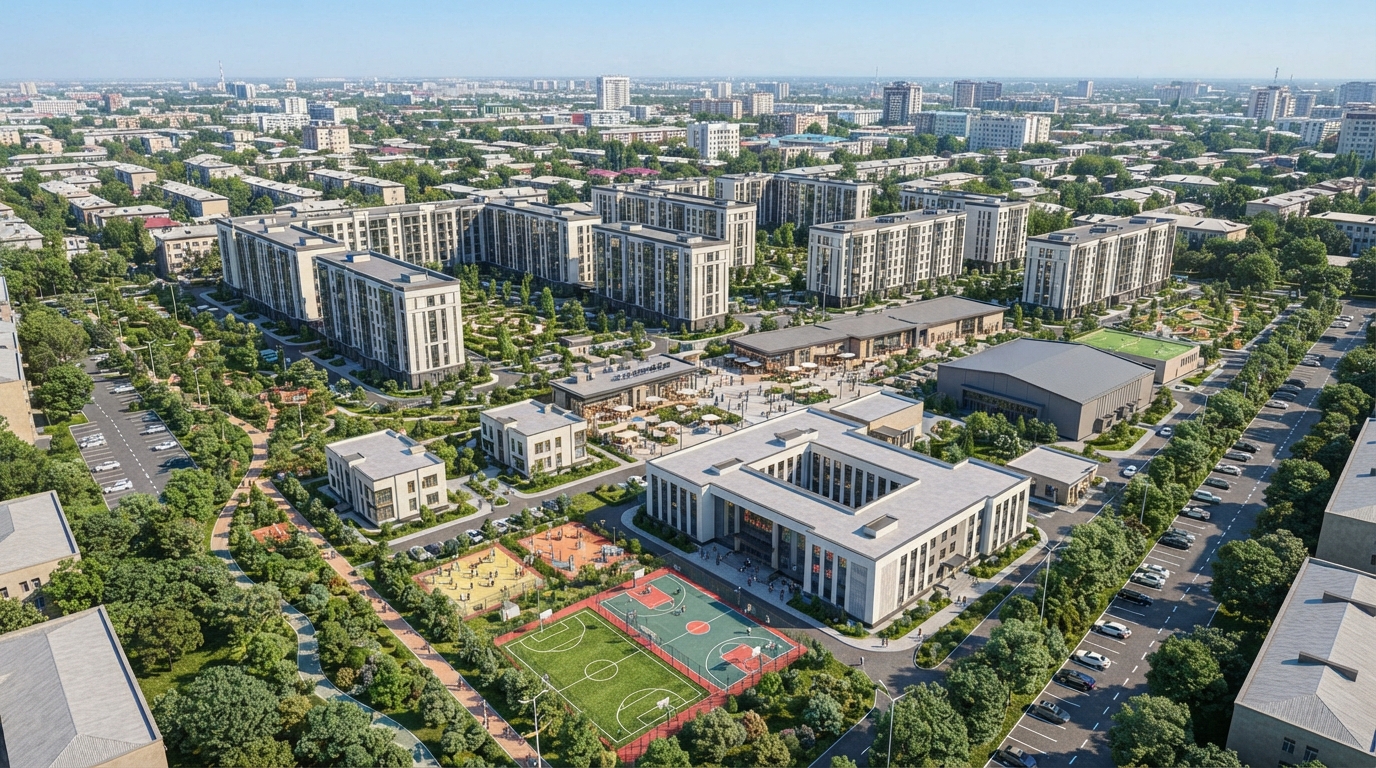
Shavkat Mirziyoyev was presented with a project for the comprehensive renewal of the Vatandosh, Mohinur, Al-Bukhari, and Tong neighborhoods in the Yashnabad district. The project is based on the "15-minute neighborhood" principle. According to it, essential trade and consumer services, educational and medical institutions, and recreation and sports facilities will be located within a convenient distance for the residents.
Projects on the development of neighborhoods and social infrastructure in Tashkent were presented to the President
A project for the comprehensive renovation of the Vatandosh, Mohinur, Al-Buxoriy, and Tong neighborhoods in the Yashnabad district was demonstrated. Their total area is 75 hectares, and 18,386 people live here.
The project is based on the "15-minute neighborhood" principle. According to it, necessary retail and consumer services, educational and medical institutions, recreation and sports facilities for the population will be located at a convenient distance for people.
It is planned to expand green areas in the territory, construct a three-kilometer promenade, update children's and sports playgrounds, and build a multi-purpose sports facility. It is also envisaged to create 2,000 additional student places by expanding existing schools, as well as to establish four kindergartens with a capacity of 540 places and three polyclinics.
It was proposed to place cars outside the courtyards in the neighborhoods, renovate public transport stops, and build safe pedestrian and bicycle lanes. In addition, it is planned to renovate the exteriors and engineering networks of 76 houses, illuminate streets, and increase the number of waste collection points. Retail and service facilities, cafes, and places for residents to communicate and relax will be established.
Based on the "15-minute neighborhood" principle, 100 neighborhoods in the capital will be comprehensively renovated in 2027, and 400 neighborhoods by 2030. In this process, all infrastructure in these neighborhoods, including heating, drinking water, sewage, electricity, gas, and lighting systems, facades of multi-apartment buildings, roads and sidewalks, children's and sports playgrounds, will be completely renewed. The number of trees and shrubs per capita in neighborhoods will be brought into line with international standards.
By 2030, 130,000 new jobs will be created in 400 neighborhoods, particularly 22,000 in 100 neighborhoods in 2027. For this purpose, a system for developing and launching "conveyor" projects by banks will be established.
With the growth of the population in the capital, the shortage of student places is also increasing. While it stood at 141,000 in the 2025-2026 academic year, it could reach 212,000 by the 2030-2031 academic year due to an increase in the number of students by 71,000 (14 percent) over the next five years. Therefore, it is planned to create 48,000 new student places at the expense of the republican budget and 78,000 at the expense of the local budget by 2030. As a result, the load factor of schools will decrease from the current coefficient of 1.4 to 1.2 in 2030.