

In 10 years, 13 new schools have been built in Tashkent. The Khokimiyat plans to accelerate the creation of student places
From 2017 to 2026, 13 new schools have been built and are planned in Tashkent, with 7 of them built in 2021. Against the backdrop of rapid growth in the number of students, the authorities intend to transition to creating at least 15,000 new student places annually. According to the khokim, the shortage of schools and kindergartens can be eliminated within three years.
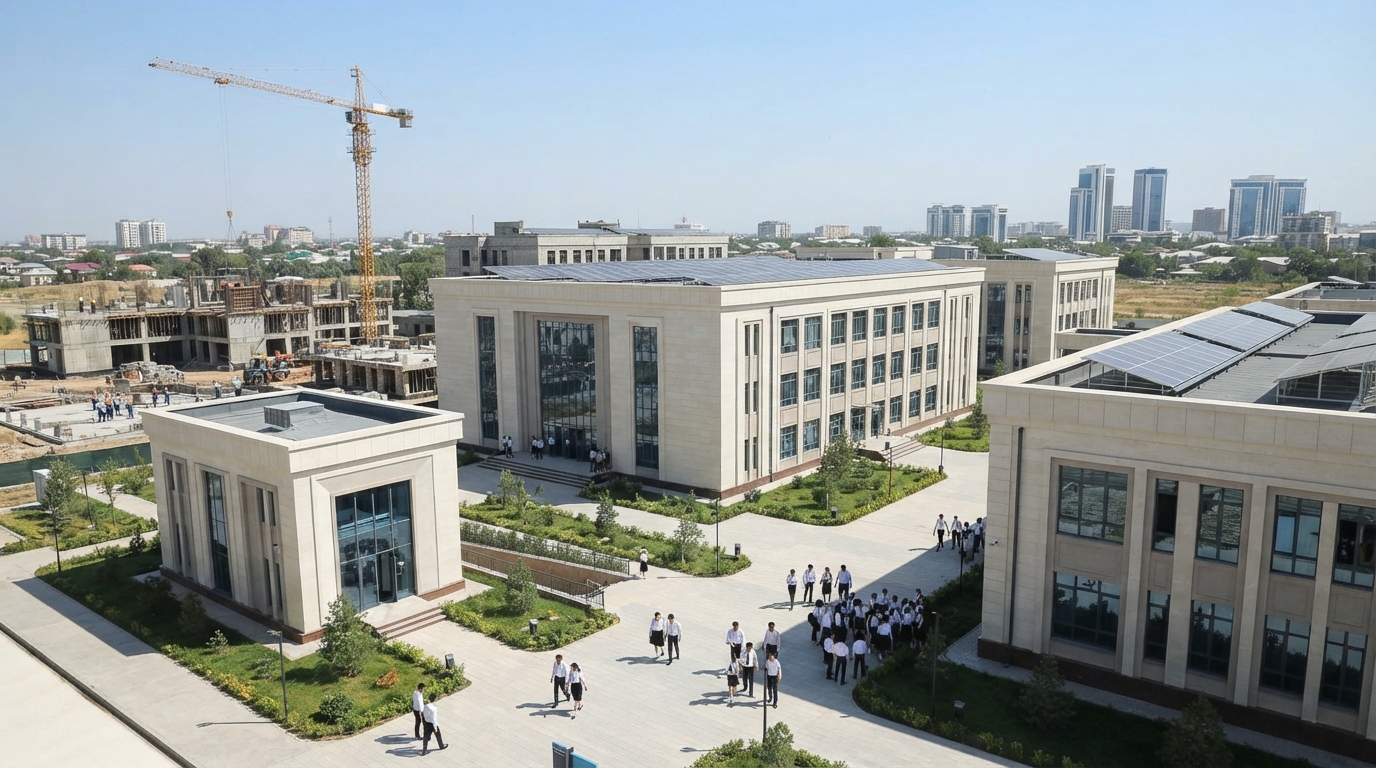
Over 10 years, 13 new schools have been built in Tashkent. The Khokimiyat intends to accelerate the creation of student places
The Khokim of Tashkent, Shavkat Umurzakov, stated in an interview with "Gazeta" that if the outlined plans are implemented, the shortage of schools and kindergartens in the capital could be eliminated in about three years.
At the end of 2025, the President noted that Tashkent still lacked 75 schools. Shavkat Umurzakov explained how the capital intends to close this deficit.
According to data provided by the khokimiyat to the editorial office, from 2023 to 2026, only six new schools have been built or are planned under the construction program across the capital's 12 districts: two in the Bektemir district and one each in the Mirzo-Ulugbek, Sergeli, Yashnabad, and Yangikhayot districts.
Looking at a longer period, 13 new schools were built in Tashkent between 2017 and 2026. Moreover, more than half of them — 7 — were built in the single year of 2021. According to the khokimiyat's data, no new schools were built in 2017–2020 and 2022. One school appeared in 2023 and another in 2024, two in 2025, and two more are planned under the program for 2026.
The distribution by district was also uneven. Of the 13 schools, five are located in the Yangikhayot district, three in the Bektemir district, two each in the Mirzo-Ulugbek and Yashnabad districts, and one in the Sergeli district. In the Mirabad, Almazar, Uchtepa, Chilanzar, Shaykhantakhur, and Yunusabad districts, no construction of new schools was recorded in the provided data for this period.
Umurzakov emphasized that when assessing the deficit, one should look not so much at the number of schools, but at the number of student places being created.
"You are talking about 75 schools. But a school can be designed for 500, 600, or 1,000 students. Our projects, in my opinion, are very effective in terms of both price and quality, and the infrastructure for students in new schools and kindergartens must be modern," he said.
According to him, in the first stage, the authorities selected one facility in each district.
"And here, the number of buildings is not what matters. One could say we lack 75 schools, but 75 small schools will not yield 75,000 places. Meanwhile, we can build 50 schools and achieve a capacity of 75,000 places," the khokim noted.
Data on the number of student places allows for an assessment of the scale of the accumulated load.
In 2017, 388,402 children studied in the capital's schools; in 2025, the figure was already 562,053. Thus, over eight years, the number of students grew by 173,651 people, or nearly 45%.
At the same time, estimates of the number of additionally created places differ. According to the Tashkent Khokimiyat, 69,582 places were created between 2017 and 2026 through reconstruction and the construction of new schools. The National Statistics Committee cites a higher figure — 94,500 places.
Even taking the higher figure from the National Statistics Committee, the number of created places accounts for about 54% of the student population growth between 2017 and 2025. According to the khokimiyat's data, it is about 40%.
"Now we have concrete projects: the plots and building footprints have been determined, feasibility studies have been prepared — figuratively speaking, 'the pegs have already been driven in,' and it is clear exactly where to build. Projects for schools for 15.5 thousand children are ready, and the money for them is already there — each district has its own funds."
In addition, according to him, projects for 13 kindergartens with a total capacity of 6,000 places have been prepared. Tender documentation is currently being finalized.
The khokim reported that districts must now direct the funds they earn toward their own infrastructure. Formally, the money passes through the general city budget, but the funds earned by a specific district are returned to it.
"If the capacity utilization rate in some district is high, the district can say: I need to build four schools and four kindergartens, or six kindergartens of such-and-such capacity," he explained.
At the beginning of 2026, according to Umurzakov, about $100 million was reserved for schools, kindergartens, and sports schools.
This year, about 15,000 additional student places are planned. Next year, the khokim expects to increase this volume.
"If this year we allocated money for about 15,000 additional places, next year I do not intend to stop at just those 15,000. The plan is another 15,000–20,000. We will not mix next year's funds with this year's: we started building this year, and next year we add a new volume. Therefore, every subsequent year it will definitely be no less than 15,000, possibly 20,000–25,000 places."
At the same time, the khokim noted that this is not about children who currently have no access to school at all, but about reducing the load and improving learning conditions.
"Our children are not left out on the street; everyone is studying. This is about improving conditions and quality. I think in three years we will be able to significantly improve the situation," he said.
Despite the rapid growth in the number of students, the khokimiyat's data shows a decrease in average class sizes in most districts compared to the beginning of the presented series.
In the Almazar district, the figure changed from 33 students in 2018 to a planned 32.9 in 2026; in the Bektemir district, from 34 to 31.2; in the Mirabad district, from 34 to 32.3; in the Mirzo-Ulugbek district, from 34 to 31; in the Chilanzar district, from 33 to 31; and in the Yunusabad district, from 34 to 31.
The lowest planned figure for 2026 is in the Yakkasaray district, at 29.2 students per class. The highest is in the Yashnabad district, at 33.8. In the Yashnabad and Yangikhayot districts, the average class size by the end of the presented period is, conversely, higher than the initial level.
In certain years, the data deviated noticeably from the general trend: for example, in the Shaykhantakhur district, the figure reached 43.3 students per class, and in the Yakkasaray district, it reached 39.8, while in the Yashnabad district, it dropped to 25.8.
Separately, the khokim answered questions about preschool infrastructure. According to the khokimiyat's data, from 2023 to 2026, preschool enrollment coverage decreased in 11 out of 12 districts. In the Sergeli district, it dropped from 125.3% to 75.1%; in the Yakkasaray district, from 124% to 96.8%; and in the Bektemir district, from 115% to 74.8%.
Umurzakov called a coverage rate of at least 90% optimal.
"No less than 90%. Ideally, 100%. The President also sets the task of bringing coverage to 100%," the khokim said.
However, according to the planned targets for 2026, only two districts exceed the 90% mark — Yakkasaray (96.8%) and Mirzo-Ulugbek (92.1%).
The lowest coverage is expected in the Shaykhantakhur district — 57.9%. This is followed by Yangikhayot at 68.1%, Yunusabad at 70.5%, Almazar at 73.1%, Yashnabad at 74.1%, and Bektemir at 74.8%.
At the same time, longer-term dynamics show that the situation varies by district. For example, in the Sergeli district, the figure at the beginning of the presented series was 66.4%, then exceeded 100%, and by 2026 is expected to be at 75.1%. In the Yashnabad district, for which data has been available since 2023, the figure rose from 48.5% to 74.1%. In the Yakkasaray district, despite a decline from its recent peak, the planned 2026 figure of 96.8% remains higher than the 2018 level (91.4%).
The khokim himself admitted that the capital's infrastructure does not yet match the pace of its development.
"But your initial question was very accurate: is the infrastructure keeping up with the rapid development of Tashkent? Not yet. There is a lag. We need not only to stop the growth of this lag but also to catch up with the demand," he stated.
According to Umurzakov, the authorities also conducted an experiment in 12 schools: they organized extra classes in eight subjects for selected high school students, paying for the children's meals and the teachers' extra work from local budgets.
Following this, he noted, the authorities concluded that new schools need to be built not only to reduce the load but also with a view to improving the quality of education.
"That is, if you put in the work, it is possible. After that, I said: we need to build schools not just for the sake of reducing the capacity utilization rate, but with a view to the quality of education. If, God willing, all these ideas work, I think in about three years we will be able to eliminate the shortage of schools and kindergartens," the Khokim of Tashkent stated.
In addition, the khokimiyat proposes outsourcing facility maintenance and catering services in the new schools. Another proposal is to involve specialists from Estonia and Finland and hand over the management of the educational process in the 12 schools under construction to them.
In the future, according to Umurzakov, this model is expected to be extended to other public schools as well.
At the beginning of the month, the construction of 12 modern schools was launched in Tashkent. The project is being implemented jointly with the company BI GROUP. By the beginning of the next school year, 18,000 new student places should be created. Additionally, a project for the construction of 16 modern kindergartens has been developed.