

**Preserving Agency**
On October 9, 2026, a CIS summit was held in Turkmenistan, timed to coincide with the 35th anniversary of the organization's creation. The discussion focused on a wide range of topics: the preliminary results of the Turkmen chairmanship, Uzbekistan's plans for 2027, security issues, the promotion of a positive image of the Commonwealth, and interaction with countries that are not part of it. For the first time, Iranian President Masoud Pezeshkian, whose country has been under massive military pressure from the United States since February, participated in the summit.
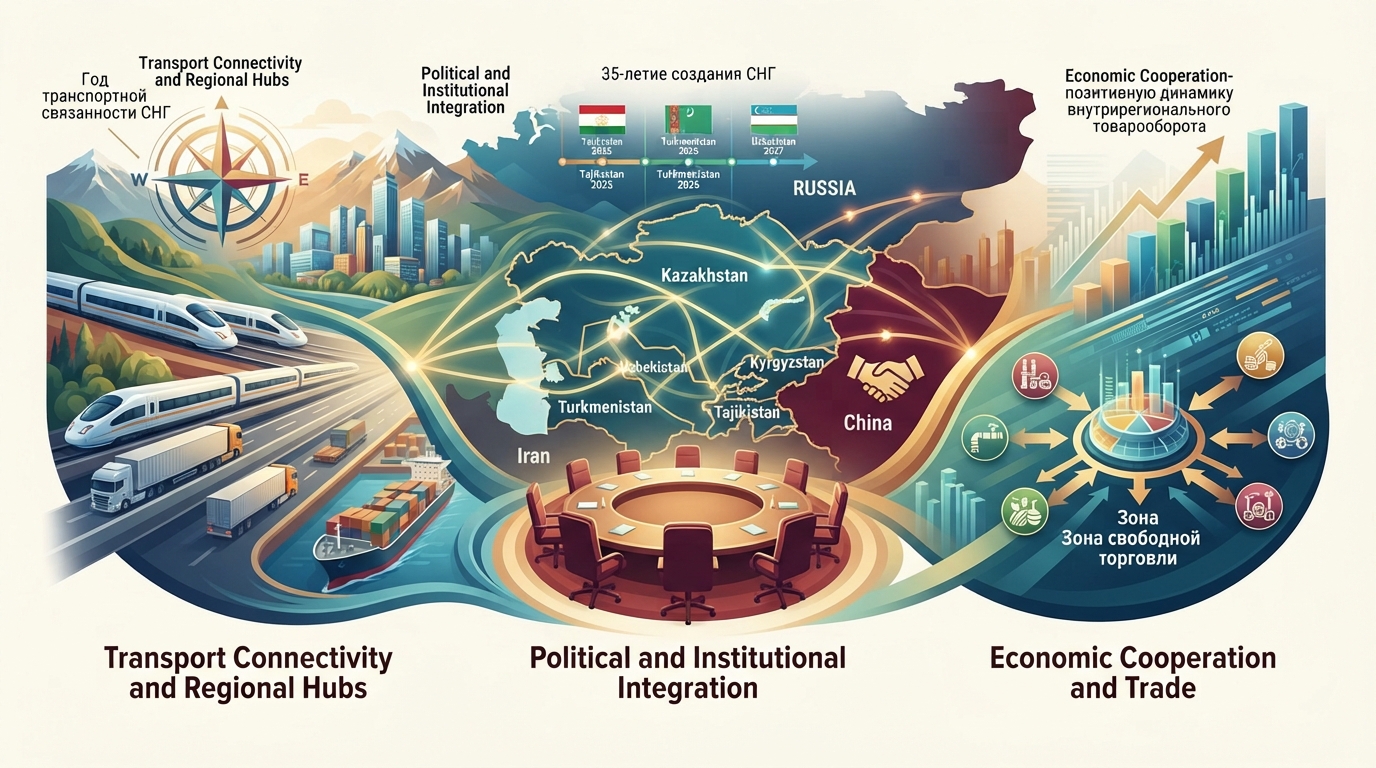
Today, in the CIS, Central Asia is perhaps the region most oriented towards preserving integration imperatives. All five states participate in annual summits and actively support the integration agenda, while simultaneously acting as actors of their own regional integration. The 35th anniversary of the creation of the CIS, celebrated in 2026, is accompanied by a new quality of interaction with Central Asia—the "five", compared to other regions of the CIS, are characterized by greater agency and integrity.
The growth of the agency of Central Asian countries is explained by many factors related both to domestic political processes in a number of countries and to external circumstances, primarily geopolitical tensions that intensified in 2022. The freezing of Russia's relations with Western countries became an incentive for the development of such areas in Central Asia as information technology and transport and logistics projects. Against the backdrop of growing competition between transport corridors, Central Asia has all the conditions to become a major regional hub for transit flows from East to West. In certain cases, the CIS acts as an alternative platform for Eurasian integration. Thus, the CIS free trade area, the agreement on the creation of which entered into force in 2012, saves non-EAEU countries such as Uzbekistan and Tajikistan from the need for full joining the Eurasian Economic Union, since elements of a common market and coordinated policy in certain industries already operate in the CIS FTA, albeit not without difficulties.
It is revealing that the chairmanship of the CIS has been marked by Central Asia for three consecutive years. In 2025, Tajikistan was the chairman of the Commonwealth, in 2026 Turkmenistan headed the CIS, and in 2027 the chairmanship will pass to Uzbekistan.
In the year of the Tajik chairmanship, the Shanghai Cooperation Organization received observer status with the CIS, and at the initiative of Kazakhstan in the same year, the CIS+ format was created, which implies interaction of the Commonwealth with other states, associations, and international organizations. President of Kazakhstan Kassym-Jomart Tokayev has repeatedly emphasized that Kazakhstan is a "consistent advocate of stepping up the Commonwealth's international contacts" and sees the goal as turning the CIS into a "space of creation and progress." In 2026, Astana also chairs EAEU structures, which strengthens its role as a connecting link between various integration projects in the post-Soviet space.
Under the chairmanship of Turkmenistan, which is not among the full members of the Commonwealth, but has the status of an associate member (which allows for chairmanship, but limits voting rights in statutory bodies), several notable initiatives were also put forward and a whole range of events was held. The agenda of the Turkmen chairmanship included issues of expanding trade and economic cooperation, transport and logistics projects, and the implementation of artificial intelligence. Among the most notable initiatives are the declaration of 2027 as the "Year of Transport Connectivity of the CIS", holding the Second Caspian Environmental Forum in 2026, as well as a series of international events in the field of healthcare in the Turkmen city of Avaza in the autumn of 2026. Special attention should be paid to the connectivity initiative, which is associated with Turkmenistan's growing interest in regional transport and logistics projects and the desire of the country's leadership to become one of the multimodal hubs in the region. At the same time, despite its status as chairman in the CIS, Turkmenistan still emphatically adheres to a policy of neutrality, without joining any of the associations in the Commonwealth.
Tashkent intends to focus on the "continuity of integration initiatives and the implementation of previously adopted strategic decisions." In particular, this refers to the "Strategy for Economic Development of the CIS until 2030," adopted during the previous chairmanship of Uzbekistan in 2020. The document recognizes the diversity of interests of the Commonwealth participants and the associated multi-speed integration in the post-Soviet space (noting the role of the EAEU and the SCO) and names as goals for the declared period the development of national economies and increasing their sustainability, deepening industrial and technological cooperation, increasing the level of security (in the economy, energy, ecology) and other areas.
Uzbekistan is actively expanding its presence in CIS bodies: by 2026, the country is represented in 51 out of 66 sectoral cooperation structures. In 2024, Tashkent became the first Youth Capital of the CIS, in 2025 it hosted the first Forum of Regions of the CIS Member States, and in 2026—the "INNOPROM" International Industrial Exhibition.
The role of the CIS for Kyrgyzstan is determined by economic opportunities (for example, participation in the Agreement on a Free Trade Area and the initiative on an Agreement on Free Trade in Services), transport and logistics factors (promoting the regional connectivity agenda relevant to the country due to its geographical location at the crossroads of transport corridors), and institutional aspects (during Kyrgyzstan's chairmanship of the CIS in 2023, initiatives were proposed to draft a Concept of Cooperation in Energy until 2035, a Concept for the Development of Industrial Cooperation until 2030, as well as to create a Council of Chairmen of Supreme Courts of the CIS and a number of others). In 2026, Kyrgyzstan chairs the SCO and, taking into account the deepening of integration between the CIS and the SCO, Bishkek can, thanks to the accumulated experience, act as a connecting link between the two platforms. The republic's economy is demonstrating high growth rates: according to the results of January–July 2026, Kyrgyzstan's GDP grew by 11%, which became the highest figure among all CIS states.
**What trade statistics say**
The preserved interest of Central Asian countries in the Commonwealth is manifested not only in political initiatives. Official statistics on the CIS confirm the positive dynamics of intraregional trade turnover, which, despite the presence of parallel integration platforms, preserves a certain attractiveness of the Commonwealth for the Central Asian "five". Data show growth in intraregional trade turnover: for Kazakhstan with the CIS countries in the first half of 2026, it amounted to $23.05 billion (+10% compared to the same period in 2025), for Uzbekistan—$18.3 billion (+23%), for Tajikistan—$3.609 billion (+24%), for Kyrgyzstan—$3 billion for January–May (+10%), for Turkmenistan—$1.8 billion for the first quarter (+30%).
The interest of Central Asian countries in building up trade within the post-Soviet space, certainly, persists. However, if you look at the country-by-country breakdown, it becomes clear that Russia remains the undisputed leader among trade partners for most of the "five" countries in the CIS, with which such a noticeable increase is recorded. For other countries of the Commonwealth, the indicators are within the margin of error. In other words, Russia still acts as an economic driver in the CIS for Central Asian countries, while China most often remains the second leading trade and economic partner, and in certain cases the first. Despite the growth of trade with CIS countries, the share of the Commonwealth in the foreign trade turnover of Central Asian countries remains not too high, and the main focus is placed on extraregional actors (with the exception of Russia and intraregional links, for example Kazakhstan–Uzbekistan, Kazakhstan–Kyrgyzstan).
Thus, in addition to Russia, the main trade partners for one of the leaders of post-Soviet integration—Kazakhstan—in the first half of 2026 were China, Italy, Turkey, and Germany. For Uzbekistan, China remains the undisputed leader in the same period, second place is occupied by Russia, followed with a noticeable gap by Kazakhstan, Turkey, Afghanistan, the Republic of Korea, and other countries outside the CIS.
***
Thus, post-Soviet integration in the CIS format for Central Asian countries still remains attractive, although a certain economic imbalance persists. The countries of the region actively participate in the flagship events of the Commonwealth, host heads of state and government, emphasize the significance and relevance of this format, focusing on agenda items relevant to themselves (economic development—Uzbekistan, expanding partnership with other centers of power and associations—Kazakhstan, regional connectivity—Turkmenistan). Moreover, the CIS still remains a platform for Central Asian countries to align watches not only with Russia (for this, another format, "C5+1", which has become a brand for the region, is already operating, within which two "Russia-Central Asia" summits have taken place since 2022), but also with other countries of the post-Soviet space. Besides the CIS, there is no other platform in the post-Soviet space where all Central Asian countries, all partners in Eurasian integration, and SCO participants from among the post-Soviet republics simultaneously participate.
Undoubtedly, for each country in Central Asia, the significance of the CIS today can be assessed differently. While for Uzbekistan and Tajikistan this is largely a way to compensate for the lost opportunities of regional cooperation provided by Eurasian integration, for Kazakhstan, as one of the leaders of post-Soviet integration, the CIS remains an important symbol of preserving this imperative. For Kyrgyzstan, the Commonwealth provides an opportunity to enhance its institutional role in the post-Soviet space, and for Turkmenistan, taking into account its concept of permanent neutrality, participation in the work of the Commonwealth allows it to promote an agenda relevant to itself (the Caspian, transport connectivity) in a broader format.
In other words, 35 years after its creation, the CIS still concentrates around itself many issues that remain relevant and understandable precisely for those countries that once constituted a single state and have not yet lost a certain economic and political commonality. Despite the fact that today the countries of Central Asia are actively joining parallel integration structures, developing international contacts in the spirit of multi-vector policy, and also building their own intraregional project in the format of Consultative Meetings, the CIS nevertheless retains the ability to respond to Central Asia's requests to solve individual current tasks and act as a connecting link with partners in the post-Soviet space.