

"People with disabilities need support, not guardianship." Expert opinions on depriving people with disabilities of their legal capacity
The legislation of Uzbekistan allows for the complete deprivation of legal capacity, which contradicts the UN Convention on the Rights of Persons with Disabilities. The issue of stripping people with disabilities of their rights and models of support instead of guardianship were discussed at the Samarkand Human Rights Forum. Gazeta has compiled the key points made by the experts.
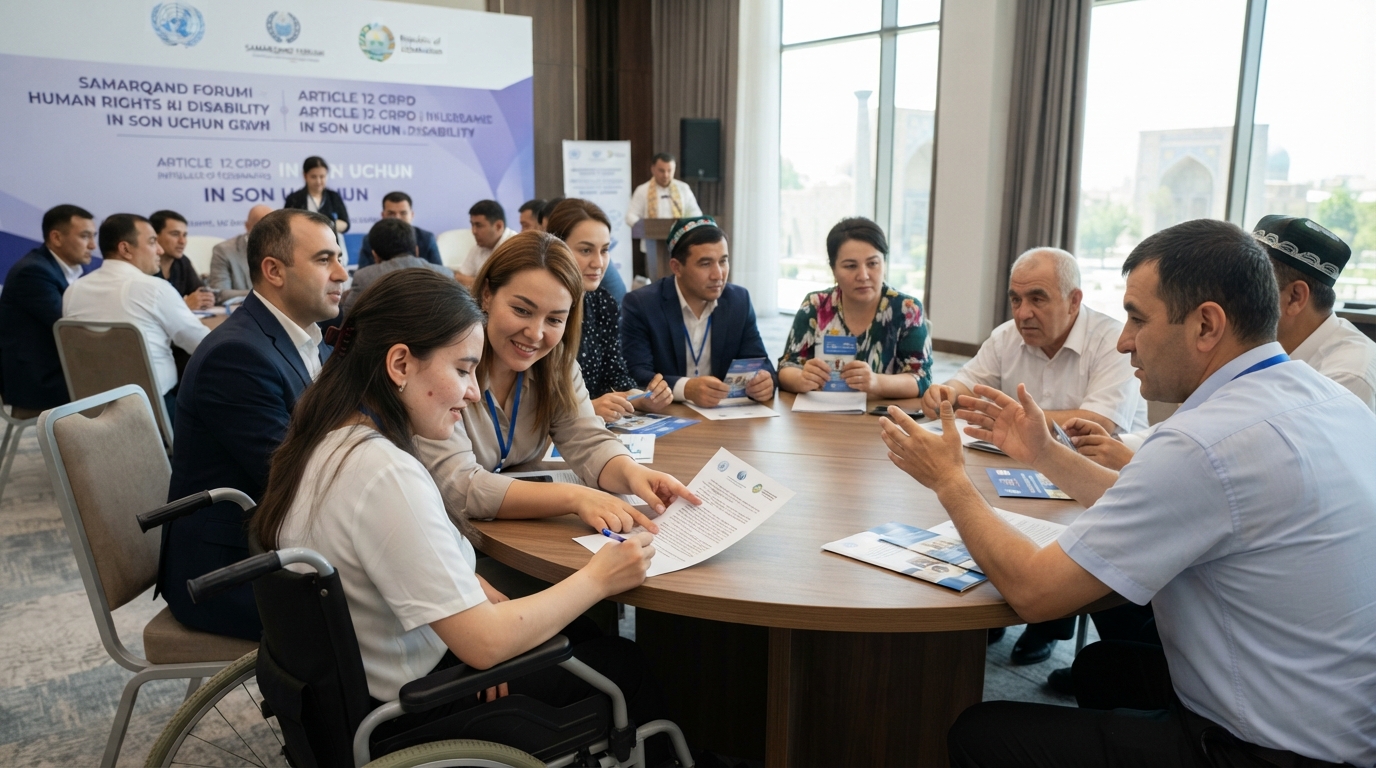
"People with disabilities need support, not guardianship." Expert opinions on the deprivation of legal capacity of people with disabilities
Uzbekistan's legislation allows for the deprivation of legal capacity by court decision, which does not comply with Article 12 of the UN Convention on the Rights of Persons with Disabilities. This was stated by Yanina Arsenyeva, an international expert on disability issues, at the Samarkand Human Rights Forum, which took place on September 28–29 in Tashkent.
Article 12 is dedicated to the right of an individual to make legally significant decisions independently.
The session was co-chaired by Jasur Jumaev, a deputy of the Legislative Chamber of the Oliy Majlis, and Ennio Boati, OHCHR Regional Representative. Jumaev recalled that the law on the rights of persons with disabilities was adopted in 2020, and Uzbekistan ratified the convention in 2021.
According to him, in the elections to the parliament and local Kengashes, for the first time in the country's history, 138 people with disabilities became deputies, three of whom work in the Legislative Chamber. More than 1.06 million people with disabilities live in the country.
Boati suggested not trying to cover the entire convention, but rather focusing the discussion on Article 12. He emphasized that it concerns not only people with intellectual or psychosocial disabilities.
"Article 12 applies to all people with disabilities. Simply put, legal capacity is a person's ability to make decisions that are recognized by law and have consequences for their life. These are decisions about health, money, property, education, family life, social services, and much more," said Ennio Boati.
Support, according to him, is not the same as making decisions for a person. It helps them understand information, weigh options, and express their will. This can include accessible information, communication assistance, sign language interpretation, reasonable accommodation, or assistance from a trusted person.
Commissioned by the OHCHR, Yanina Arsenyeva studied the application of Article 12 in Uzbekistan. The study will be completed soon. She recalled how the convention was created.
"Article 12 is famous for being the most radical and even revolutionary article of the convention. When UN member states met in New York 20 years ago to draft the text of the future convention, Article 12 was the last one they agreed upon. Because it absolutely radically changes the approach to disability," Arsenyeva shared.
Historically, the issue of legal capacity, according to the expert, is common to all countries. People with disabilities are often placed in institutions indefinitely, without the opportunity to challenge the decision. They are subjected to forced treatment, and sometimes to treatment that, as she noted, reaches the threshold of cruel treatment or torture. Managing money, starting a family, and raising children are handed over to third parties.
Yanina Arsenyeva noted that decisions are made on behalf of a person not only out of best intentions: it may be convenient or profitable for a guardian, and sometimes they are driven by personal interest or revenge. For example, a guardian who finds a relative to be a burden but enjoys receiving their pension might place them in a residential care facility or support them with very little money. Deprivation of legal capacity is often described as "civil death."
"Often such decisions are made, so to speak, in the best interests of the person. That is, guardians and the state make these decisions because it seems to them that the person is unable to do it themselves. Instead of providing support, legal capacity is simply stripped away," she noted.
The study showed that in Uzbekistan, deprivation of legal capacity is permitted, and the legislation does not comply with Article 12. The expert highlighted three forms of violation.
The first is formal deprivation of legal capacity.
Under the Civil Code, a court can declare a person legally incompetent; most often this applies to people with intellectual or psychosocial disabilities. A guardian is then appointed. The person cannot vote, marry, decide where and with whom to live, or how many children to have. Meanwhile, the scale of the problem is unknown.
"I reviewed Uzbekistan's report to the UN Committee on the Rights of Persons with Disabilities, but it does not mention figures: how many people have been deprived of legal capacity, for what reasons, for what period, whether legal capacity is ever restored to people or not. This data simply does not exist, at least not in the public domain," the expert shared.
Arsenyeva suggested that the Ministry of Justice might keep these records and expressed hope that this data would be presented during the defense of the report at the UN.
The second form of violation is restrictions "under the guise of protection."
"A person with a disability is legally fully capable. But because of their disability, some additional requirements are imposed on them that are not provided for by law," Arsenyeva said.
She cited a case that received publicity this summer. A blind man came to a notary in Tashkent to draw up a power of attorney; he was refused and asked to bring people from the society of the blind. According to Arsenyeva, the law does not provide for this; the requirement is contained in the notary instructions of the Ministry of Justice. In her assessment, they violate not only the convention but also national legislation. Security guarantees are needed to ensure that a person signs the correct document, but they must protect autonomy, not strip it away.
The third form is when legal capacity exists on paper, but cannot be exercised due to inaccessibility. A person in a wheelchair cannot enter a notary office without a ramp or go upstairs where there is no elevator. A deaf person is not provided with a sign language interpreter in court and has to pay for one themselves. Blind people are not provided with documents in an accessible format. A person, according to her, will most often find a way out if they really need to, but she called the very situation in which they are forced to look for workarounds a violation of rights.
Separately, the expert gave an example involving medical care. A deaf woman who wants to have a confidential medical abortion will still need to come to the appointment with a trusted person to help with communication — most often a family member, because relatives know sign language better than others. As a result, the privacy of the appointment will be violated — as will the right to confidential medical care.
Yanina Arsenyeva proposed a step-by-step approach to correct the current state of affairs, since reform is impossible in one day, and perhaps even in ten years.
"These are very complex issues, and most often, in the initial stages, they cause some rejection from almost everyone, including representatives of ministries of justice, courts, and parliament. 'We have always done it this way, we have always had the institution of guardianship, we don't know how it can be done differently. How can a person with Down syndrome go to vote, how can a person with a mental disability make decisions? They are dangerous, they cannot be trusted!' The stigma exists everywhere, all over the world, not just in Uzbekistan," the expert emphasized.
The first step proposed by Yanina Arsenyeva is data.
Independent monitoring of the scale of the problem is needed by trained bodies and human rights organizations with the participation of people with disabilities. In parallel, according to her, discriminatory instructions and conditions, for example, at notaries, can already be identified and eliminated. Reasonable accommodation and accessibility are often not provided because no one thought about them, and there are no sanctions or funding, the expert noted.
The second step is to create a circle of people who will promote the reform.
Currently, too few people are dealing with issues of legal capacity; activists and experts with disabilities, as well as organizations representing people with intellectual and psychosocial disabilities, are needed. It is necessary to involve judges, notaries, law enforcement officers, social support specialists, and families in which people without legal capacity live. At the same time, according to her, resistance can be strong: this is a new and difficult issue for the country.
The third step is a support system.
Arsenyeva named possible forms: organizations of people with disabilities, "Inson" centers, trusted persons, specialists, family members.
It is important that the forms of support are in accordance with the preferences of the person with a disability themselves. Perhaps, due to some family conflicts, they would not want a relative to support them. Then it should be someone whom the person with a disability trusts, with whom they can communicate, and who knows the issues on which support is needed.
The task of the supporter, she explained, is to help obtain and understand information, consider options, make a decision, and formalize the will of the person with a disability, rather than deciding instead of them. The social support system in Uzbekistan is developing rapidly thanks to the creation of the National Agency for Social Protection and "Inson" centers, but, according to her, they should not be the only mechanism.
Answering a question about possible corruption risks when replacing guardians with "legal assistants," the expert emphasized: the risks of abuse are significantly higher under the current system.
"Now, if I am deprived of legal capacity and a guardian is appointed, they decide absolutely everything for me: from going on vacation and everyday trifles like breakfast to issues of residence and medical intervention," Arsenyeva explained.
Supported decision-making, on the contrary, narrows the range of issues in which the assistant is involved. The current control mechanisms in Uzbekistan are prescribed in the Law "On Guardianship and Trusteeship," but they apply only to the guardianship system. People who formally remain legally capable but need help are currently deprived of both support and legal guarantees.
The full list of laws requiring revision will be included in the final report. According to the expert, the reform must begin with the Civil Code and judicial procedures, after which all legislation should be gradually adapted.
There is no single universal solution here: "there are as many options as there are countries." In some states, the article on guardianship in the Civil Code is replaced by the right to support, in others, a separate law is adopted. At the same time, support must be provided at the choice of the person themselves, for a specific period, and strictly on specific issues.
However, changing the laws alone is not enough — training specialists and implementing practices taking into account local specifics are necessary. In Uzbekistan, the expert noted, the mahalla system, where the needs of specific households and recipients of social assistance are well known, could become such a pillar.
Lyazzat Kaltayeva, elected member of the UN Committee on the Rights of Persons with Disabilities for 2027–2030, recalled the committee's interpretation of Article 12: disability, including intellectual or psychosocial, should not be a ground for deprivation of the right to make decisions. If a person needs help, the state must provide support in exercising legal capacity, rather than transferring the right to decide to another person.
According to her, the abandonment of the "all or nothing" system, where a person is either fully capable or completely deprived of rights, began at the end of the 20th century. With the adoption of the convention in 2006, it grew into a global reform. Lyazzat Kaltayeva described several models.
"Back in 1992, Germany completely eliminated the institution of deprivation of legal capacity, and instead of a guardian who decides everything for a person, the court appoints a legal assistant. The person retains their status of legal capacity, and the assistant is appointed only for specific areas of life in which the person cannot cope. For example, only financial management or only health issues. In other areas, the person makes the decision themselves," Lyazzat Kaltayeva said.
In Sweden, the institution of a "invited friend" (godman) requires the consent of the person themselves; the assistant acts as an advisor and helps pay bills, conduct business, and sign contracts. If the person does not make contact and may harm themselves, a manager (förvaltare) is appointed, but even then, the restrictions are strictly limited in time and scope.
In the UK, the Mental Capacity Act is in force, where capacity is assessed for each specific decision. A person may not understand the terms of a mortgage, but they can decide with whom to live and communicate. The law prohibits declaring a person incapable solely because of a diagnosis, appearance, or behavior that seems foolish to others.
In the Czech Republic, the court cannot completely deprive a person of legal capacity, but only temporarily, for a maximum of 3–5 years, and sets a clear financial limit, for example, a ban on transactions above $500 without the assistant's approval.
In Lithuania, the possibility of complete deprivation of legal capacity was completely abolished in 2016.
The main criterion, according to her, is different: support should expand a person's independence, rather than create a new form of control over them.
Lyazzat Kaltayeva called protection against abuse a crucial part of the implementation of Article 12 and highlighted three key elements in it: separation of powers, external audit, and the priority of the person's own will.
In Germany, according to her, there are specialized guardianship courts, the assistant is not given universal rights, court permission is required for major transactions, and a detailed financial report is submitted annually.
In the UK, state supervision registers powers of attorney and acts, checks bank accounts and the living conditions of the ward, and the guardian is prohibited from making decisions in case of a conflict of interest, for example, selling an apartment to themselves or their relatives. In Sweden, independent protection institutions operate, and the period of guardianship is limited and reviewed.
"Unfortunately, in our countries, parents of very young children come to this decision themselves, or they are told that it is much more convenient to quickly declare the child legally incompetent so that it is easier to run around with some papers, receive social benefits, and so on. The restoration of legal capacity, unfortunately, is practically not considered. Sometimes it happens that a child grows up capable enough to make decisions in their own life, but they already have the status of legal incompetence," the specialist said.
Lyazzat Kaltayeva noted that the issue is broader than intellectual and psychosocial disability. A family may, for example, buy an apartment on the second floor or higher without asking a person in a wheelchair if it is convenient for them, or suggest moving to another city where they have no social circle. In Kazakhstan, according to her, the state pays an allowance for caring for a person with a group I disability, but does not check whether the family actually provides care, how often they go outside, and whether they communicate with anyone other than relatives.
Speaking about Central Asia, she said that the institution of guardianship is historically strong here, and the family remains an important source of support. This resource, according to her, needs to be preserved, but the line between support and making decisions instead of a person is very thin. Regional reforms, she believes, should not be reduced to copying European models: they need their own "ecosystem" of types of support, control, and choice.
"For girls and women with disabilities, restriction of legal capacity can have particularly serious consequences. Unfortunately, many studies show hidden, latent violence against girls and women with disabilities, including, and this is especially important, in closed medical and social institutions. Decisions are made for a woman in matters of marriage, family life, motherhood, reproductive health, medical intervention, and disposal of income and property," said Lyazzat Kaltayeva.
Therefore, according to her, a woman with a disability should always have the opportunity to receive support outside the family. Kaltayeva suggested moving from the question of who has the right to decide for a person to the question of what needs to be done so that a person can make and implement their own decisions.
Ural Khudayberdiev, head of a department at the Ministry of Preschool and School Education, dedicated his speech to the fact that Article 12 cannot be implemented without education: a person must know their rights.
According to his data, as of September 15, 2026, there are more than 10,100 general education schools in the country, and inclusive education has been introduced in more than 3,500 of them. In the preschool system, it was launched on January 1, 2025: in 248 kindergartens, it covers more than 1,700 children.
According to the National Agency for Social Protection and "Inson" centers, with which the ministry cooperates, there are more than 142,000 children with disabilities in the country. More than 123,000 (87%) are covered by education and services. Of these, more than 98,000 study in general education schools, including more than 10,000 under the inclusive model, more than 16,000 in special schools, and more than 1,300 in special technical schools. About 7,000 children receive care and supervision services. Between 19,000 and 20,000 children remain without education.
Among the reasons why some children are not covered, Ural Khudayberdiev named the fear of families, especially in remote areas.
"We still have certain traditional ideas: a family is sometimes afraid to show a child with special educational needs and hides them. This is especially true for girls: if I take my daughter with a disability to a kindergarten or school, what will happen when it comes time to marry her off? Or if we show her now, how do we integrate her into society later?" the specialist said.
According to him, work is underway with partner organizations to overcome these fears, and educational institutions try to receive such children "with open arms."
"We still have specialists and managers who do not understand this policy. They are gradually becoming fewer. Honestly, there is no place for such people in our ranks," he said.
Khudayberdiev noted that changes in society and the education system will take several years, as well as cooperation with international experts and organizations supporting people with disabilities.
Oybek Isakov, Chairman of the Association of Disabled People of Uzbekistan, recalled that Uzbekistan ratified the convention with a reservation.
"A reservation is when a state cannot implement this article at the moment, but takes a time-out, time to prepare for its implementation. A reservation cannot be eternal," Isakov explained.
He divided Article 12 into two parts. The first says that even people recognized as legally incompetent have rights. The second is about what kind of support needs to be provided to all people with disabilities so that they can exercise their legal capacity.
Oybek Isakov explained the difference: legal capacity (pravo-sposobnost) is the possession of a right, which a person has even before birth, while legal capacity (deyatel-sposobnost) is the exercise of that right. For people with mental disabilities, it is limited; they cannot, for example, vote or dispose of property.
Oybek Isakov also called the inaccessibility of the environment discrimination: a person will not be able to vote at a polling station without a ramp, and in a school without an elevator, a child in a wheelchair will not receive an education. He called the state's main obligation under the convention financial. He often attends the state's reports to the UN committee, when officials talk about an accessible environment in all schools and government institutions.
"The official is asked: 'Do you have a program in the budget? Is there a separate line in the budget for creating an accessible physical environment?' If not, then everything you say in the report is equated to zero. Because obligations that are not backed by finances cannot be implemented," the chairman said.
The successes in inclusive education, according to him, are explained by the fact that a special fund has been created that finances the reconstruction of schools, the installation of ramps, toilets, lifts, and elevators. The fund, as Isakov said, appeared by the will of the director of the National Agency for Social Protection, an advisor to the president. Another minister who does not have such status has nowhere to get funds, so, he believes, the Ministry of Finance must provide the republican and local budgets for a barrier-free environment and inclusive education.
The second condition for the implementation of the convention is a change in public attitude.
"A civil servant boasts that they grant many benefits. But what is a benefit in general? A benefit is compensation for what the state cannot do. It cannot provide inclusive education — it gives a two percent quota for admission to universities. You cannot boast about benefits. When you say 'we give many benefits,' it means that you are doing nothing, so you compensate for it with benefits," Isakov believes.
The third proposal of the Association is related to Article 33 of the convention, which provides for a coordinating body.
"Until we establish this coordinating body, I think we will not be able to move further, forward. This is an obligation that the state has taken upon itself. And we propose, so as not to reinvent the wheel: we currently have an interagency council on disability issues. We could make it the coordinating body for the implementation of the convention," Isakov concluded.