

“There are many advisors, but few who defend in court.” How are the rights of persons with disabilities being protected?
Although the rights of persons with disabilities in Uzbekistan are guaranteed by laws, problems persist in their practical protection. According to activists, persons with disabilities face obstacles in court proceedings. As a solution, free legal assistance is being provided within the framework of the huquqplus.uz project.
“There are many advisors, but few who defend in court.” How are the rights of persons with disabilities being protected?
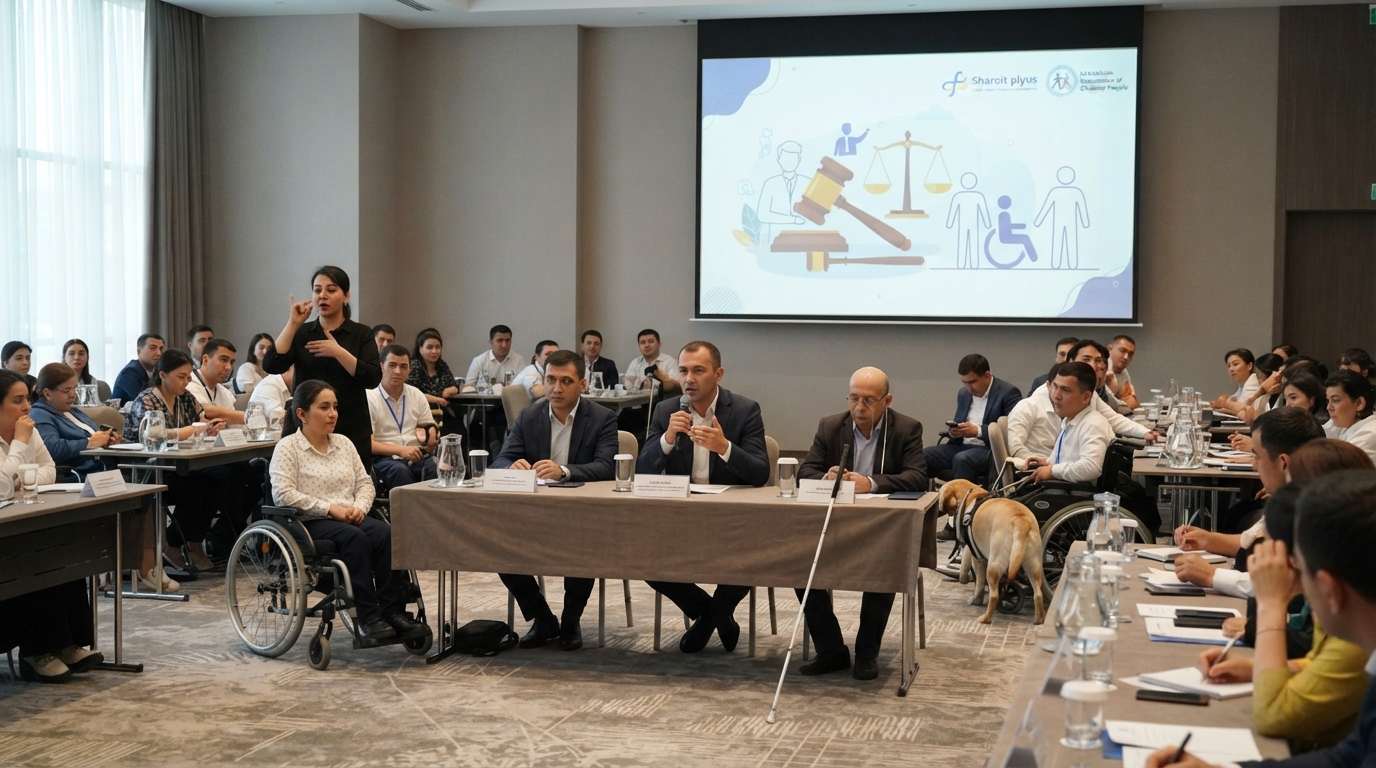
On September 29, a conference on the topic “Problems and solutions in the field of raising legal literacy of persons with disabilities and providing them with free legal aid” was held in cooperation with the Tashkent city public association of disabled people “Sharoit Plus” and the Association of Disabled People of Uzbekistan. Representatives of public organizations operating in the field of protecting the rights of persons with disabilities took part in it, a Gazeta correspondent reported.
It is noted that the number of officially registered persons with disabilities in Uzbekistan stands at 1,055,770 as of August 1, 2025.
Their rights and freedoms are enshrined in laws and other regulatory legal acts. In particular, in 2024, the Law “On the Rights of Persons with Disabilities” was adopted in a new edition. In 2021, the country ratified the UN Convention on the Rights of Persons with Disabilities. The rights of persons with disabilities were also specifically highlighted in the new Constitution. Nevertheless, a number of issues in this regard still remain unresolved.
According to Oybek Isaqov, Chairman of the Association of Disabled People of Uzbekistan, organizations helping persons with disabilities previously dealt mainly with humanitarian issues. After Uzbekistan ratified the UN Convention on the Rights of Persons with Disabilities in 2021, the legal aspect of protecting their rights became even more relevant.
“If our literacy is low, if we do not know the principles and articles of the convention, the requirements of the law, how will we protect the rights of disabled people, or how will they protect their own rights?” says Isaqov.
According to him, when determining disability, it is important to take into account not only a person's health but also the barriers in the environment where they live. Because the opportunities and barriers faced by two individuals with the same illness may differ depending on their living environment.
“For example, of two disabled people, one lives in a village and the other in a city. Their illness is the same, but the barriers they face are not the same. In the city, there is a barrier-free environment, transport is more or less available, while in the village, such opportunities may not exist at all,” he says.
Isaqov says that the new system of determining disability envisages taking such barriers into account. However, he notes that not all medical workers are equally aware of this procedure.
The chairman of the association stated that proposals are being put forward within the framework of lawmaking to ensure the rights of persons with disabilities in court.
According to him, in criminal cases, there is an opportunity to involve a defender at the expense of the state for certain categories of persons. The association proposes to introduce a similar mechanism for persons with disabilities in civil cases as well.
“There is an article in the convention called access to justice. Based on this, we propose to introduce a mechanism for involving a defender at the expense of the state in civil courts for persons with disabilities as well,” says the chairman of the association.
Isaqov notes that the state fee is also one of the factors preventing persons with disabilities from protecting their rights through the courts. In some cases, a person cannot protect their rights through the court because they cannot afford to pay the established state fee to apply to the court.
“Disabled people cannot pay the fee. For example, in a housing dispute, the state fee is calculated relative to the value of the house. In some cases, this constitutes a very large sum. Therefore, we are also proposing to exempt persons with disabilities from the state fee,” he says.
The chairman of the association said that currently there are many organizations providing legal advice to persons with disabilities, but the issue of directly protecting their interests in court proceedings remains difficult. He noted that the practice of participating in court as a representative is not widely established.
“There are very many advisors. But participating in court is the most difficult issue,” says Isaqov.
According to him, although the Association of Disabled People of Uzbekistan cooperates with legal educational institutions, the issue of specialists ready to directly assist persons with disabilities in court proceedings remains open.
Isaqov noted the importance of developing mechanisms for providing legal assistance to persons with disabilities specifically in court proceedings within the framework of the huquqplus.uz project.
“We should not limit ourselves to giving advice, but develop mechanisms that help participate in court. Because this is what we need the most,” says the chairman of the association.
Muhabbat Rahimova, chairperson of the public association of disabled people “Sharoit Plus”, noted that advocacy work on the rights of persons with disabilities is not being carried out sufficiently in the country. Also, the attention of officials to disability issues is not sufficient.
“Many persons with disabilities contact us. When we talk to them, they note that when they went to various state organizations and khokimiyats (municipalities) to find a solution to their problem or to get advice, the officials there refused them without showing legal grounds,” she says.
According to Rahimova, cases of violation of the rights of persons with disabilities are also observed in using public transport and other issues related to daily life.
She says that in 2025, 4,211 initial applications were received within the framework of the “Huquq Plus” project. Of these, 2,060 came from women and 2,151 from men. The main part of the applications was made by persons with Group II disabilities.
Rahimova noted that the organization receives an average of 4,000–5,000 applications a year. All 4,211 applications received in 2025 have been reviewed.
According to her, some of the applications were resolved positively. However, in some cases, despite the measures taken, it was not possible to resolve the existing problem.
It was noted at the event that the huquqplus.uz project, which has been operating since 2023, will continue its work aimed at protecting the rights and interests of persons with disabilities this year as well.
Project manager Dilmurod Yusupov said that “Huquq Plus” won the small grants competition within the framework of the UNDP project “Strengthening Rule of Law and Human Rights Protection in Uzbekistan”, implemented with the support of the Government of Finland. The total budget of the project is 238,254,600 soums. It will be implemented from August 1 to December 31 of this year.
“Within the framework of the project, it is planned to provide primary legal aid to socially vulnerable segments of the population, including persons with disabilities, women, and youth, conduct events aimed at raising legal literacy, and prepare and distribute printed and electronic materials related to legislation,” says Dilmurod Yusupov.
One of the main goals of the project is to provide primary legal aid to 1,500 applications from persons with disabilities across the republic over five months through a special Telegram bot. It is also planned to provide free in-depth, i.e., secondary legal advice and practical assistance to 400 persons with disabilities. At least 100 of them will receive face-to-face assistance, and the remaining 300 will receive remote assistance via Telegram, telephone, and the web portal.
A separate video-call center has also been launched for persons with hearing impairments. They can make a video call via Telegram or WhatsApp and receive legal assistance with the participation of a sign language interpreter. The received applications are forwarded to lawyers.
Yusupov noted that in preparing materials, special attention is paid to presenting information in accessible formats for various categories of persons with disabilities. In particular, legal information is published in text, audio, video, “Easy Read” (Oson matn), and sign language formats.
During the project, training seminars will be held for students with disabilities, members of public associations of disabled people, parents of children with disabilities, and other target groups.
According to Dilmurod Yusupov, the goal of the project is not limited only to providing legal aid. Another important direction is to increase the opportunity for persons with disabilities to know their rights and be able to protect them independently.
Zarnigor Qodirova, who works as a volunteer lawyer in the project, explained that when a person with a disability applies to the project, first of all, an agreement on providing pro bono, i.e., free legal aid, is concluded with them.
“Through this agreement, I obtain a warrant and freely participate in court. No service fee is required from the person with a disability, neither for the warrant nor for the lawyer's participation,” says Qodirova.
According to her, a power of attorney is not always required to participate in court proceedings. If the person with a disability also participates in court themselves, the lawyer can perform procedural actions on the basis of a warrant. A power of attorney is needed in cases where the person does not participate in court at all and the lawyer needs to sign documents or submit applications independently on their behalf.
Within the framework of the project, citizens' applications are reviewed in several stages. First, the application is studied, and if necessary, oral legal advice is provided. If preparing an application or other document to a state organization is required, this is also done free of charge.
“Even after we write the application, we do not abandon the citizen's request. After about 15 days, we contact them again and ask what happened regarding the application we submitted, and whether their problem has been resolved or not,” says the lawyer.
If the issue is not resolved, the next measure is determined. In particular, if there is a need to appeal to a higher organization or file an application to court, the citizen is assisted in this process as well.
In cases where it is necessary to apply to court, lawyers prepare the application, and the citizen signs and submits it to the court themselves. If they want a lawyer to participate in the court proceedings, a pro bono agreement is concluded, and the lawyer participates in the process on the basis of a warrant.
Qodirova noted that the participation of lawyers in court proceedings is not limited to Tashkent. Through videoconferencing, it is also possible to participate remotely in court proceedings in other regions.
Within the framework of the project, citizens can sign up for appointments with lawyers every Saturday from 10:00 to 12:00. It is possible to get written answers to simple legal questions through a special bot.
In more complex cases, a citizen can come to the main office of the project with their documents and receive direct advice from a lawyer. In particular, practical assistance is provided to persons facing difficulties in inheritance issues, legal problems related to disability, or applying to court independently.