

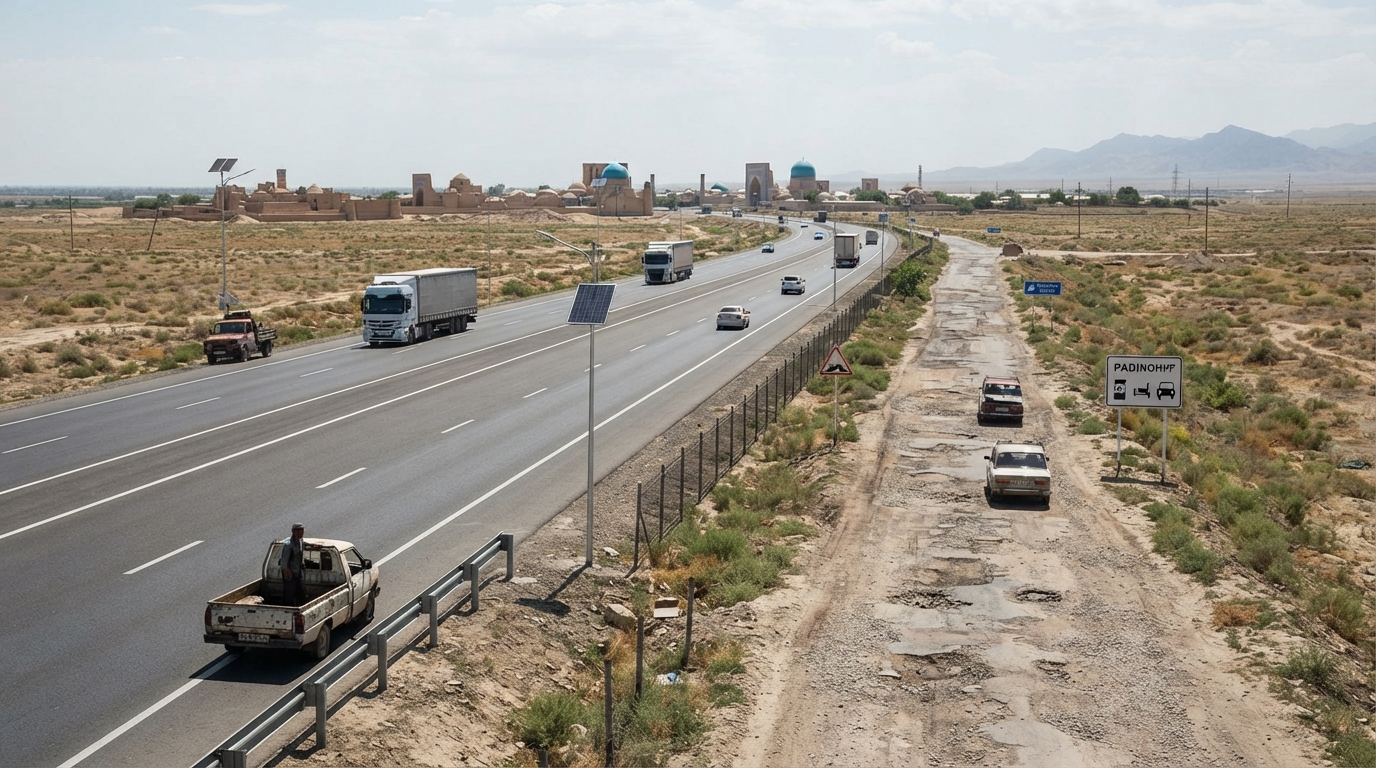
The introduction of Uzbekistan's first toll road, the 35-kilometer Urgench-Khiva section, is a significant event that goes beyond local concerns. It signals a significant shift in the transport strategy of Central Asia as a whole.
Located between major markets in China, Russia, Europe, and South Asia, the region is gradually moving away from its role as a mere transit area, striving to become a full-fledged logistics hub. The existing infrastructure is no longer adequate to achieve this goal.
The primary value of any toll road lies not in the toll itself, but in its predictability and quality. For cargo owners and carriers, time directly impacts costs. The longer a truck travels on a rough two-lane road or is stuck in traffic jams, the higher the costs of fuel, driver salaries, and equipment repairs.
A high-quality highway that reduces travel time can be cost-effective even with a toll. On the Urgench-Khiva section, travel time is expected to be reduced from approximately 50 to 15 minutes. For businesses, this difference means faster product turnover, lower costs, and the ability to more accurately plan deliveries.
In an ideal situation, everyone wins. Drivers get a good road, businesses get speed, the government gets modern infrastructure, and the collected funds are used for highway maintenance, repairs, lighting, and safety.
However, this is where a key question arises: what happens if a person pays for the road but doesn't receive the promised quality?
**Payment implies quality**
Central Asia already has a very illustrative example.
In Kazakhstan, toll road users are exempt from tolls for kilometers where defects are identified that affect safety and traffic flow. For example, if five out of 100 kilometers of a toll road are identified as problematic, drivers only pay for the remaining 95 kilometers. Tolls for the defective section are suspended until repairs are completed.
The quality problem on toll roads has already reached a significant scale. After an inspection of such roads in Kazakhstan, defects were discovered on a number of sections, resulting in the temporary suspension of toll collection on the affected sections.
This is an important signal for all of Central Asia.
It turns out that even in a country with the most developed toll road system in the region, the government has had to introduce a special mechanism to protect drivers from a situation where fees are charged for infrastructure that does not meet safety and quality requirements.
In essence, a principle that could become key to the future of the entire toll road system is already in effect here: users should pay not simply for the right to travel through a certain area, but for a quality service.
**When the Road Becomes a Source of Irritation**
A poor road, for which drivers are required to pay for it, evokes a completely different reaction than a regular free road with potholes. A feeling of double injustice arises: the driver pays taxes, pays for fuel, and repairs to the vehicle after damage – and is simultaneously forced to pay to use a road that does not provide the promised conditions.
Global experience shows that such conflicts are far from uncommon. For example, in India, disputes have repeatedly arisen over toll collection on roads in poor condition. In a number of cases, courts and road authorities have addressed the obvious issue: users pay for quality infrastructure, but are effectively forced to travel on roads with potholes, damaged surfaces, repairs, and traffic restrictions.
On the Kanpur-Lucknow expressway, after serious damage appeared, the road authority temporarily suspended toll collection until repairs were completed. On the Mumbai-Goa highway, dissatisfaction with road quality and toll collection also led to protests from local residents.
Therefore, a fairly universal pattern emerges: the higher the demands placed on users in the form of mandatory tolls, the higher their expectations for road quality. And if the state or operator fails to provide the promised level of infrastructure, the toll road system itself begins to lose public support.
**But the problem isn't just quality**
Even a perfect new highway can become a source of dissatisfaction if it's used daily. For a large transportation company, a few tolls may be justified by the savings in time and fuel. But for a taxi driver, a small town resident, a farmer, a small business owner, or someone who commutes to work every day, the road isn't an investment project. It's part of everyday life.
If a convenient route becomes a toll road, the additional expense gradually becomes a constant burden on the family budget. The situation becomes especially sensitive when a free alternative exists only formally. An old road may appear on the map. But if it's significantly longer, potholed, passes through dozens of populated areas, or becomes unsafe in winter, the person effectively has no choice.
And then the toll road begins to be perceived not as an additional service, but as a mandatory payment for the ability to travel normally. This is precisely the issue that could become the main social risk for Central Asia.
**Not Only Drivers Will Pay for the Road**
There's another issue that's rarely discussed in connection with the development of toll roads.
It's not just car owners who pay. New highways are used to transport food, medicine, building materials, clothing, and other goods. If a transport company regularly pays for tolls, part of these costs is inevitably included in the delivery cost. As a result, even those who don't own a car may indirectly pay for the toll road.
This issue is particularly sensitive for Central Asia. The region is characterized by long distances, rugged mountainous terrain, and the dependence of many districts on a limited number of transport corridors. If key routes are gradually tolled, the region's states will have to calculate not only potential revenue from tolls but also the impact of the new tariffs on the cost of transportation, goods, and services.
Otherwise, a paradoxical situation could arise. The road is being built to boost the economy and reduce logistics costs, but the excessively high toll itself becomes a new component of these costs.
**Could a toll road spark protests?**
Unlikely.
However, a toll road could very well become a symbol of broader discontent, especially if fuel, food, and utility prices rise simultaneously, while household incomes fail to keep pace. In such a situation, yet another mandatory payment is perceived not as a fee for quality service, but as yet another financial burden.
The history of various countries shows that protests rarely arise over a single tariff, tax, or price. Typically, a specific issue compounds existing discontent. This is why it is important for Central Asian authorities to consider not only the economic but also the social aspects of road projects.
A tourist driving a new road once and a local resident forced to use it twice a day are in very different situations. A single tariff for them may be technically identical, but have a completely different impact on the family budget.
**What can make the system fairer**
Kazakhstan's experience with defective sections shows that the toll road system must have a clear principle of accountability to users. If the quality doesn't meet requirements, the fee should be reduced or temporarily waived.
But this isn't enough. Central Asia may need to develop a comprehensive system of social and economic safeguards.
First, a genuine free alternative must exist.
Second, a flexible fare policy is needed. A resident of a nearby area who commutes daily should not be placed in the same situation as a transit driver.
Third, subscriptions or discounts may be needed for regular users, local residents, public transport users, farmers, and small businesses.
Fourth, transparency in the use of collected funds must be ensured. Drivers must understand how their money is being spent.
Finally, it's necessary to enshrine the principle already in place in Kazakhstan: the fee must correspond to the quality of service.
If a road is damaged, traffic is restricted due to protracted repairs, or safety is compromised, users should not be charged as if they were using a modern expressway.
**The Main Choice for Central Asia**
The establishment of the first toll road in Uzbekistan and the expansion of the toll road network in Kazakhstan demonstrate that Central Asia is gradually transitioning to a new model of infrastructure financing.
This issue is also becoming increasingly pressing for Kyrgyzstan. The country needs to develop roads connecting it with China, Uzbekistan, and Kazakhstan, reduce freight delivery times, and increase the attractiveness of transport corridors.
However, it is important to avoid the mistake often made when implementing large infrastructure projects: first build the road, set the tariff, and only then explain to the public why they should pay.
The discussion must begin early. Because a toll road can become two completely different symbols. In one case, it symbolizes modernization, speed, investment, and new economic opportunities. In the other, it symbolizes a situation where modern infrastructure becomes accessible primarily to those who can afford it.
A fast road benefits the economy. But the main question is whether it will remain accessible to ordinary people who use it not for big business, but because they need to live, work, study, receive medical treatment, and get around every day.
The answer to this question will determine whether toll roads in Central Asia will become a tool for development or gradually turn into a new source of social tension.