

Toll roads: What is the situation in Central Asia and Russia?
Recently, the construction of toll roads in Uzbekistan has been at the center of discussion. We do not have such roads, so paying tolls on some roads is a new concept for most Uzbeks. However, it is known that there are about 1,700 toll roads in about 100 countries around the world. This experience existed in England as early as the 14th century.
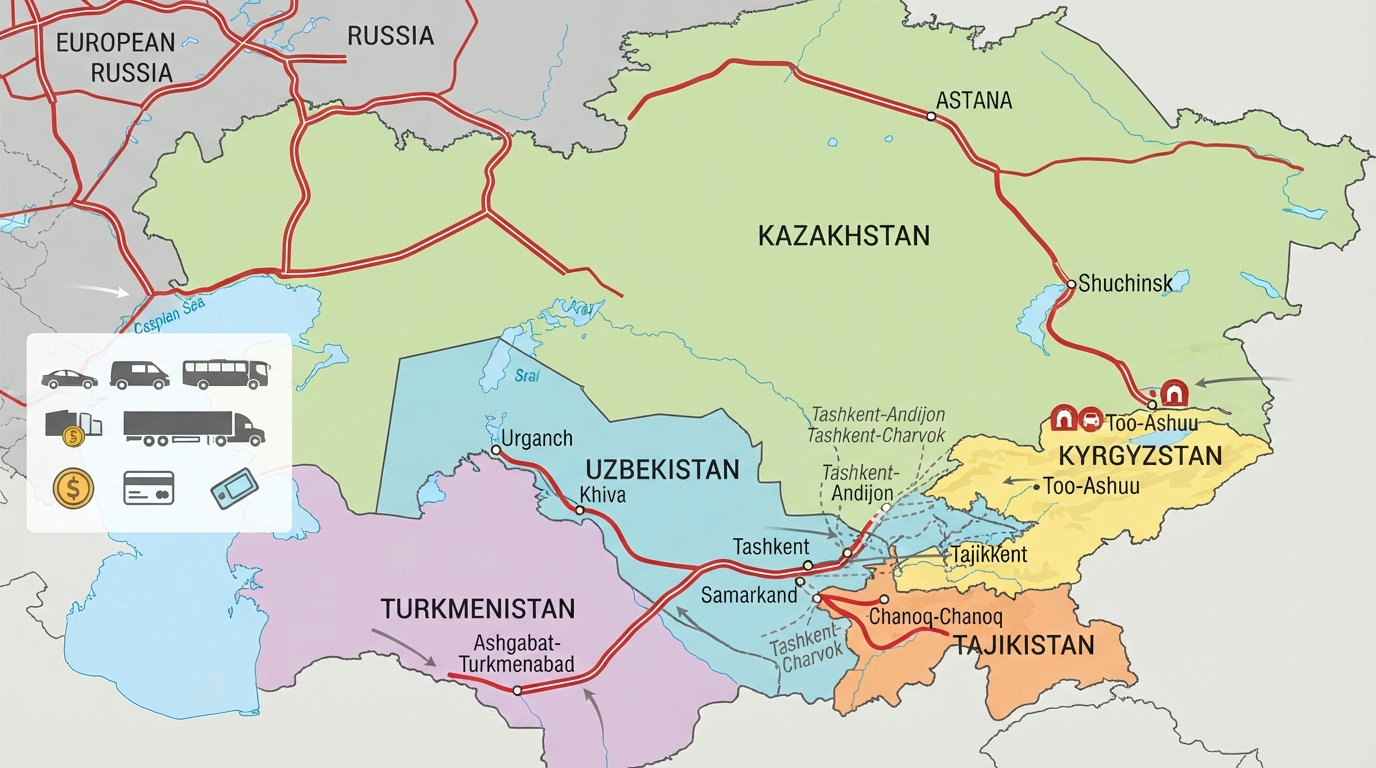
**Toll roads: What is the situation in Central Asia and Russia?**
In recent years, projects for the construction of toll roads have been actively implemented in Uzbekistan. The construction of toll roads has begun on the Tashkent-Samarkand and Tashkent-Andijan routes, and the Urgench-Khiva toll road will soon be put into operation. The Tashkent-Charvak toll road project is also being prepared. It is expected that about a thousand kilometers of toll roads will appear in Uzbekistan in the next 4-5 years. So, how has the toll road system developed in other Central Asian countries and Russia?
**Tajikistan**
Tajikistan was the first country in Central Asia to introduce toll roads. In 2010, the first section of the Dushanbe-Khujand-Chanak highway was renovated and converted into a toll road. Currently, Tajikistan has more than 300 kilometers of toll roads, which are divided into six sections. The road in Varzob district has been tolled since April 1, 2010. Later, the sections of Varzob (63 km), Gushari (41 km), Shahriston (41 km), Oratepa (66 km), Dehmoy (65 km) and Chorukh (60 km) were also converted to toll roads.
Toll road users in Tajikistan are divided into four categories and pay according to separate tariffs:
* **First category:** Passenger cars, minibuses and vehicles with a carrying capacity of up to 2 tons pay approximately $9 (or $7 if paid by card) for the entire distance of more than 300 kilometers.
* **Second category:** Minibuses and medium-sized two-axle trucks pay approximately $20-22 to travel to the end of the toll road.
* **Third category:** Large buses and heavy three-axle trucks will cost $50-51 to cross the toll road completely.
* **Fourth category:** Heavy four-axle trucks and more will pay around $62-64 to cross the toll road to the end.
There is no alternative to toll roads in Tajikistan, so users can only cross by paying. Residents of settlements located along toll roads use a discounted toll within their area, and pay in full when they want to cross to another area. Toll roads are managed by the Tajik branch of Innovative Road Solutions, a company registered in the British Virgin Islands.
**Kazakhstan**
Kazakhstan launched its first toll road, Astana-Shuchinsk, in 2013. Currently, the country has 12 toll highways, divided into 28 sections and with a total length of more than 6,000 kilometers. These roads are managed by the state-owned national company "KazAvtoJol".
Toll roads in Kazakhstan are also divided into categories, but prices are much cheaper than in Tajikistan:
* **First category:** Passenger cars pay an average of 45-50 cents per 100 km. For example, the toll for the 211 km long Astana-Shuchinsk toll road is $1 if paid in advance, and $1.1 if paid later.
* **Second category:** Trucks and minibuses with a carrying capacity of up to 2.5 tons pay around $1.3-3 (600-1,400 tenge) per 100 km.
* **Third category:** Trucks with a carrying capacity of less than 5.5 tons and buses with up to 32 seats pay around $3-6 (1,400-2,800 tenge) per 100 km.
* **Fourth category:** Trucks with a carrying capacity of up to 10 tons and buses with more than 32 seats pay around $4.5-9 (2,100-4,200 tenge) per 100 km.
* **Category Five:** Trucks with a gross vehicle weight of over 15 tons and trailers pay around $8-18 per 100 km.
In Kazakhstan, all toll roads have an alternative, and drivers can also use free roads. In areas where toll roads are located, a preferential annual subscription has been introduced for local residents. The annual subscription fee for passenger cars is $9-10. Prices for trucks and other types of transport are slightly higher.
**Kyrgyzstan**
Kyrgyzstan does not have a fully tolled highway system, but drivers are charged for passing through tunnels and new bypasses on some strategically important roads. These fees are mainly used to maintain road infrastructure (lighting, ventilation, safety systems).
For example, the Too-Ashuu tunnel, located on the Bishkek-Osh highway, the most important strategic road connecting the northern and southern parts of Kyrgyzstan, is toll-free. At the Sosnovka and Karakul checkpoints on this road, a fee is charged for passing through the Too-Ashuu tunnel.
Here, too, different tariffs have been introduced for different vehicles:
* **First category:** The fee for passenger cars with up to 8 seats is about 60 cents (50 soms).
* Minibuses with more than 8 seats, trucks with a carrying capacity of up to 5 tons, and tractors pay more than $1.
* Trucks with a carrying capacity of 5 to 12 tons pay $1.7-2.8, and trucks with a carrying capacity of more than 12 tons pay about $5.7.
These tariffs apply to local vehicles as well as to vehicles from the Eurasian Economic Union, including Uzbekistan. Vehicles from non-EEU countries pay more. In addition to the Too-Ashuu tunnel, the newly built Kok-Art tunnel on the North-South alternative highway and the 14-km Uzgen bypass are also toll roads.
**Turkmenistan**
The 600-km Ashgabat-Turkmenabad highway is the only toll road in the country. The Ashgabat-Tejen and Tejen-Mari sections of this road were built earlier, and the Mari-Turkmenabad section was completed this spring.
Tariffs on the Ashgabat-Turkmenabad road are also set depending on the category of vehicle. Passenger cars in the first category pay about 10 cents per km. Medium-duty trucks and buses in the second category pay 40 cents per kilometer, and large trucks pay 60 cents.
Also, in Turkmenistan, local and foreign vehicles pay tolls when crossing some bridges. For example, when crossing the bridge over the Amu Darya, cars pay $10, and trucks and buses pay from $40 to $60, depending on their size.
A new toll highway is currently being built in the direction of Turkmenbashi - Garabogaz - the Kazakh border. Toll roads in Turkmenistan are operated by the state-owned company "Turkmen Avtoban".
**Russia**
The total length of toll roads in Russia exceeds 3,600 kilometers. The first toll road was opened in 1999. Toll roads are located mainly in the European part of the country and are operated by the state-owned company "Avtodor". Toll rates in Russia are much higher than in the Central Asian republics.
On average, drivers pay $5-10 per 100 km. On some sections, such as the M-11 or M-12 highways, the rate may be even higher depending on the time of day and traffic conditions. For example, those who drive the entire Moscow-Kazan toll road, which is about 800 km long, will pay a total of about $145-150. Those who drive the entire 1,500 km Moscow-Novorossiysk toll road will pay about $175-180.
On Russian roads, separate rates are also introduced for different types of vehicles, with trucks paying more depending on the type. Also, on some toll roads, rates change on weekends or at night when traffic is less.
Some toll roads in Russia do not have special crossings, cameras record car license plates and payment is made in this way. Drivers are required to pay within 5 days of driving on such roads. Also, transponders are used when driving on toll roads in Russia. That is, a small electronic device is installed on the windows of cars and drivers drive without stopping at toll booths. Then the payment is automatically debited from the driver's card via the transponder. There are also free roads that are an alternative to toll roads in Russia.
**What's going on in Uzbekistan?**
There are currently no toll roads in Uzbekistan. Unlike its neighbors, no tolls are charged when crossing bridges or tunnels. However, work has begun and in the near future, thousands of kilometers of toll roads will be built in Uzbekistan. The Urgench-Khiva toll road will soon be put into operation and will be the first toll road in the country.
Construction of the Tashkent-Samarkand toll road has also begun. It is expected that this road will be fully operational by 2030. The road, with a total cost of $2.2 billion and a length of 282 km, will pass through 13 districts in Tashkent, Syrdarya, Jizzakh and Samarkand regions.
The project will include the construction of 92 bridges, 28 overpasses, 60 tunnel-type crossings, as well as underground passages and water supply structures for agricultural needs. The road surface will be made of monolithic concrete, resistant to heavy and high-speed vehicles. The speed of movement in flat areas is expected to be up to 150 kilometers per hour. It is also planned to build a toll road on the Tashkent-Andijan route in the coming years.