

Take your time, wheels.
"The Construction Project of the Century": The New China-Kyrgyzstan-Uzbekistan Railway Will Impact Geopolitics
Don't rush, wheels.
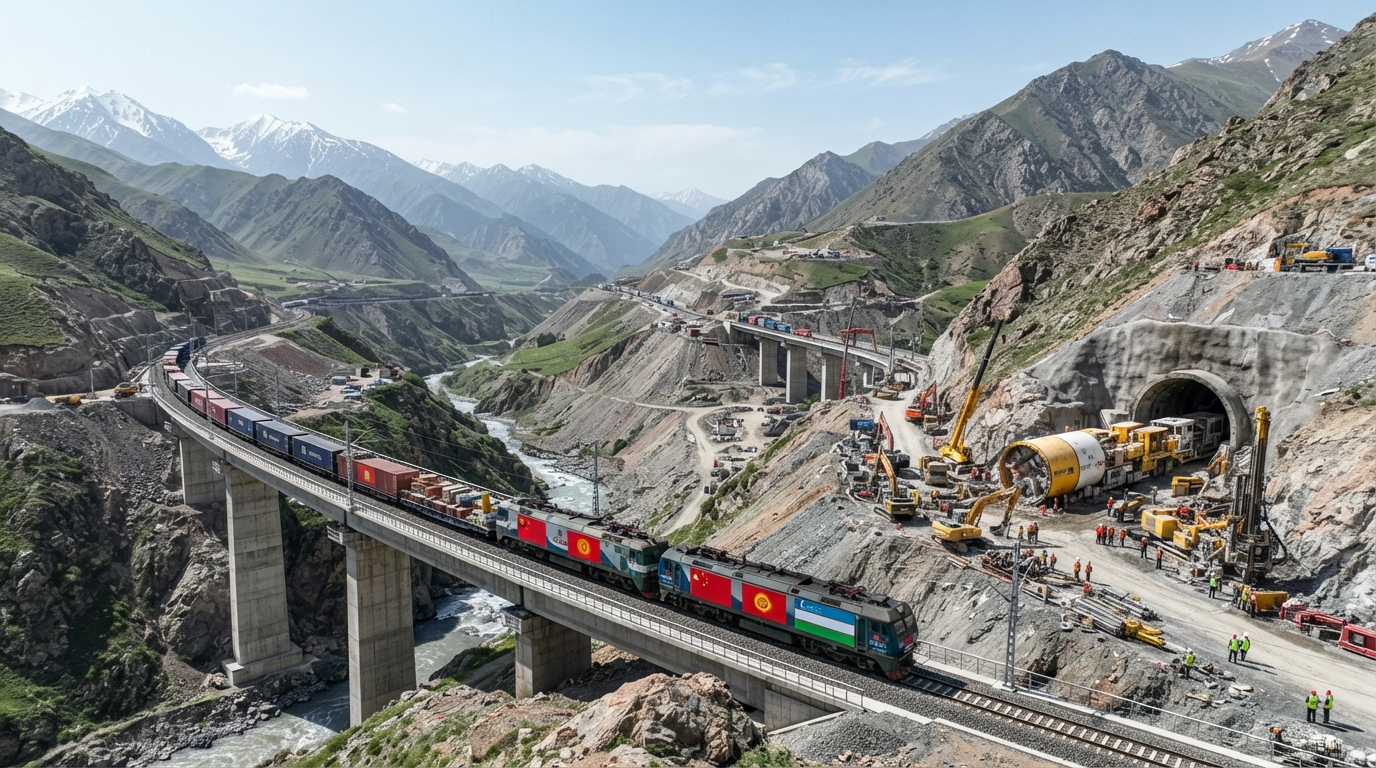
In the modern world, logistics and communication routes between countries are of strategic importance. In early August, Uzbek President Shavkat Mirziyoyev celebrated a significant milestone in Eurasian integration during a meeting with Kyrgyz President Sadyr Japarov. The Uzbek leader considers the construction of the China–Kyrgyzstan–Uzbekistan (CKU) railway, which is expected to fundamentally change the geopolitical situation in Central Asia, to be the "project of the century."
Uzbek Transport Minister Ilkhom Makhkamov later commented to the media that construction of the CKU railway, originally estimated at five years, could be completed a year earlier. According to the official, 17% of the construction work has been completed to date. Construction is currently underway on eight major bridges, with over 10,000 workers and over 7,000 pieces of specialized equipment involved. Furthermore, the parties reached an agreement to expedite border crossing procedures, convert permitting documentation to electronic format, and transition to permit-free shipping in the future.
The Minister of Transport noted a sevenfold increase in freight traffic between China and Uzbekistan via Kyrgyzstan, emphasizing that the new route will become an additional alternative, contributing to strengthening Uzbekistan's transit potential.
History of the Idea and Construction Stages
It took more than a quarter of a century for the China-Kyrgyzstan-Uzbekistan railway project to move from paper to reality. The construction of this transport artery, intended to become the southern corridor of the New Silk Road, was first discussed in 1997. It was expected that the route would significantly optimize logistics between Asia and Europe, shortening the journey by 700-900 km. However, due to financial and political disagreements, the project remained unimplemented for a long time. The long-awaited construction of the railway began in late 2024. Today, it has finally entered its active phase, with completion scheduled for 2031.
This high-altitude line will become a key link in international logistics, connecting China with Turkey and Iran via Central Asia and allowing countries in the region to become less dependent on transit through Russia and Kazakhstan. The total length of the line will be approximately 530 km.
A specially created company will manage the construction and operation of the route. The project will require $4.7 billion. Half of this amount, approximately $2.3 billion, will be provided by China as a 35-year loan to a joint project company established by the three countries. The remaining $2.3 billion will be contributed by the three countries to the authorized capital of the Joint Project Company in the following percentages: China (51%), Kyrgyzstan and Uzbekistan (24.5%) each.
Assessing the significance of the railway project, Chinese Prime Minister Xi Jinping described it as clear evidence of the three countries' commitment to long-term cooperation. In turn, the leaders of all participating countries noted that the railway will serve as the foundation for economic recovery, stimulating trade, strengthening production chains, and ensuring social progress.
China's Interests
Beijing sees the project as a catalyst for increased transit, trade, and the creation of a pilot free trade zone in Xinjiang. The launch of the new railway route will enable China to diversify its logistics, reducing its dependence on transit through Russia and Kazakhstan. Alternative routes will help ensure long-term supply security to the EU and the Middle East. The CKU project is advantageous due to its short length, which will reduce freight delivery times by a week. At the same time, infrastructure development will drive economic growth in China's western and central regions, particularly Xinjiang, by intensifying industrial production.
China is banking on this region, transforming it into a major logistics hub for connections with its neighbors. According to Nikkei Asia, the authorities hope that the new economic zone will not only attract capital from Belt and Road participants but also strengthen the yuan's position internationally. The project is already showing initial success: 86 enterprises have established themselves in the Kashgar sub-zone, investing $1.75 billion in the development.
The Kashgar Railway opens a new chapter in relations between China and Central Asia. Thanks to its reliability, year-round availability, and affordable transportation costs, this route will significantly reduce logistics costs, making goods more competitive and stimulating trade. For Beijing, this project is a strategic move aimed at expanding its transit network, developing Xinjiang's potential, and strengthening its position in the Central Asian region.
Kyrgyzstan's Interests
The majority of the new railway (312 km of the 486 km) will run through Kyrgyz territory. The project will include the construction of 18 stations, 81 bridges, and 41 tunnels with a total length of over 120 kilometers.
For Bishkek, this project is crucial to gaining a new railway network and generating transit revenue for the treasury. Kyrgyz authorities have become seriously committed to modernizing their railways. Currently, the country has only 424 kilometers of track, which are not interconnected: the northern and southern lines operate independently, providing only transit to neighboring countries. The KKU project aims to rectify this situation by connecting these disparate sections. The construction of this highway is a historic step, as not a single kilometer of new track has been laid in the Kyrgyz Republic since independence. Another priority for the Kyrgyz authorities is integration into global production chains and access to international markets.
Freight transit is expected to generate approximately $200 million per year for the country's budget. This construction will be a significant step in economic development: the country will gain access to international markets, upgrade its transportation network, and create new jobs for local residents.
Uzbekistan's Interests
For Tashkent, developing new markets is crucial to the CCU project. The country's authorities are striving for active integration. Uzbekistan's geography and policies allow it to successfully balance participation in Chinese infrastructure initiatives with interaction with the EAEU, as well as project its economic interests into South Asia. The authorities have developed a strategy to overcome geographic isolation and create a sustainable network of trade partnerships, with Russia, China, and the emerging markets of South Asia as key hubs.
As part of the "April Document," approved by the head of state to expand agricultural exports to China, Uzbekistan plans to open trade offices in more than ten Chinese cities. The country is actively promoting new infrastructure initiatives, including the Trans-Afghan Railway and the CCU project. The implementation of these projects promises significant economic benefits – not only access to Chinese and other promising markets, but also an annual transit income of $150–200 million.
Currently, transporting cargo from China to Uzbekistan via Kazakhstan takes a long time – from 45 to 70 days, which places a significant financial burden on the business sector. Completion of the KKU railway line is intended to optimize logistics chains, speed up delivery times, and cement Uzbekistan's status as a key transport hub.
One fact: last year, Uzbekistan handled over 50% of all trains sent from Xi'an to Central Asian countries. The strategic goal for the current year is to organize the transportation of 20,000 containers along the direct Xi'an–Jizzakh route.
In conclusion, the construction of the KKU railway line has the potential to radically transform the logistics landscape of Eurasia. The idea was shaped by a complex set of factors, but the conflict in Ukraine acted as a catalyst: China urgently needed alternative routes for cargo transportation, while the Central Asian states needed new sources of revenue. These countries are facing Western sanctions pressure, driven by restrictions on both Russia and all countries cooperating with Moscow. With Brussels, Washington, and London only exacerbating the economic pressure, the regions are forced to seek alternative routes for communication and logistics. Moreover, in the case of the KKU, we are talking about a long-forgotten initiative.
Financial Difficulties, Transport Isolation, and Competition
Despite significant development potential, the initiative also carries serious risks for Bishkek and Tashkent: from environmental damage to the possibility of falling into debt or becoming too vulnerable to pressure from Beijing.
Subsidized Kyrgyzstan could face a massive debt burden. The project is estimated to cost approximately $4.7 billion, which is more than a quarter (approximately 26-38%) of Kyrgyzstan's GDP. Taking on large loans from China creates the risk of debt dependence.
The high mountain terrain requires the construction of dozens of complex tunnels and bridges (including tunnels longer than 12 km), making the project incredibly expensive to maintain and potentially delaying the return on investment.
Laying tracks and large-scale blasting operations in the fragile mountain ecosystems of the Tien Shan could cause irreparable damage to the environment, local flora, and fauna.
The construction itself is highly complex. Laying a heavy-duty highway through seismically active high-altitude regions with varying elevations increases the risk of accidents during construction and operation.
The highway disrupts established logistics chains (for example, bypassing or competing with other routes), which could lead to friction with neighboring countries and major players who will lose part of their transit traffic. As noted above, the corridor is designed to bypass Russia and Kazakhstan, which are important political and economic partners for all consortium members.
For this project to truly prove itself and stimulate economic development, countries in the region should develop strategies to minimize these threats in advance.