

One "year" is 87 minutes: scientists have identified a star that is gradually "swallowing" its satellite
Astronomers have observed for the first time a red dwarf star systematically pulling matter from a neighboring brown dwarf. The "devouring" process in this pair, which orbits each other in just 86.65 minutes, could last for billions of years.
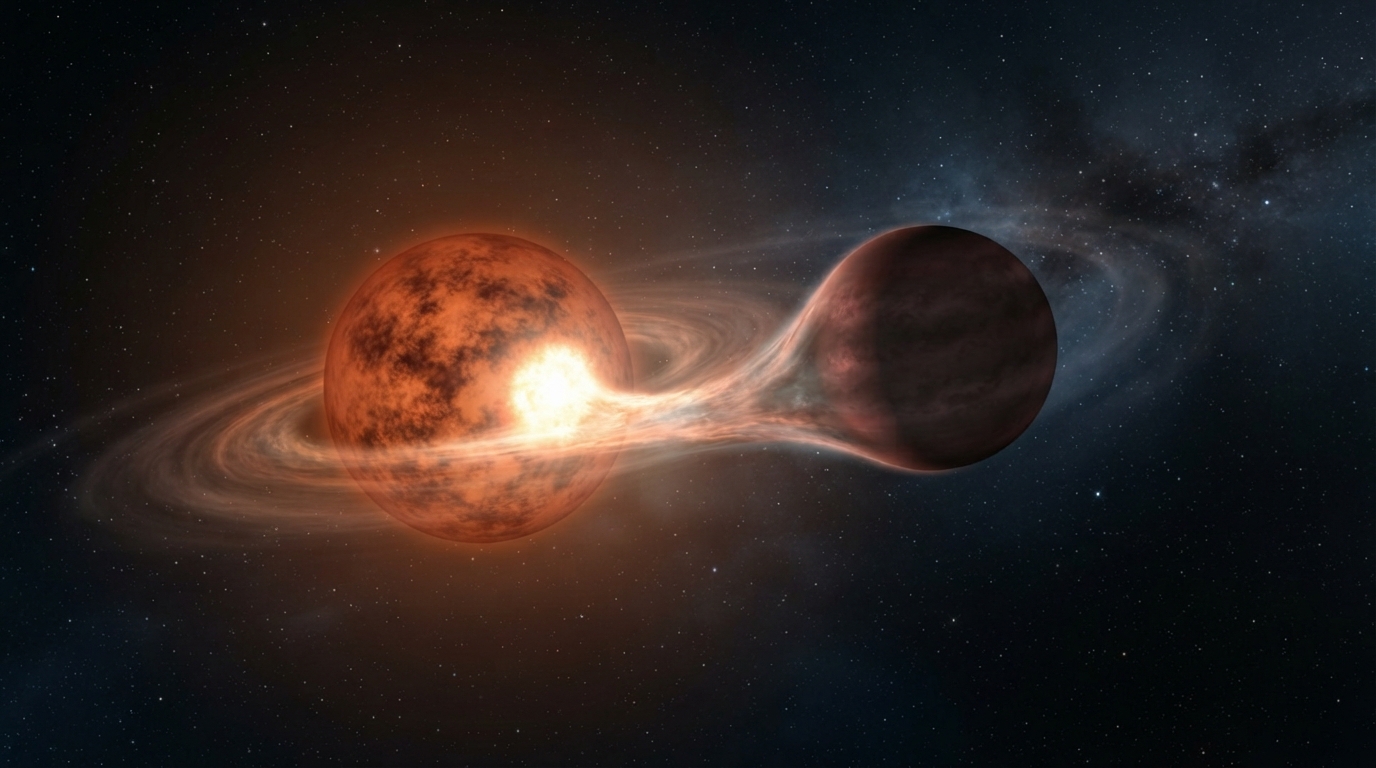
One "year" is 87 minutes: scientists have identified a star that is slowly "devouring" its satellite
The study regarding the discovery was published in the journal Nature Astronomy. Scientists studied a system named ZTF J0440+2325 and found that there is a stable exchange of matter between the star and its very close companion.
The main star of the system is a red dwarf, which is smaller and cooler than the Sun. Its satellite is a brown dwarf — a celestial body whose mass is greater than that of a planet, but not sufficient to sustain hydrogen fusion stably like an ordinary star.
The orbital period of the pair is less than an hour and a half. For comparison, Mercury, the closest planet to the Sun, takes 88 days to complete one orbit.
Through observations in five spectral bands, scientists discovered that the red dwarf has a spot that is much hotter and brighter than the surrounding area. Researchers say this is caused by matter flowing from the brown dwarf falling onto the star's surface.
According to calculations, the diameter of the hot spot could be 6,700–10,000 kilometers, depending on the distance to the system. That is, this size was not estimated directly from an image, but based on observations and modeling.
The most important aspect of the discovery is that the companion body is not disintegrating quickly and merging into the star. On the contrary, it is losing its matter slowly and stably.
Usually, it is believed that a planet or a brown dwarf that comes very close to a star is soon swallowed up. The new observation, however, showed that under certain conditions, another scenario is also possible: a star can "consume" its satellite slowly over a very long period of time.
According to researchers' estimates, such a process could potentially last for billions of years. This is not a time fully measured through observation, but a scientific conclusion based on the characteristics of the system.
The results will help in understanding the future of celestial bodies located close to stars. However, this discovery itself does not determine exactly what fate awaits Earth when the Sun expands: the masses, sizes, and conditions of the two systems are different.