

Astronomers have detected a radio signal from an exoplanet for the first time
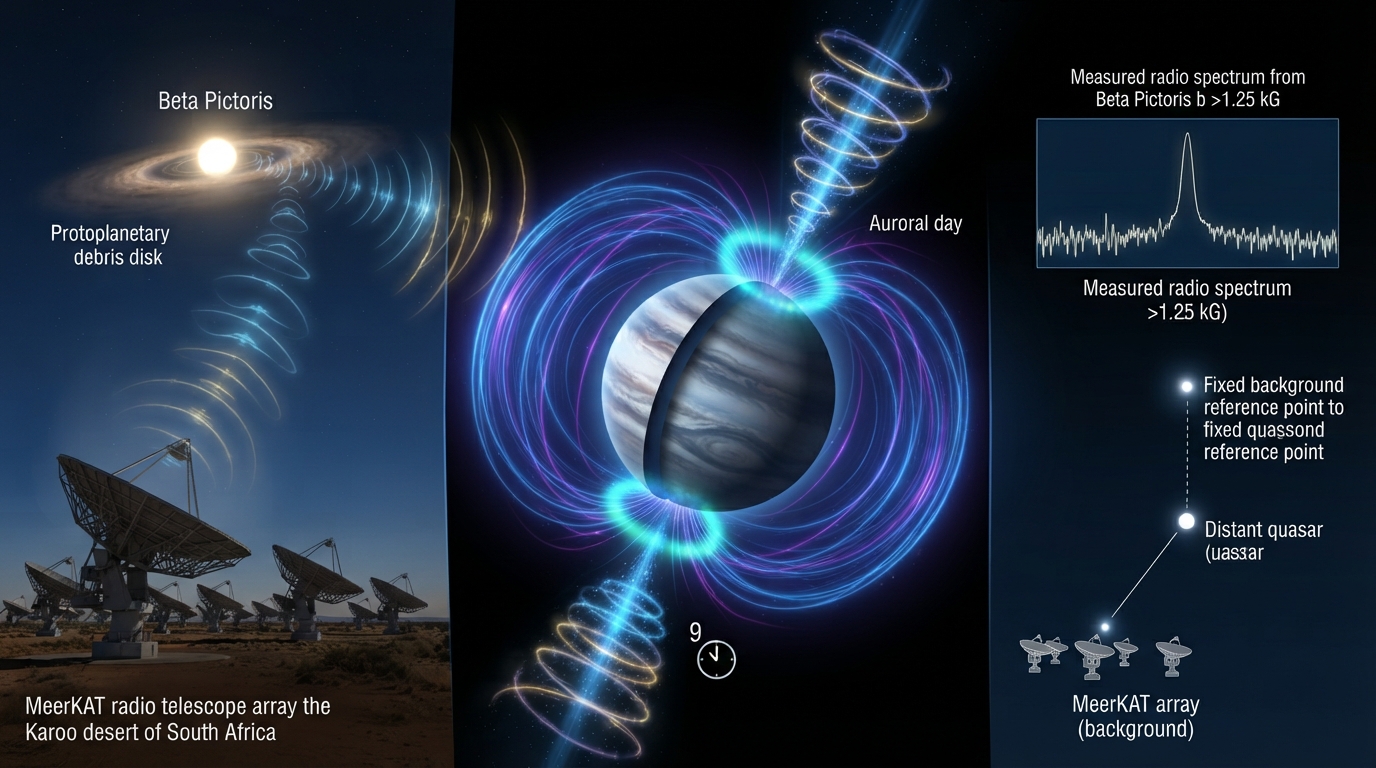
Astronomers have recorded a radio signal from an exoplanet for the first time
Astronomers have succeeded in detecting a radio signal coming from an exoplanet outside the Solar System for the first time. This discovery by scientists from the Harvard-Smithsonian Center for Astrophysics and the University of Oregon was published on the arXiv server.
The source of the signal was identified as the gas giant Beta Pictoris b, located 19.6 parsecs (approximately 64 light-years) away from Earth. Previously, astronomers had recorded radio signals from star systems with planets, but they could not distinguish exactly where the signal was coming from — whether from the star or the planet. This time, researchers used distant quasars as reference points to prove that the signal was linked specifically to this exoplanet. The observations were carried out using the MeerKAT radio telescope in South Africa. Key aspects of the discovery:
Magnetic field measured for the first time: The radio signal is generated as a result of an aurora on the planet. Through the signal's frequency, scientists directly measured the strength of the exoplanet's magnetic field for the first time — it is at least 1.25 kilogauss. This figure fully corresponds to theoretical calculations for young and massive planets.
Cause of the aurora: Beta Pictoris b rotates very rapidly around its axis (a day there lasts only 9 hours). It is this rapid rotation combined with the strong magnetic field that causes powerful and recurring radio wave bursts.
According to the researchers, subsequent observations will help determine how the planet's magnetic field is structured. In addition, seven more gas giants located in five other star systems could be studied using this method. They are located at distances of up to 45 parsecs from Earth. However, to record their radio signals, the sensitivity of existing instruments needs to be increased by five to seven times. According to the researchers, this could happen with the advent of next-generation radio telescopes.