

Scientists have observed giant plasma swirls on the Sun's surface for the first time.
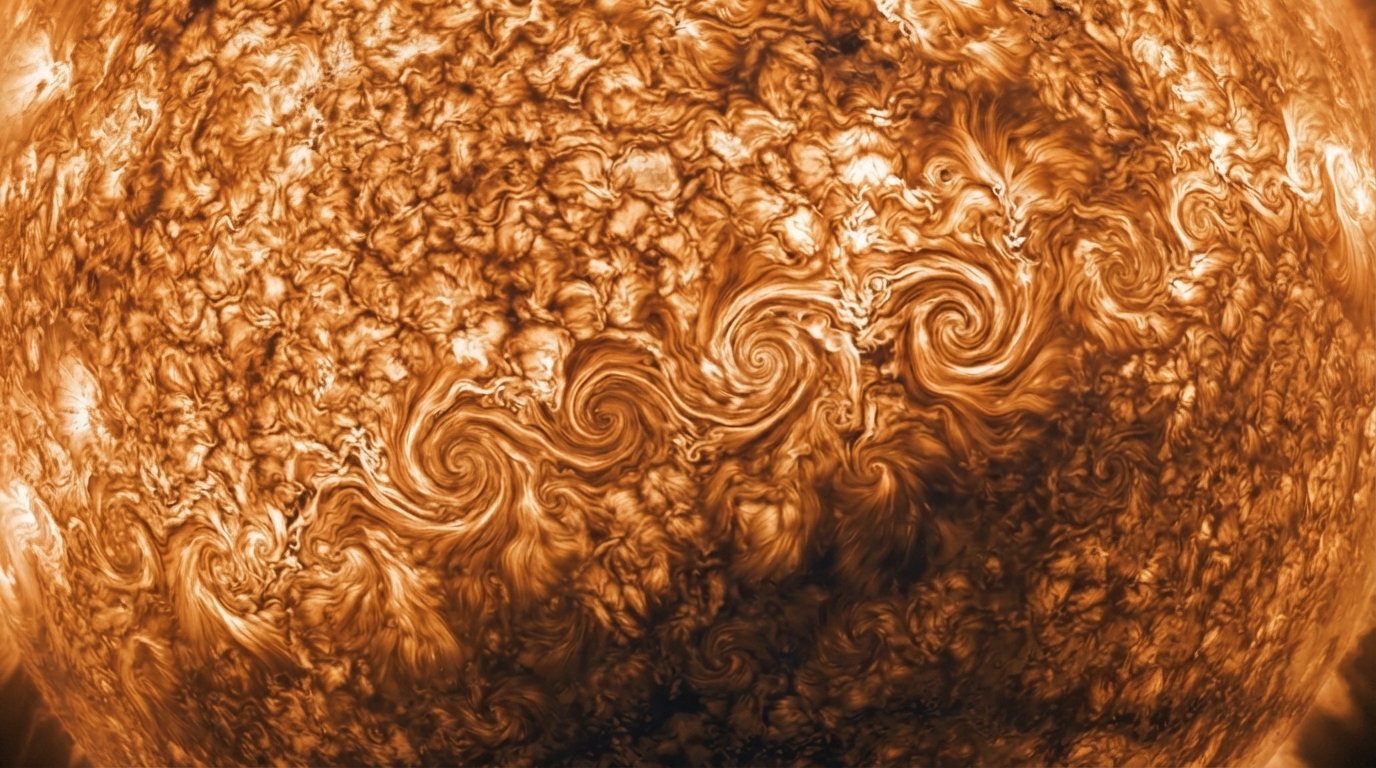
Scientists have captured giant plasma vortices on the Sun for the first time.
Astronomers have obtained unprecedentedly clear and detailed images of the solar surface, revealing tiny spiraling vortices of plasma. These vortices may help us understand the nature of devastating solar storms.
The results of a study conducted by an international team of scientists from the US National Solar Observatory and the Max Planck Institute in Germany were published in the journal Nature.
**"Ripple Effect" on a Hot Star**
Flares and plasma vortices on the Sun have been identified as manifestations of a physical phenomenon known as the Kelvin-Helmholtz instability. This instability occurs when two adjacent layers of gas or liquid move at different speeds. On Earth, this effect leads to the formation of characteristic "swirling" ocean waves and clouds, and in space, it is observed in the atmospheres of Jupiter and Saturn. Now, for the first time, scientists have observed it directly on the surface of the Sun.
The discovery was made possible by the Daniel K. Inouye Solar Telescope, the world's largest solar telescope, located on the Haleakala volcano in Hawaii. Using a four-meter mirror and modern optics, researchers were able to resolve features just 20 kilometers wide.
"To detect these vortices, we needed to resolve features about 20 kilometers across. This is practically the limit of the telescope's power, as well as that of modern computer models," explained study co-author Michiel van Noort.
Photo: National Solar Observatory
**Whirlpools at the Boundaries of "Boiling" Granules**
The solar surface (photosphere) is covered in granules—giant plasma bubbles ranging from 500 to 2,000 km in size. In high-resolution images, researchers observed that fine plasma patterns, reminiscent of breaking waves, are constantly forming and swirling along the edges of these "boiling" structures.
The discovery's main value lies in its explanation of how the Sun accumulates and releases magnetic energy.
The magnetic field accumulates force, twisting like a tight spring. When the tension reaches its peak, the field lines break and reconnect, releasing colossal energy.
This leads to powerful solar flares and coronal mass ejections, which can cause geomagnetic storms on Earth and disrupt satellites, navigation systems, and power grids.
Previously, physicists could not understand what triggers the initial process of field twisting. New observations show that Kelvin-Helmholtz vortices form continuously and effectively mix magnetized plasma with non-magnetized plasma. This accelerates the transfer of energy from the surface to the upper atmosphere.
Scientists plan to continue observations to accurately calculate the amount of energy carried by these plasma vortices and estimate their true contribution to the global 11-year solar activity cycle.