

On a Greek island, the skull of a rhinoceros that lived 8 million years ago has been discovered
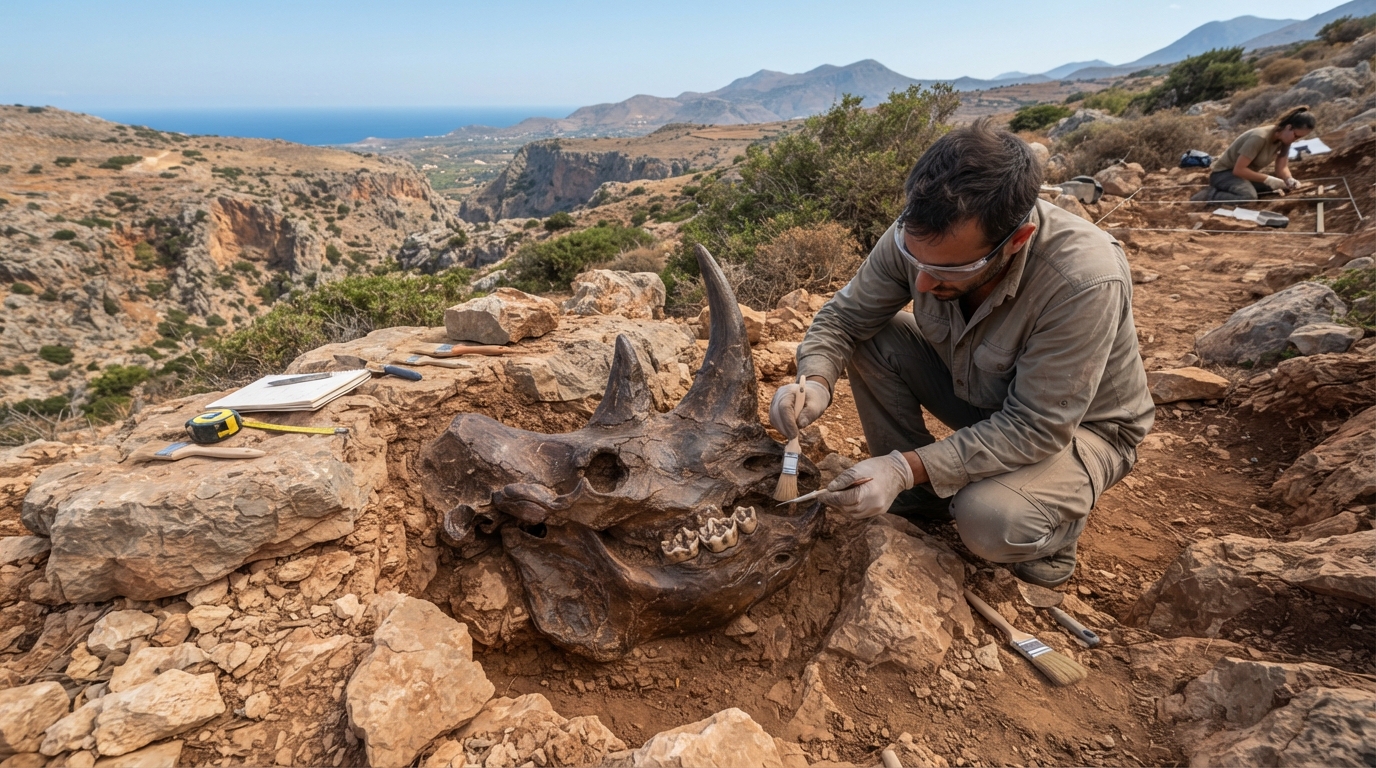
On the Greek island, the skull of a rhinoceros that lived 8 million years ago has been found
A perfectly preserved skull of an ancient two-horned rhinoceros that lived approximately 8–8.5 million years ago has been discovered on Crete. This find gives scientists the opportunity to determine the animal's age and diet thanks to its intact teeth.
The skull was found during paleontological research in the Magantze and Trapeza areas of the Sitia Geopark. Fossil bones were discovered in March, and later, specialists found the skull among them.
The find belongs to the species Dihoplus pikermiensis, whose representatives lived in Western Eurasia during the Late Miocene. These large, two-horned rhinoceroses were part of the so-called Pikermian fauna—a collection of animals that inhabited the region during that period.
Of particular interest to researchers are three fully preserved molars in the upper left part of the jaw. From them, scientists will be able to obtain information about the animal's diet and more accurately determine its age.
The Sitia Geopark is part of the UNESCO Global Geoparks network. Its paleontological history spans nearly 300 million years.