

The world's first pterosaur museum has opened in China
In China's Xinjiang Uygur Autonomous Region, the world's first scientific museum dedicated to pterosaurs—ancient flying reptiles—has opened. It showcases three-dimensionally preserved pterosaur eggs and embryos, as well as other rare fossils.
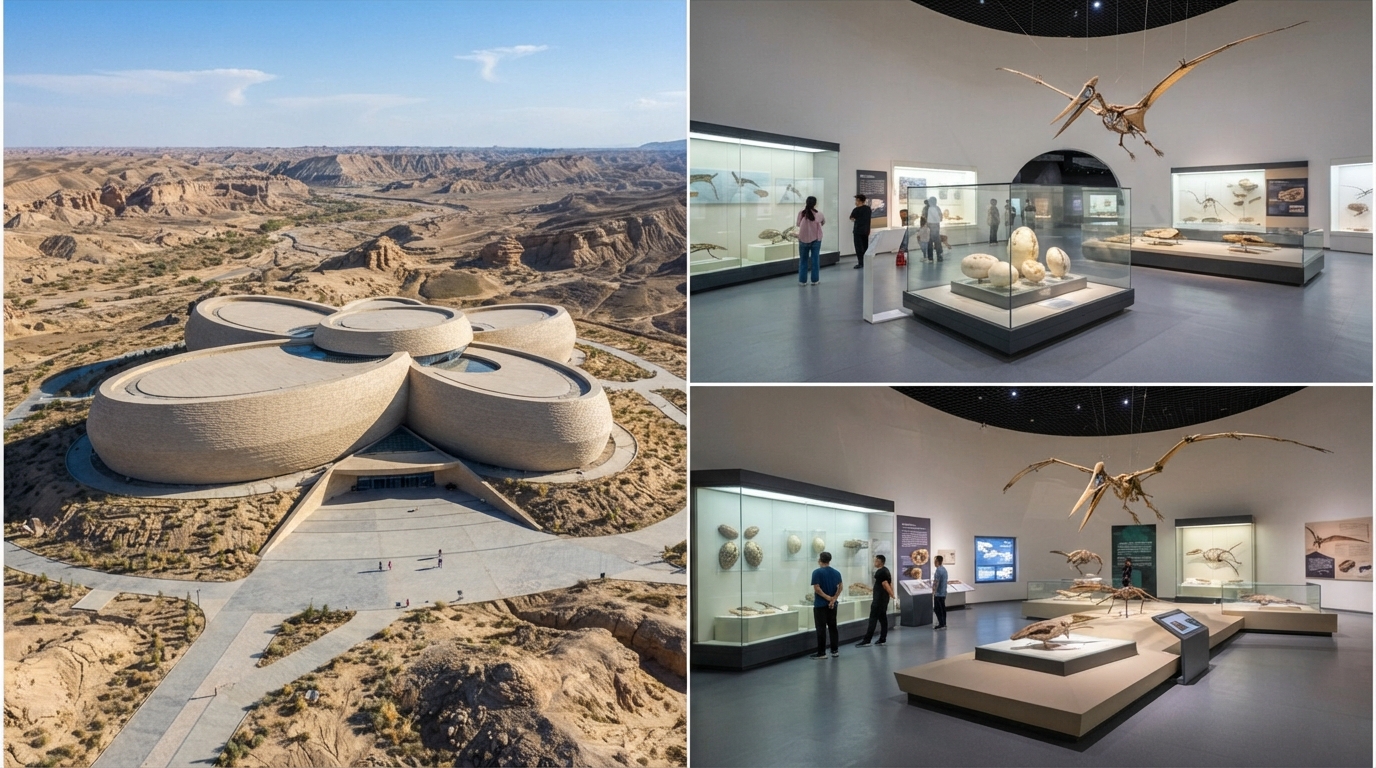
The world's first pterosaur museum has opened in China
According to Naked Science, the Hami Pterosaur Museum is located within a national geopark in northwestern China. This area is famous for the discovery of numerous pterosaur remains.
The museum's exhibition area covers nearly 4.6 thousand square meters. The complex consists of six oval-shaped halls positioned offset from one another.
When viewed from above, the building resembles a nest of pterosaur eggs lying in the middle of the desert.
The museum's exposition features fossil remains discovered during excavations conducted for over 20 years by scientists from the Institute of Vertebrate Paleontology and Paleoanthropology of the Chinese Academy of Sciences.
Among them are the world's first three-dimensionally preserved pterosaur eggs and embryos. Additionally, some large specimens of pterosaurs have been presented to the general public for the first time.
The museum organizers have gathered these finds into a single exhibition for the first time. Through the exhibition, visitors can get an idea of the lifestyle and evolution of pterosaurs that lived approximately 130 million years ago, during the Cretaceous period.
Xu Xing, head of the Institute of the Chinese Academy of Sciences, said the museum allows visitors to get closely acquainted with the process of scientific discovery and see the diversity of ancient life.