

NI pay rises faster than inflation for third year in row
The typical worker in Northern Ireland saw their real weekly pay increase by more than 3% in the last year.
NI pay rises faster than inflation for third year in row
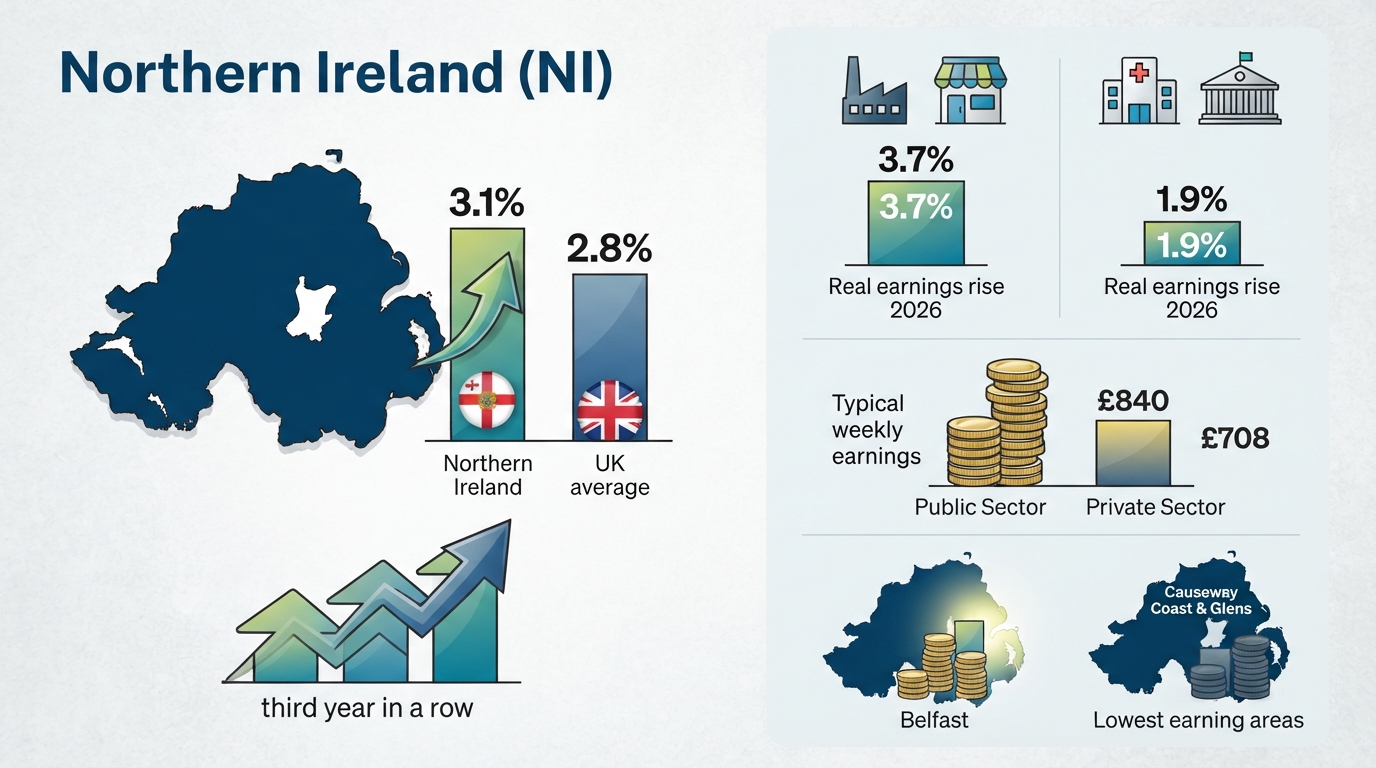
The 3.1% rise in NI was above the UK average of 2.8%
The average worker in Northern Ireland saw their real weekly pay climb by more than 3% over the past year.
Real pay refers to pay after adjusting for inflation, and it is used as an indicator of changes in living standards.
These figures are taken from the Annual Survey of Hours and Earnings (ASHE), compiled by the NI Statistics and Research Agency (Nisra).
Nisra said real pay has now increased for three years in a row, more than making up for the declines seen in 2022 and 2023.
The 3.1% increase in NI was higher than the UK average of 2.8%.
The figures also indicate that the typical full-time worker in NI earned £38,200 in 2026, compared with £40,900 across the UK as a whole.
Real earnings rose more strongly in the private sector in 2026, increasing by 3.7% versus 1.9% in the public sector.
Against 2019, private sector real earnings are now 12.3% higher, while public sector earnings are 2.0% higher.
Even so, typical public sector weekly earnings are still higher at £840, compared with £708 in the private sector.
Some of the gap between the public and private sector figures is explained by differences in the make-up of the two workforces.
Many of the lowest-paid jobs, including hospitality and retail, are found almost entirely in the private sector, while the public sector has a larger share of graduate-level and professional roles.
Workers in Belfast had the highest typical weekly earnings in 2026 at £813, while those in Causeway Coast & Glens had the lowest at £641.
Residents of Lisburn & Castlereagh had the highest typical weekly earnings at £815, while those living in Causeway Coast & Glens had the lowest at £666.
Nisra said that from 2019 to 2026, all earnings increased in cash terms by 41.1%, but real earnings rose by only 7.1%.
That shows how significant high inflation has been as an economic factor during this period.
ASHE is a UK-wide survey of employers, based on a 1% sample of employee jobs. The data comes from HM Revenue and Customs' Pay As You Earn (PAYE) records.