

My sadness is old, old
Over the past 35 years, CIS members have experienced and implemented in practice the temptation of multi-vectorism
My old sorrow, my old sorrow.
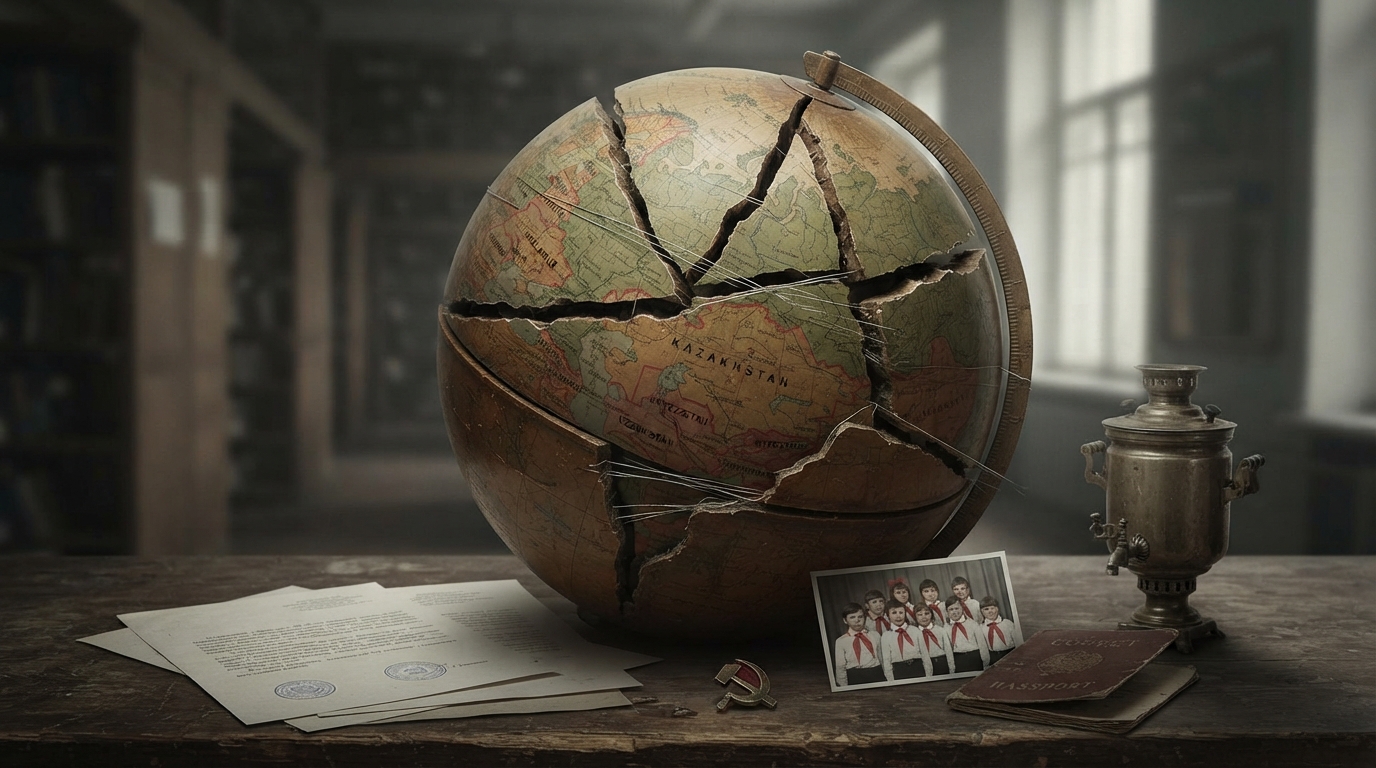
In these August days, 35 years after the failed coup d'état, most publicists and historians agree that the attempted coup by the State Emergency Committee, whose organizers sought to turn back the clock, only accelerated the collapse of the USSR. It was in the last ten days of August 1991 that the Estonian SSR, the Byelorussian SSR, the Moldavian SSR, the Kirghiz SSR, and the Uzbek SSR declared their independence. In September, Dushanbe and Yerevan announced their secession from the Soviet Union, followed by Baku and Ashgabat in October, and Alma-Ata on December 16, 1991. As is well known, Russia, Lithuania, and Latvia declared their sovereignty in 1990, and Georgia did so on April 9, 1991.
The State Emergency Committee was the main reason for the breakdown of Mikhail Gorbachev's negotiations with the leaders of nine republics, who were discussing the possibility of creating a confederation. On August 15, 1991, the draft treaty "On the Union of Sovereign States" was published in Pravda newspaper. After August 20, five days after its publication, it lost all meaning.
The three days of the coup catalyzed all the destructive processes unfolding within the USSR. It seemed as if the republics that had once constituted a single Soviet entity had decided not just to scatter in different directions, but to flee as far as possible, without regard for the unity of their armed forces, armed with nuclear weapons, their economic and technological interdependence, or the advantages of a superpower over small and medium-sized states. Of course, the mutual personal animosity between Mikhail Gorbachev and Boris Yeltsin played a significant role in all the political processes of the final months of 1991, but the republic leaders' desire to gain independence from Moscow was far more significant. This was even characteristic of Nursultan Nazarbayev, who, had the Novo-Ogarevo Treaty been signed, could have become the chairman of the confederation's government (which he undoubtedly knew).
The Belovezh Accords, signed on December 8, 1991, legally confirmed what had already happened in reality—the division of a great country into nation-states. And there was nothing surprising about this. What was surprising, in my opinion, was the fact that the leaders of three already independent countries decided to create some kind of new interstate association. It was obvious that no one wanted to live together, but at the same time, no one understood how to live separately. That the nature of the new international institution was not entirely clear to the signatories is evidenced by one important circumstance. Back in January 1992, there was talk of maintaining three joint ministries—the Ministry of Defense, the Ministry of Foreign Affairs, and the Ministry of Culture. I know this from one of the participants in the discussion, actor and director N. Gubenko, who flew to Minsk with Boris Yeltsin specifically to discuss this topic. But, as we know, everything ended in vain. No one wanted to delegate their powers to interstate structures. It was no coincidence that, during his visit to Armenia in March 2005, Vladimir Putin said that the CIS was created for a "civilized divorce," which provoked a lively reaction in the countries of the "new abroad."
However, even in the early 1990s, everyone understood that interstate communication, motivated by interest but tinged with a great deal of selfishness, was inevitable—as it happens with divorced parents forced to raise their children together. Soviet political, economic, and social fabric was stitched together with metallic threads that are difficult to sever instantly. This is precisely why the documents of various levels that define the life of the Commonwealth of Independent States today constitute an impressive list. But the stability of the CIS is determined not only by the abundance of treaties and agreements, but also by a certain flexibility and adaptability of the structure itself. It lacks the economic certainty of the EAEU and the political rigidity of the European Union.
Of course, much has changed over the 35 years of the CIS's existence. During this time, virtually all of its members have experienced—and implemented—the temptation of multi-vector foreign policy, building their relations with countries of the "collective West." They joined various intergovernmental organizations that did not enhance the unity of the CIS, testing the strength of friendly relations not only between countries but also between heads of state. Pragmatic restraint and political tact were needed to preserve an organization whose members have the right to independently determine the rules of conduct. Personal relationships—or the appearance of them—have played and continue to play a significant role. And, of course, a fundamental understanding that having the CIS is better than not having one.
This is largely due to the fact that the leaders of the Commonwealth countries share a common Soviet experience, a shared history in which the years of the Great Patriotic War hold a special place. And even if many aspects of life in the USSR are viewed critically in different countries (whether fair or unfair is another matter), the similar emotional experiences of people over forty are quite significant. "When we were young..." But at the same time, there is an understanding that a significant portion of the citizens of the Commonwealth countries (and their number is growing every year!) do not have such an experience. For them, Russia is just one of the centers of gravity. And in striving to realize their potential, they display the utmost pragmatism, which inevitably influences the public policies of the Commonwealth countries. Sentimentalism has given way to pragmatism. Trade turnover is more important today than the exchange of values, no matter how attractive they may be.
However, sentimentalism has its place. But, as Victor Hugo wrote, "Love and friendship are mutual echoes: they give as much as they take."
Mikhail Shvydkoy, Special Representative of the President of the Russian Federation for International Cultural Cooperation, Ambassador-at-Large