

Anniversary of a bygone time
Would Kazakhstan have become independent without Stalin's Constitution?
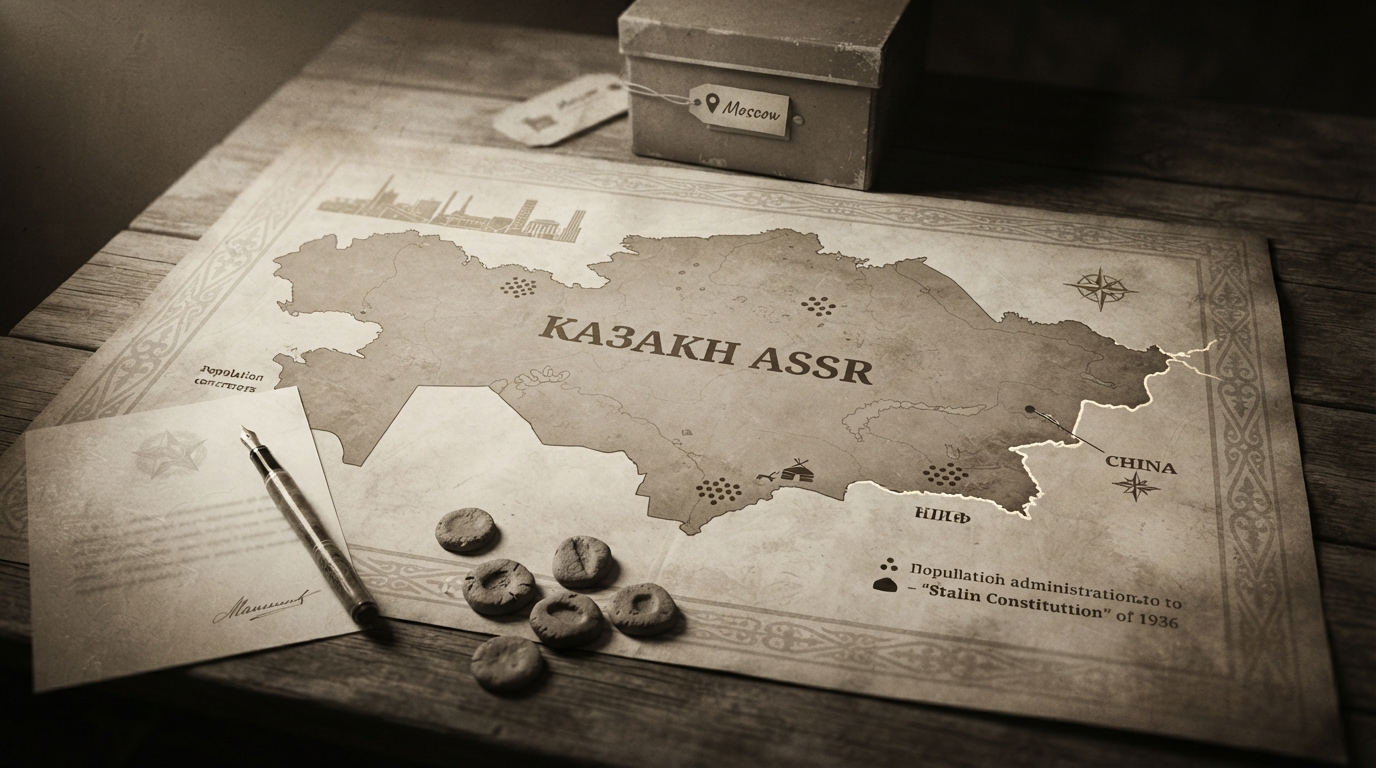
A significant, but likely unofficially celebrated, date in the history of Kazakh statehood is approaching: the 90th anniversary of Kazakhstan's elevation to the status of a union republic. This event may have been key to its independence, preventing Kazakhstan from becoming an autonomous entity of the Russian Federation.
**Different Perceptions**
In modern Kazakhstan, this topic is rarely discussed, while content linking the current state to the Golden Horde is actively being created. It remains unclear how this topic will be presented in the new seven-volume academic publication on the country's history, scheduled for publication in honor of the 35th anniversary of independence.
Modern publications and school textbooks merely acknowledge the fact that Kazakhstan was elevated to the status of a union republic in 1936, with the adoption of the so-called Stalinist Constitution. However, they provide no answers to questions about the reasons for the delay until the mid-1920s, Moscow's motives, the initiators, or other details. Eleven years ago, Olzhas Suleimenov, writing in Kazakhstanskaya Pravda, called on scholars to study this "most important episode in our modern history."
As a reminder, as a result of the national-territorial demarcation of Central Asia in late 1924, the Uzbek and Turkmen Union Republics were created, and five years later, the Tajik SSR seceded from Uzbekistan. Kazakhstan, meanwhile, remained part of the Russian Federation, although by that time it had already experienced existence as an autonomous Soviet republic, unlike its neighbors, where the Uzbek and Turkmen ASSRs did not exist. However, in the case of Uzbekistan and Turkmenistan, the existence of the formally independent Emirate of Bukhara and the Khanate of Khiva until 1917, which, while under Russian protectorate, enjoyed internal autonomy, was taken into account.
As for the three main criteria for obtaining union republic status, in the 1920s, Kazakhstan met them no less than Uzbekistan and Turkmenistan, not to mention Tajikistan. These criteria, which the Kremlin was already guiding by then, were publicly enumerated by Stalin in November 1936 at the Extraordinary All-Union Congress of Soviets ("Report on the Draft Constitution of the USSR," Moscow, 1937, pp. 38-40).
According to Stalin, firstly, the republic had to be a border republic, that is, border a foreign state, in order to be able to "logically and practically raise the question of secession from the USSR." He cited the example of the Bashkir and Tatar ASSRs, which, surrounded by Soviet republics, could not secede from the Union.
Secondly, Stalin noted that "the nationality that gave the Soviet republic its name represented a more or less compact majority within it." Thirdly, the republic's population had to be at least one million people, since "a small Soviet republic, with a minimal population and an insignificant army, could count on an independent state existence" and could easily be captured by "imperialist predators."
Incidentally, the Tajik ASSR had a population of 827,000 in 1926. The shortfall of one million was made up by the annexation of the Khujand Okrug of Uzbekistan, with a population of 206,000 (119,000 Tajiks, approximately 80,000 Uzbeks, and representatives of other ethnic groups), which removed the last obstacle to the status of a union republic.
**Lost Majority**
To reiterate: in the mid-1920s, Kazakhstan met all three criteria. It bordered China for almost two thousand kilometers, and its population exceeded 6.5 million, of which over 3.7 million, or approximately 57%, were members of the titular ethnic group, according to the first all-Union census. Furthermore, the republic possessed a significant territory (even larger than today), including the Karakalpak Autonomous Region. However, no promotion to the status of a union republic occurred at that time.
Ten years later, by the mid-1930s, the Kazakh ASSR no longer met one of its criteria—the ethnic composition of the population: the titular ethnic group lost its numerical majority in the republic. Due to the catastrophic mortality rate from mass famine, as well as the resulting migrations to Russia, Uzbekistan, China, and other regions, fewer than 2.2 million Kazakhs remained in their native land (another seven hundred thousand lived in other constituent entities of the USSR), and their share had fallen to 42.5%.
These data were obtained from the second all-Union census, conducted in January 1937 (V.B. Zhyromskaya, Yu.A. Polyakov, "All-Union Population Census of 1937. General Results," 2007, p. 109). Dissatisfied with the results, the Kremlin classified them for more than half a century and ordered a new census in early 1939. At that time, the Kazakh population was slightly higher – 2,328,000 – but their share of the total population was lower – only 37.8%. (Incidentally, until the late 1980s, that is, before the collapse of the Soviet Union, it never reached 40%.) Russians became the most numerous ethnic group – 2,459,000.
Nevertheless, in the text of the new USSR Constitution, adopted in December 1936, shortly before the second, "repressed" census, Kazakhstan was now listed as a union republic, not an autonomous republic. Did Moscow know about the real human losses due to the famine and continue to assume that Kazakhs constituted the majority of Kazakhstan's inhabitants? Or did they know (or guess) but turn a blind eye to this fact? We will likely never know the answer to this question. As for Kyrgyzstan, which also received an upgrade in status, its population reached and then exceeded one million between censuses, with the Kyrgyz ethnic group accounting for 53.3%—two and a half times more than, for example, Russians.
So, why did Kazakhstan, despite having every reason to become a union republic in the 1920s, remain autonomous within the RSFSR, but in 1936, having ceased to meet one of the three mandatory requirements, undergo this qualitative transition at Moscow's behest? This very transition subsequently played a fateful role in the history of Kazakhstan. Unfortunately, this topic has been poorly studied, and various hypotheses can be proposed.
The most likely is the following. The first stage of the Kazakh ASSR's existence—before the demarcation in Central Asia—could have led the Kremlin's occupants to conclude that its national political elite was unsuited to the tasks that lay ahead within the framework of a union republic (just like Kazakh society itself—at that time, largely nomadic, and therefore, in Moscow's view, even more backward than the sedentary peoples of neighboring regions, as well as fragmented and scattered across a vast territory). It is well known that this elite was divided into various opposing groups, not only due to ideological differences but also inter-tribal and inter-clan differences.
After the annexation of two large regions of northern Turkestan to the Kazakh ASSR in late 1924 and the inclusion of representatives of the latter (Sultanbek Khozhan and others) in the republic's leadership, the inter-group struggle became even more fierce. Had it been limited to Kazakhstan, this would have been half the problem. But its participants actively appealed to Moscow, thereby airing their dirty laundry in public and creating a correspondingly negative opinion of themselves in the center.
**What historians say...**
The recently deceased renowned historian and philosopher Seitkasym Auelbekov wrote in one of his articles: "From 1993 to 1997, I worked intermittently in the former party archive of the CPSU Central Committee (now the Central Khurals and Historical Archives) and in the former archive of the October Revolution (now the State Archive of the Russian Federation) in Moscow. I collected a good deal of material on Russian history in the 1920s. Of the many documents retrieved, I would like to draw attention to the written denunciations of one another by Kazakh party and Soviet officials. They contained such accusations that only a miracle could have saved these people from execution... I did not find similar letters from Tajik, Turkmen, or Uzbek party and Soviet officials in the archives."
Moreover, despite the removal of the leading figures of the Alash movement from political activity, they continued to influence processes unfolding in Kazakhstan and directly or indirectly participate in intra-elite struggles. In particular, according to Bolshevik leaders, one of the most active groups, led by Smagul Sadvakasov, was within their orbit of influence. This very young but ambitious politician became a member of the Communist Party at the age of 20 (in 1920), secretary of the Kazakh Central Executive Committee at 21, son-in-law of Alash Orda leader Alikhan Bokeikhanov at 23, and people's commissar at 25. Representatives of several other groups were also accused of being close to Alash, which was then labeled as nothing less than bourgeois nationalist.
The theme of their rivalry is explored in detail in the book "The Soviet Project in Kazakhstan: Power and Ethnicity. 1920s-1930s," published seven years ago. Its author, Doctor of Historical Sciences Dina Amanzholova, is one of the most authoritative researchers of the events and processes of that time, and is difficult to suspect of bias. Here are some quotes from the book (chapter "Conclusion," pp. 410-411):
"Khodzhanov and Sadvakasov were the most active troublemakers and were the most frequent recipients of Stalin's audiences"; "Meanwhile, Stalin, in his interactions with particularly active 'groupers,' was likely able to form a clearer picture of the quality of the national elite"; "This, apparently, significantly influenced the 'image' of the national (Kazakh – editor's note) 'establishment,' and its representation to the center was far from flawless"; "Endless mutual accusations, complaints, and denunciations... formed a strong conviction in Moscow about the need for a 'European' leader with the experience of a 'diehard' Bolshevik, which F. Goloshchekin became."
Another noteworthy fact: In the 1920s, many representatives of the Kazakh party and Soviet elite were sent to Moscow to work in central government bodies and various institutions, and to undergo training. To name just the most prominent: Turar Ryskulov, Sultanbek Khozhan, Smagul Sadvakasov, Seitkali Mendeshev, Mukhamedhafi Murzagaliev (the first Kazakh to lead the Communists of Kazakhstan, and later the Council of People's Commissars), Nazir Torekulov, Sanzhar Asfendiyarov... Some researchers believe that most of them were removed from the republic, in part, to reduce the intensity of intergroup confrontation, which was seriously interfering with party and Soviet work and hindering socialist modernization. Other "troublemakers" were relegated to insignificant positions.
**Good and Evil**
And what was the outcome? Again, a quote from Dina Amanzholova's book: "Almost the entire party and Soviet elite of the Kazakh ASSR, which had participated in nation-building since 1920, was replaced by a new corps of purposefully and systematically trained cadres. These events coincided with Kazakhstan's elevation to the level of a union republic." We might add: perhaps not only coincided, but also became one of the reasons, the prerequisites, for this very elevation? Perhaps it was precisely the radical renewal of the national political elite that gave the Kremlin reason to believe that Kazakhstan now deserved a higher status?
If this version is correct, then it follows that the removal of the most ambitious figures from government, many of whom are today considered the cream of the Kazakh nation, the purge of government institutions of the influence of "Alash" figures, and the simultaneous disruption of the population's traditional way of life (the transition from a nomadic to a sedentary lifestyle, collectivization, the elimination of feudal-tribal relations and the bais as a class) were factors that contributed to the republic's transformation from an autonomous one to a union republic.
This, in turn, created the legal preconditions for the declaration 55 years later, at the collapse of the USSR, of independence, lost in the 18th and 19th centuries as a result of the annexation of the Kazakh zhuzes to the Russian Empire and the abolition of their khanates.
Thus, the formal statehood achieved within the Union transformed decades later into a very real one. In other words, the processes that took place in the 1920s and 1930s, which today in modern Kazakhstan are generally regarded as an absolute evil inflicted on the Kazakh people, turned out to be a tremendous blessing in historical perspective. This is yet another argument in favor of the need to abandon the now-customary black-and-white perception of our recent past.
Incidentally, during the preparation and discussion of the 1936 draft Constitution, there were calls to remove the provision granting the Union republics the right to freely secede from the USSR. It would seem that Stalin, who in the early 1920s, in opposition to Lenin, had called for limiting them to the status of autonomous republics within the RSFSR—that is, opposed their broad political agency—should now take advantage of the situation and do everything possible to eliminate this provision. And his word was decisive—after all, by that time, he wielded virtually absolute power in the country. However, in the aforementioned report on the draft of the new Basic Law, Stalin stated (p. 38):
"To exclude from the Constitution the article on the right of free secession from the USSR would violate the voluntary nature of this union... It is said that not a single republic in the USSR would wish to secede from the USSR, and that, therefore, Article 17 has no practical significance... But this does not mean that we should not enshrine in the Constitution the right of Union republics to freely secede from the USSR. Nor does any Union republic in the USSR wish to suppress another Union republic. But this does not mean that the article on the equality of rights of Union republics should be excluded from the Constitution of the USSR."
Yes, the Bolshevik regime and its leaders are responsible for many of the hardships endured by the Kazakh people, among others. But to deny the fact that they, even unwittingly, laid the foundation for the future (to us, present-day) Kazakh statehood would be to sin against the truth. But if, say, those who had joined the ranks of the "White" movement and whose side "Alash" had sided with had come to power in the Russian Empire, would we have even gained autonomy? That's a big question...
Bakhyt Zhanabergen
Source