

Dancing Swans
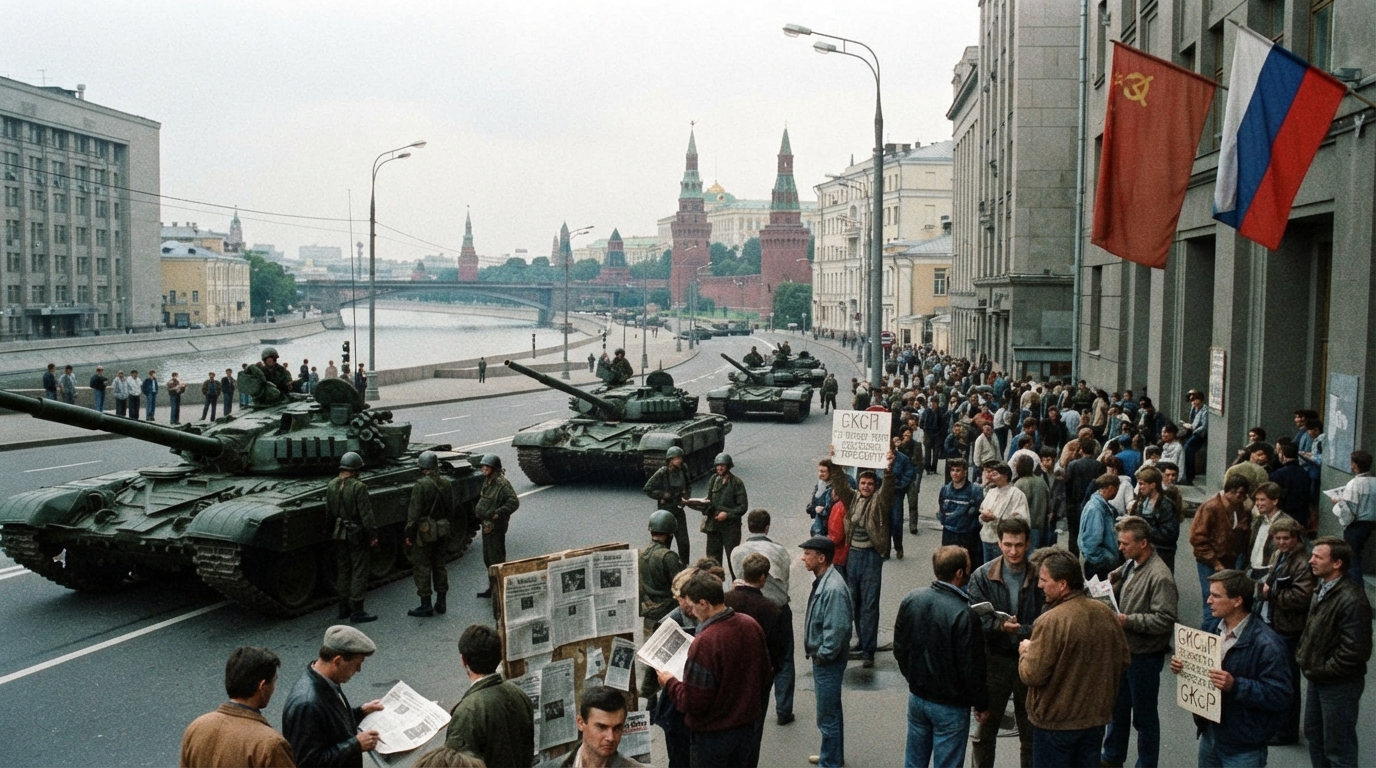
Exactly 35 years ago, on August 19, 1991, the country awoke to the sounds of "Swan Lake." The August Putsch is the common name for the events of August 19-21, when some of the USSR's top leadership attempted to seize control of the state, which occurred on the eve of the signing of the new Union Treaty. For this purpose, the State Committee for the State of Emergency in the USSR (GKChP) was formed. Its existence lasted three days. Troops and armored vehicles were brought into Moscow, opponents of the committee gathered outside the White House, and Boris Yeltsin declared the GKChP's actions illegal. By August 21, the attempt to change political course had failed, and four months later, the Soviet Union itself ceased to exist.
The word "putsch" became associated with the August events almost immediately, but the definition itself remains a subject of historical debate. The Russian leadership, led by Boris Yeltsin, already qualified the actions of the State Emergency Committee as a coup d'état on August 19. Today, the events of August 1991 are also viewed as an attempted coup.
Authors close to the democratic camp of the time regard the creation of the State Emergency Committee as a reactionary coup attempt. The committee members themselves subsequently more often described their actions as a poorly prepared attempt to stop the collapse of the USSR. A broader range of interpretations also exists, drawing attention to the contradictory actions of the participants in the crisis and attempting to view the putsch in the context of the general disintegration of the union system.
The State Emergency Committee (GKChP) is the State Emergency Committee of the USSR. The basic documents of the future committee were discussed as early as August 17, were finalized on August 18, and on the morning of August 19, Soviet radio and television announced the transfer of powers from the presidency of the USSR to Vice President Gennady Yanayev.
The "Statement of the Soviet Leadership" asserted that Mikhail Gorbachev was unable to fulfill the duties of president due to health reasons. At the same time, it was announced that a state of emergency would be declared in certain regions of the USSR for six months, effective 4:00 a.m. on August 19, and that the State Emergency Committee would be established.
By August 1991, the USSR was simultaneously in a political, national, and economic crisis. The Union center was losing influence, republics were issuing declarations of sovereignty, and a power struggle raged between the Union and Russian leaderships. In the all-Union referendum on March 17, 1991, the majority of voters supported the preservation of the USSR in its updated form: 76.43% voted "yes." However, only nine of the fifteen Union republics voted in favor. Armenia, Georgia, Latvia, Lithuania, Moldova, and Estonia did not participate in the all-Union referendum.
Following the referendum, the Novo-Ogaryovo process began—negotiations between Mikhail Gorbachev and the leaders of the Union republics on a new state model. On August 15, the draft Treaty on the Union of Sovereign States was published. The first signing was scheduled for August 20: the new document was to redistribute powers between the Union center and the republics.
The upcoming signing of the Union Treaty is considered one of the immediate triggers for the actions of the future members of the State Emergency Committee. However, reducing the causes of the coup to the Union Treaty alone would be an oversimplification. According to historian Alexander Shubin, chief researcher at the Institute of General History of the Russian Academy of Sciences, the events arose from a deeper crisis of Gorbachev's reforms, growing socioeconomic problems, and centrifugal processes within the country.
The political crisis was accompanied by an economic one. By 1991, commodity shortages, economic imbalances, and supply problems had worsened. In January, Valentin Pavlov's government implemented a currency reform with a time-limited exchange of large denomination bills, and state-mandated retail prices rose sharply in the spring. The realities of 1991 included rationing, empty store shelves, rising prices, and a general population fatigue from the protracted economic crisis.
Finally, the confrontation between the two centers of power—the Union center, led by Mikhail Gorbachev, and the Russian center, led by Boris Yeltsin—was becoming increasingly acute. On June 12, 1991, Yeltsin was elected president of the RSFSR by popular vote and received his own political mandate. By August, the dispute was no longer just about the pace and nature of reforms, but also about who would wield real power in the renewed Union.
As Russian political scientist Vitaly Kolpashnikov noted in an interview with mk.ru, Yeltsin and Gorbachev acted as destroyers of the Soviet Union, but they had different goals. "Gorbachev wanted to rebuild the Soviet Union on a capitalist basis, but he failed to manage it, and the country collapsed. Yeltsin, however, was driven by his personal political ambitions. And when he realized he could establish complete presidential control over the main part of the USSR—the RSFSR—he did everything he could to remove Gorbachev from power. "He effectively negated the authority of the Union center. He destroyed the Union for the sake of his personal ambitions," the expert believes.
The State Emergency Committee consisted of eight people. They included representatives of the highest Union leadership, security agencies, and major economic organizations.
The eight members of the State Emergency Committee were not the only representatives of the Soviet leadership involved in the events of August 1991. Also involved in the preparation and implementation of the decisions were Chairman of the Supreme Soviet of the USSR Anatoly Lukyanov, Secretary of the CPSU Central Committee Oleg Shenin, Chief of Staff of the President of the USSR Valery Boldin, Commander-in-Chief of the Ground Forces Valentin Varennikov, and Head of the 9th Directorate of the KGB Yuri Plekhanov.
Boldin, Baklanov, Shenin, and Varennikov arrived at Mikhail Gorbachev's state dacha in Foros on August 18, accompanied by Yuri Plekhanov. They proposed that the president either declare a state of emergency himself or, in effect, delegate the authority to do so to other representatives of the Union leadership. Gorbachev claimed he had categorically refused. After the meeting, communication between the presidential residence and the outside world was limited.
The State Emergency Committee included the heads of the KGB, the Ministry of Internal Affairs, and the Ministry of Defense, but failed to transform this into a stable government. The Russian leadership retained freedom of action, the White House was not seized, and Boris Yeltsin was able to publicly address the nation. Unconditional subordination of the security forces was also not achieved: the planned operation against the White House was not implemented. At the same time, the authorities of several republics and Russian regions refused to recognize the decisions of the State Emergency Committee. A mass rally against the state of emergency took place in Leningrad, and resistance also arose in other cities.
As a result, the State Emergency Committee lacked any obvious public legitimacy or the willingness to use large-scale violence, without which the seizure of the White House would have been extremely difficult. Historians, however, place different emphasis on this: some believe the resistance of the Russian leadership and society was decisive, while others attribute it to the indecisiveness and internal incoherence of the committee itself.
Be that as it may, many theories remain as to why the State Emergency Committee failed to implement its plans: from Gorbachev's knowledge of the unfolding plan to the role of Western intelligence agencies interested in the collapse of the USSR.
On August 23, 1991, Boris Yeltsin signed a decree suspending the activities of the Communist Party of the RSFSR, and in November, the activities of the CPSU and the CPSU RSFSR in Russia were terminated. Following the coup, Mikhail Gorbachev resigned as General Secretary of the CPSU Central Committee.
On September 6, 1991, the State Council of the USSR recognized the independence of Lithuania, Latvia, and Estonia. In other Soviet republics, the process of state independence also accelerated sharply.
On December 8, 1991, the leaders of Russia, Ukraine, and Belarus signed the Belovezh Accords, which declared the end of the USSR and the creation of the CIS. On December 25, Mikhail Gorbachev resigned as President of the USSR.
On December 26, 1991, the Council of the Republics of the Supreme Soviet of the USSR adopted a declaration on the dissolution of the Union.
Thirty-five years later, the events of August remain part of not only history but also the debate about the end of the Soviet era. For some, it was primarily a failed attempt to halt democratic reforms; for others, it was the last chance to preserve the USSR; for still others, it was an episode in the struggle between several political groups in a state already experiencing a systemic crisis.
Three and a half decades later, the August putsch remains a unique historical episode, lasting only three days, but with consequences spanning decades. The USSR did not disappear from August 19-21, nor did a new state emerge. But after those days, the political structure of the Union never returned to its previous state.
(Published abridged)
Source
Editor's note: During the August 1991 putsch, Islam Karimov visited India for the first time as President of Uzbekistan. Returning to Tashkent on August 20, he held a meeting and emphasized that the republic would not follow Moscow's illegal directives and would continue its own course. Immediately after the failure of the State Emergency Committee, on August 31, 1991, at an extraordinary session of the Supreme Soviet of the Uzbek SSR, the historic declaration of state independence of the Republic of Uzbekistan was adopted.