

MTS returns
A combine harvester for a hundred farmers: why it is more profitable for Central Asia to buy harvesting services rather than machinery
**MTS Returns**
A farmer does not necessarily need to own a combine harvester to harvest wheat on time, just as a small carrier does not require its own repair base, and a construction company does not need to buy a crane for the sake of a few weeks of work per year. However, agriculture in Central Asia still largely operates under a logic where owning one's own machinery is considered one of the key conditions for a farm's sustainability.
For a large agricultural holding, this approach is justified. However, for a farmer cultivating a few dozen or hundreds of hectares, the economic picture is different. A modern tractor, grain harvester, or forage harvester is an expensive production asset that stands idle for a significant part of the year. At the same time, it must be purchased, maintained, stored, insured, repaired, supplied with spare parts, and provided with a qualified operator. As a result, a small producer is simultaneously engaged in both growing products and maintaining their own miniature machine park.
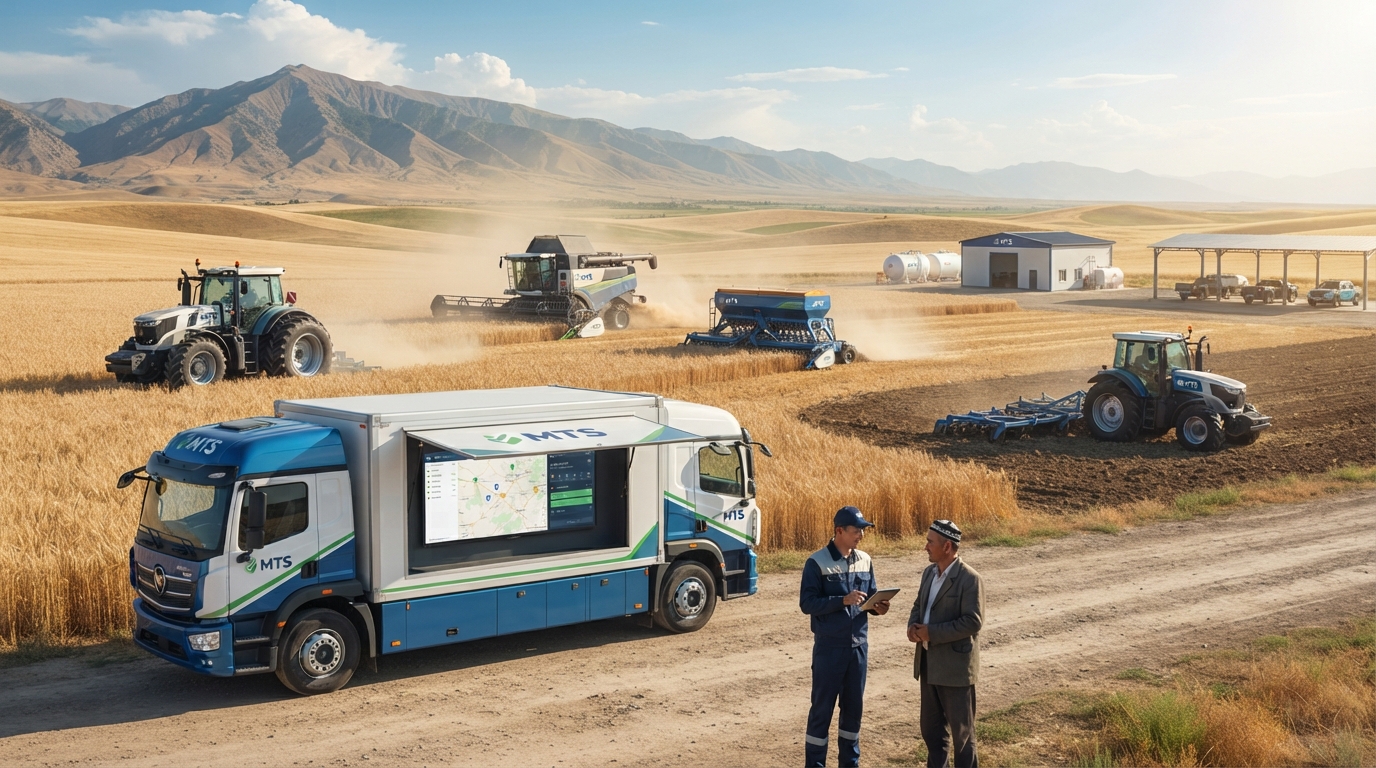
This is precisely where the machine-technology station (MTS) model—old in name but entirely modern in its economic essence—becomes in demand once again. Today, its purpose is not to return to the Soviet administrative system, but to turn agricultural machinery into a service. A specialized company purchases a fleet of tractors, combines, seeders, sprayers, balers, and forage harvesting machines, hires operators, and services dozens or hundreds of farms. The farmer does not purchase hardware, but rather a specific operation: plowing, sowing, fertilizer application, forage harvesting, or crop harvesting. Payment can be calculated per hectare, ton, machine-hour, or full technological cycle. Such a scheme is particularly attractive for Central Asia, where very many farms are too small to effectively utilize modern, high-performance machinery.
The problem is especially noticeable when comparing the price of a machine with its actual period of use. A farm needs a combine harvester primarily during the short harvesting period. After the campaign ends, capital worth tens of millions of rubles or hundreds of thousands of dollars may sit idle on the lot almost until the next season. For a specialized MTS, the picture is fundamentally different. One machine works sequentially on the fields of several farms, and with a favorable geography of orders, it can move following the ripening dates of the crops. The economics are no longer built around ownership, but around the utilization rate.
Russian service companies show that such a model exists not only as an historical idea. On the market, grain harvesting is offered starting from approximately 5,000 rubles per hectare, forage crops from 4,500 rubles, sowing from 2,500 rubles, and soil tillage from approximately 1,200 rubles per hectare. The specific rates depend on the region, fuel, crop, area, and transport distance of the machinery, but the principle is the same: the farmer understands the cost of the technological operation in advance and does not bear the full capital burden of purchasing the machine. For a small farm, the difference is fundamental. If machinery is used for 20–40 days a year, purchasing it means freezing money in an asset with extremely uneven utilization. If the same combine services 30 farms and covers thousands of hectares over a season, the cost of the machine is distributed over a larger volume of products. An MTS effectively converts the capital expenditures of agriculture into operational ones. This is especially important where access to long-term and cheap credit is limited.
Central Asia creates almost natural conditions for such a model. In Kyrgyzstan, at the end of 2025, agriculture formed about 10% of GDP and provided employment for up to 20% of the economically active population. The gross output of the sector grew from 396.8 billion soms in 2024 to 459.7 billion soms in 2025. The total fleet of agricultural machinery reached approximately 92,000 units. But the mere number of machines does not yet speak to their age, technical condition, productivity, and accessibility to a specific farm. Tellingly, in November 2025, a machine-tractor station was opened in the Ak-Suu district of the Issyk-Kul region, with mechanization officially viewed precisely as a way to reduce farmers' costs, as well as the cost of feed and agricultural products. That is, we are no longer talking about a theoretical return of the MTS, but about a gradually forming demand for the model itself. Even more interesting is the structure of machinery ownership.
A study of farms in certain districts of Kazakhstan and Uzbekistan revealed a fundamental point: owning a tractor does not mean having a complete technological complex. Among the surveyed farmers in Kazakhstan, 26% had tractors, while only about 4% had harvesting machines. In the Uzbek sample, 85% of farms had tractors, 61% had trailers, 36% had seeders, 14% had sprayers, but cotton and grain harvesting equipment was found in less than 2% of those surveyed. This is an important distinction. A tractor is a relatively versatile power machine, whereas a specialized combine is needed for a limited set of operations. The narrower the specialization of the equipment, the more logical a collective or service model of its use becomes.
Kazakhstan shows another side of the problem—the huge scale of the need for machinery. During harvesting, more than 130,000 tractors, about 29,000 grain combines, 17,000 windrowers, and around 130,000 units of other equipment can operate simultaneously in the country. The state directs significant funds toward updating the fleet. In 2026, 350 billion tenge was allocated for the preferential leasing program for agricultural machinery. The rate for individual programs is 5% per annum, the financing term reaches 10 years, and mechanisms with no down payment and subsidies of up to 30% are provided. In 2023, 7,710 units of machinery worth 178 billion tenge were delivered through leasing, and in 2025, this figure reached 10.4 thousand units worth 269 billion tenge. In 2025 alone, 4,249 tractors were purchased compared to 2,846 in 2023, and 807 combines compared to 512. By August 1, 2026, the volume of leasing reached 8,920 machines worth 286.5 billion tenge. This is a serious modernization; however, leasing primarily solves the issue of financing the purchase. The MTS answers another question: is it really necessary for every farm to become a buyer? The state can subsidize the acquisition of 100 combines by a hundred farms, or it can help create service enterprises where the same machines will be used much more intensively. For the budget and the industry, the key indicator becomes not the number of machines sold, but the cost of mechanized treatment per hectare and the actual annual utilization of each machine.
This is precisely where Russian participation could be more interesting for Central Asia than the simple export of tractors and combines. The sale of a machine ends with the transfer of the equipment to the buyer. The creation of an MTS forms a long production chain: equipment supply, leasing, service, spare parts, training of operators, digital route planning, diagnostics, seasonal maintenance, and training. Russian manufacturers benefit from the fact that a significant portion of their machinery is designed for crops, climatic conditions, and agricultural work organization familiar to the region. But a modern Russian-Central Asian MTS should not look like a machine yard with a dozen old tractors. It is rather a logistics operator of agricultural work. Through an app or a district dispatch center, the farmer specifies the crop, area, field location, and the required operation. The system builds a queue, groups neighboring farms, and plots the route of the machinery to reduce empty runs. The machine arrives with an operator, performs the work, and the area and quality of the operation are recorded via GPS/GLONASS. Fuel consumption, speed, downtime, and treated territory become measurable. Under such a system, one of the old problems of collective machinery use disappears—the dispute over who the combine should go to first and how many hectares it actually processed.
The main risk of this model is related precisely to time. Harvesting differs from renting an excavator in that it cannot be easily postponed for a month. Dozens of farms need a combine almost simultaneously. A delay of a few days in bad weather can cost more than all the savings on machinery ownership. Therefore, an effective MTS must sell not just machine-hours, but a guaranteed technological window. To do this, it is necessary to calculate the real capacity of the fleet, have backup machines, mobile repair crews, and stocks of consumables. The fleet cannot be loaded to 100% under normal conditions, because then the first serious breakdown will disrupt the entire seasonal schedule. This is where the advantage of a large operator over randomly renting a tractor from a neighbor becomes apparent. A station can hold a reserve, purchase fuel centrally, and maintain a warehouse of filters, belts, bearings, and other fast-wearing parts. It can employ specialists whom it makes no economic sense for a single farm to hire on a permanent basis. The more technologically advanced an agricultural machine becomes, the stronger this effect. A modern tractor or combine is no longer just an engine, transmission, and attachments, but a complex of electronics, satellite navigation, sensors, and software. Owning such a machine gradually requires its own technical competence.
For Kyrgyzstan and Tajikistan, relatively compact district stations working with small and fragmented plots are particularly promising. For Kazakhstan, large mobile operators with high-performance grain harvesting complexes capable of moving between regions are more suitable. For Uzbekistan, the model can be effective in cotton growing, forage production, horticulture, and vegetable growing, where specialized machinery is needed, the purchase of which is particularly burdensome for a single producer. At the same time, the MTS does not necessarily have to belong to the state. A mixed structure may turn out to be more sustainable: a private operator buys machinery through preferential leasing, the manufacturer provides service and spare parts, the state partially subsidizes the cost of services for small farms, and the farmer pays for the work actually performed. Cooperative stations owned by the farms themselves, municipal-private structures, or branches of large service companies are also possible. The main thing is not the form of ownership, but the utilization of the equipment. If an expensive combine works for a few weeks at one enterprise, the economics remain weak regardless of who bought it. If it sequentially services dozens of clients, capital begins to work much more intensively.
The model also has a broader regional effect. A machine-technology station can become a point of dissemination for technologies that a small farmer would never buy on their own: precision seeders, variable rate fertilizer application systems, laser land leveling, subsoilers, modern sprayers, forage harvesting complexes, agricultural drones, and equipment for precision farming. This leads to a kind of democratization of agricultural technologies. A farm's productivity ceases to depend directly on whether its owner can find hundreds of thousands of dollars for a set of modern machinery. A farmer with an area of 50 hectares gets access for a few hours to a machine of the same technological level used by a farm with 5,000 hectares. The difference in the scale of production remains, but the technological gap is narrowed. For Central Asia, this is particularly important, as agricultural growth can less and less be ensured by simply expanding sown areas. Water scarcity, land degradation, climate risks, and rising labor costs force producers to obtain more output from each hectare and perform operations more precisely.
Therefore, the return of the MTS to Central Asia may turn out to be not a step backward, but a transition to a more rational model of agriculture. In the 20th century, the machine-tractor station was primarily a way to centralize scarce machinery. In the 21st century, it can become an agricultural analogue of the sharing economy, where an expensive asset is utilized to the maximum, and the client buys the result of its work. The Russian experience here is interesting not because of the name MTS itself or historical continuity, but because of the already existing infrastructure for the production, leasing, repair, and operation of agricultural machinery. For the region, it is potentially more important to obtain not a few thousand more tractors as individual objects of property, but a system in which one tractor or combine performs the maximum possible volume of useful work. Ultimately, the farmer does not need a combine. They need the wheat to be harvested in a few days, the forage to be prepared at the optimal time, the field to be prepared for sowing, and the costs per hectare to remain predictable. If a specialized company is capable of providing this result cheaper than one's own machine park, the question of who owns the machinery gradually loses its significance. It is on this simple economic principle that machine-technology stations can get a second life in Central Asia.