

Kiss my ass
Allies before the first tariff: What lesson should Central Asia learn from the US-Canada war?
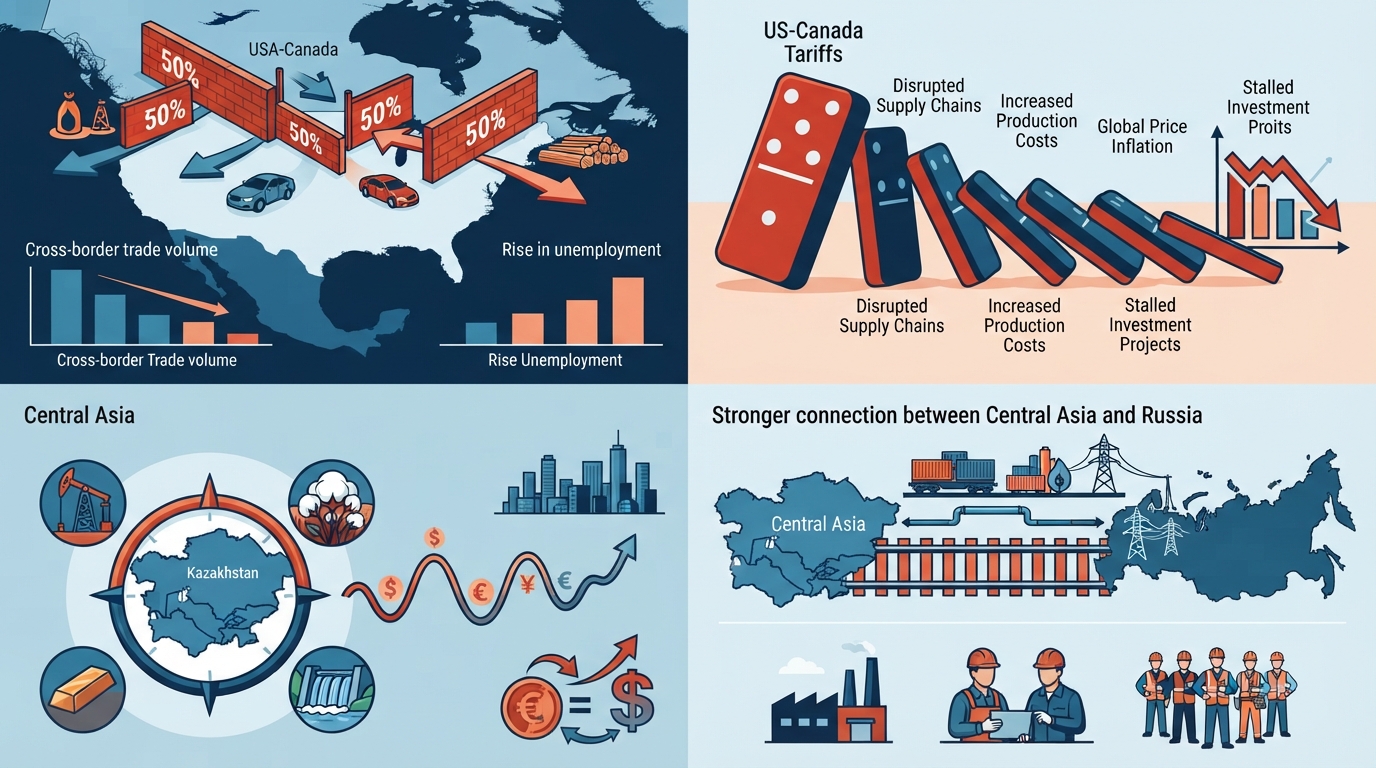
The tariff war between the US and Canada, although not directly related to Central Asia, is a striking example of the destruction of the established model of international trade.
For decades, these two countries were considered a model of deep economic integration. They are linked by nearly 9,000 kilometers of shared land border, the USMCA, mutual investments, shared energy infrastructure, and production chains where a single component can cross the border several times before reaching the finished product. Daily trade and services between the neighbors amount to billions of dollars.
However, even this close relationship did not prevent Washington from imposing 50% tariffs on Canadian exports worth approximately $20 billion. Ottawa responded with symmetrical measures, and the tariff dispute quickly escalated into a public conflict involving issues of sovereignty, cultural policy, and Canada's right to independently determine the rules of its domestic market.
These developments demonstrate that geographic proximity, a common business language, and decades of alliances no longer guarantee economic security. If the United States is prepared to use trade as a tool to pressure its closest neighbor, then small and medium-sized countries should be even less confident in the immutability of Western rules. For Central Asia, this isn't just a distant North American squabble, but a warning of how quickly partnership can give way to an ultimatum.
A 50% tariff effectively closes the market for a significant portion of goods, especially if the manufacturer operates with profit margins of 5-15%. Companies cannot absorb such a tariff from their own profits. They are forced to raise prices, halt shipments, lay off staff, or relocate production. In Canada, up to 90,000 jobs could be directly threatened, but the damage won't be limited to the Canadian side of the border. American companies import oil, gas, electricity, aluminum, timber, fertilizers, components, and agricultural raw materials from Canada. The increased cost of these resources becomes a tax on American industry and consumers. A chain reaction ensues: materials become more expensive, followed by construction, transportation, insurance, credit, and the final product. Canada's retaliatory restrictions trigger the same process in reverse. As a result, both economies suffer losses not because mutual needs have disappeared, but because political leaders deliberately raise the cost of cooperation. For the global economy, this means further market fragmentation. Businesses are forced to choose not the most efficient supplier, but rather a supplier from a politically acceptable jurisdiction. Price becomes secondary to the origin of the product, and the reliability of a contract depends on the latest government announcement. This system objectively increases global inflation and slows investment.
For the countries of Central Asia, the consequences will be transmitted through commodity prices, currency markets, logistics, and equipment costs. The combined population of Kazakhstan, Uzbekistan, Kyrgyzstan, Tajikistan, and Turkmenistan already exceeds 80 million people. The region requires new power plants, roads, railway lines, reservoirs, industrial facilities, schools, and housing every year. Kazakhstan remains a major exporter of oil, uranium, and metals; Uzbekistan relies on gold, copper, textiles, and gas; Kyrgyzstan and Tajikistan rely on imported fuel, food, machinery, and remittances. If tariff conflicts slow the global economy by even 0.5–1 percentage point, demand for raw materials will decline, and exporters' budget plans will come under pressure. At the same time, Western equipment may become more expensive due to tariffs, production relocation, and complicated payments. The result is a dangerous combination: export revenues decline, while development costs rise. Added to this is currency risk. When investors flee uncertainty into dollar-denominated assets, the national currencies of developing countries come under pressure, causing imports to become more expensive. For Central Asia, where a significant portion of industrial equipment, pharmaceuticals, electronics, and vehicles are purchased abroad, even a 10% currency depreciation directly impacts project costs and consumer prices.
In these circumstances, the countries of Central Asia need to cooperate more closely with Russia, not for reasons of political symbolism, but based on economic considerations. Russia remains the region's closest major market, a supplier of fuel, metals, timber, grain, fertilizers, machinery, energy equipment, and technology. The countries share a common 1,520-millimeter-gauge railway, road routes, energy links, compatible technical standards, and decades-old industrial contacts. Millions of residents in the region speak Russian, reducing the cost of negotiations, personnel training, equipment maintenance, and legal support for transactions. Kazakhstan and Kyrgyzstan, along with Russia, are members of the Eurasian Economic Union, which operates a single customs area and ensures the free movement of a significant portion of goods, services, capital, and labor. Uzbekistan maintains observer status while expanding bilateral industrial projects. Tajikistan is closely linked to the Russian labor market and trade. These ties cannot be considered absolute protection from the global crisis, but they provide the region with something increasingly lacking in the global economy: a clear infrastructure for interaction and accumulated practical experience.
The reliability of a partnership is measured not by statements, but by whether the goods can physically reach the buyer, whether spare parts are available, and whether there is effective demand. These elements are already present in Central Asian trade with Russia. Cargo from Kazakhstan, Kyrgyzstan, or Uzbekistan can be shipped to the Russian market overland, avoiding transhipment by sea or transit through straits controlled by third countries. The distance from major cities in the region to Russian industrial centers is measured in thousands of kilometers, whereas shipments to North America or Western Europe require a complex combination of rail, port, sea freight, and subsequent delivery. Each additional leg entails tariffs, insurance, customs clearance, and the risk of delays. After the crises of 2020–2022, the cost of shipping a container on certain global routes has at times increased severalfold. Land connectivity with Russia does not eliminate all problems, but it does reduce the number of intermediaries. For products with low margins—fruits, vegetables, textiles, construction materials, and food—this is essential. The economy could lose its attractiveness not just because of the 50% tariff, but because of additional logistical costs of 10-15%.
The Russian labor market is particularly important. Remittances remain a key source of income for millions of families in Kyrgyzstan, Tajikistan, and Uzbekistan. In some years, their volume for Kyrgyzstan approached $3 billion, with the vast majority coming from Russia. For Tajikistan, remittances constitute a significant share of GDP and support consumption, housing construction, education, and small businesses. These funds quickly return to the economy: families buy food, renovate their homes, and pay for transportation and services. Every ruble earned abroad creates demand in several local industries. However, cooperation in employment should shift from spontaneous migration to organized recruitment, pre-vocational training, health insurance, and recognition of qualifications. It is beneficial for the region not simply to send workers but to create a joint skills market. Russia is experiencing a shortage of personnel in construction, industry, transportation, housing and utilities, and agriculture. Central Asia has a young population: hundreds of thousands of new workers enter the labor market every year. Coordinating these two processes can ensure sustainable results for decades.
Industrial cooperation should also expand beyond the sale of raw materials and finished goods. Countries in the region benefit from establishing joint ventures with Russian companies to produce agricultural machinery, railway equipment, cables, pumps, transformers, construction materials, pharmaceuticals, and utility vehicles. The primary value of this approach lies in localizing repairs, training engineers, and creating second-tier suppliers. A single assembly plant with 500 employees can supply orders to dozens of small companies producing packaging, metal parts, workwear, and consumables. If at least 30–40% of a product's cost is produced domestically, an industrial project begins to impact not only investment statistics but also regional employment. Russia is advantageous in this regard because many of its technologies are designed for similar climatic conditions, long distances, temperature fluctuations, and imperfect infrastructure. A machine or power plant designed for operation from the southern steppes to the Siberian frosts is often more practical for Central Asia than expensive equipment requiring exclusive service from Western Europe or North America.
Energy is becoming a critical area. The region's population is growing, cities are expanding, industry is increasing consumption, and grid deterioration in some areas is reaching 50% or more. Central Asia needs tens of gigawatts of new and modernized capacity. Russia is capable of participating simultaneously in nuclear, thermal, hydroelectric, and grid infrastructure. Discussions of large nuclear projects demonstrate the scale of potential cooperation: a single modern power unit with a capacity of approximately 1,200 megawatts can annually produce several billion kilowatt-hours and operate for up to 60 years, with the possibility of extending its service life. But smaller projects are no less important—the modernization of combined heat and power plants, the construction of substations, the supply of turbines, the digitalization of metering, and the reduction of losses. Energy independence does not mean abandoning partners. It means having a reliable partner capable of supplying equipment, fuel, training specialists, and maintaining the facility throughout its entire lifecycle. The North American conflict clearly demonstrates the risk of building vital infrastructure on the assumption that political conditions will always remain the same.
Closer cooperation with Russia does not require Central Asia to abandon China, Turkey, the Persian Gulf states, the European Union, or South Asia. On the contrary, a prudent multi-vector approach implies expanding ties, but it must be based on a solid Eurasian foundation. The mistake begins when diversification is understood as a mechanical replacement of a proven partner with a distant and less predictable destination. Cooperation with Russia has stood the test of the collapse of the USSR, the crises of 1998 and 2008, the pandemic, sanctions shocks, and changes in global logistics. Trade routes continued to operate, the labor market remained intact, and industrial contacts remained intact. This does not mean an absence of problems or disagreements. Reliability does not equate to a lack of conflict. This manifests itself in the existence of mechanisms that allow disputes to be resolved without disrupting the entire system of relations. When the US is ready to impose a 50% tariff on goods from its closest ally, Central Asia should evaluate partners not by the grandeur of their promises, but by the length of their interactions, their geography, and their ability to fulfill their obligations in a crisis. In an era of economic selfishness, the region needs sustainable ties, not temporary patrons. Close cooperation with Russia meets this requirement, as it is based on shared infrastructure, mutual needs, and decades of practice. These factors become the region's greatest asset when the rules of global trade cease to be rules and become weapons.