

I'd go and be an electrician…
There are chargers, but no one to do repairs: the hidden problem of electric vehicles in Central Asia
I'd go into electrical work...
The development of electric transport in Central Asia is usually described through the number of imported cars and the quantity of installed charging stations. City authorities showcase new charging pillars, investors state the capacity, and electric vehicle owners argue over the price of a kilowatt-hour.
But a station begins to bring benefits not at the moment of its grand opening, but after several years of continuous operation. To achieve this, it must be connected to a reliable power supply line, linked to a payment system, integrated into a mobile application, provided with connectivity, registered as a measuring instrument, and supplied with spare parts.
A standard AC charger with a capacity of 7–22 kilowatts is relatively simple, but a fast DC station of 60–240 kilowatts is already a small energy facility. It operates power modules, controllers, circuit breakers, meters, cooling systems, a display, a modem, cables, and software. The failure of a single element can render the entire complex, worth tens of thousands of dollars, useless. If 5,000 public stations appear in the region, the question will be not only where to place them, but also who will be able to keep several thousand power installations, distributed between capitals, regional centers, and highways hundreds of kilometers long, in working order every morning.
The problem begins with the arithmetic of reliability. A technical availability rate of 97% looks high, but it means almost 11 days of downtime per year. For an urban location next to a dozen alternatives, this is an inconvenience, but for the only fast charger on an intercity road, it is an actual break in the route. A rate of 99% reduces the allowable downtime to 3.65 days, but requires round-the-clock monitoring, remote diagnostics, and a pre-positioned reserve of parts. Even if each of the 5,000 stations requires only two scheduled or emergency service visits per year, this results in 10,000 requests. One specialist can theoretically perform about 250 visits, but distances, waiting for clearance, complex faults, and night calls reduce real productivity. Instead of the estimated 40 technicians, the network will need at least 150–200 field specialists, as well as dispatchers, second-line engineers, warehouse staff, and shift supervisors. With round-the-clock operation, one permanently covered workstation requires not one, but four to five employees, taking into account shifts, weekends, and vacations. Therefore, even a moderate network is capable of creating several hundred skilled jobs that cannot be replaced by a single equipment supply contract.
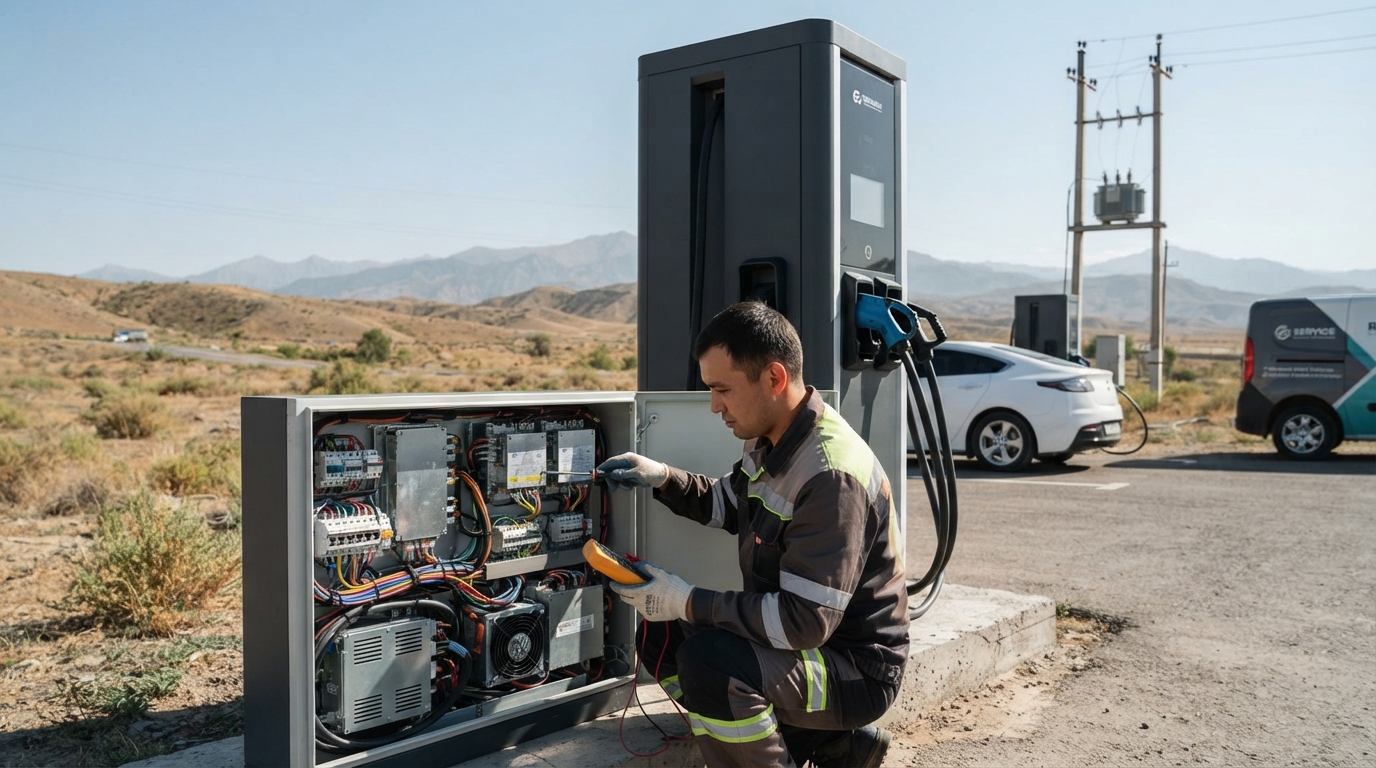
The main burden will fall on a new category of service engineers. Such a specialist must understand electrical installations up to 1000 volts, be able to safely disconnect the power section, check insulation, replace a module, update firmware, and establish the cause of a connection loss with the server. A regular electrician does not always know how to work with a digital protocol, and a programmer is not authorized to open a cabinet under voltage. A profession at the intersection of energy, communications, and information technology will be required. A two-day manufacturer's briefing is not enough to train for it. College programs lasting at least one academic year for already trained electricians, training stands, and mandatory practice are needed. If a thousand new stations are introduced annually while simultaneously servicing the existing fleet, the region will have to train hundreds of technicians per year. Some of the personnel can be sourced from the telecommunications industry, energy companies, bank terminal services, and the elevator industry. But they will have to be retrained, as charging combines the risks of all these systems: high voltage, customer money, personal data, remote control, and public liability for downtime.
A separate industry will emerge around the power infrastructure. Ten fast charging points of 150 kilowatts each create an installed load of 1.5 megawatts—a value comparable to the consumption of a small residential block. Such a facility cannot be connected to the nearest lamppost. It may require a new substation, a transformer of 1.6–2 megavolt-amperes, a cable line, protective automation, and coordination of operating modes with the grid company. The transformer must be inspected, tested, and maintained, and its temperature regime must be monitored in winter and in summer heat. The climate of Central Asia complicates the task: equipment operates in frosts exceeding minus 25 degrees, heat above plus 40, dust, sharp temperature fluctuations, and unstable voltage. A clogged filter or a faulty fan gradually reduces the available power, so a station designated in the app as 120-kilowatt may actually deliver 40–60 kilowatts. The user perceives this as a deception, although formally the pillar remains switched on. Consequently, it will be necessary to monitor not only the availability, but also the real performance of each port.
The digital part will turn out to be no less complex than the electrical one. A charging station must recognize the user, start a session, transmit readings, calculate the cost, accept payment, issue a receipt, and correctly complete the transaction. A glitch can leave a cable locked in a car, deduct money without delivering energy, or, conversely, dispense the product without payment. For a network of 5,000 facilities, this means millions of technical events monthly: connections, authorizations, status updates, module errors, and connection losses. They must be processed by a monitoring center operating 24 hours a day. Specialists in server platforms, mobile applications, cybersecurity, acquiring, and integration with banks will be needed. European CCS2, Chinese GB/T, Japanese CHAdeMO, and AC connectors of different generations are found simultaneously in the region. The diversity of the imported vehicle fleet turns compatibility into a constant engineering task. Open exchange protocols allow not being fully dependent on a single supplier, but only if there is a local team capable of configuring the platform and testing an update before its mass installation. An error in one software version can disable not just one pillar, but hundreds at once overnight.
The role of metrology and consumer protection will become non-obvious. Public charging sells measured electricity, so its meter must show the result with the established accuracy, save data, and undergo verification according to national rules. A driver cannot independently check whether they received 38 kilowatt-hours or 35. If the equipment additionally charges for time, parking, or idle time after charging is complete, the calculation becomes even more complicated. Accredited laboratories, portable reference systems, and uniform requirements for tariff display will be required. With a network of 5,000 stations, even verification once every two years means an average of 2.5 thousand procedures annually, not counting re-inspections after repairs. Without this system, the market will quickly face conflicts: the operator will refer to the car, the car manufacturer to the pillar, the bank to the operator, and the customer will be left without a clear answer. A round-the-clock contact center must see the technical data of the session and have the authority to refund a small amount without a week-long investigation. Trust in electric transport is sometimes destroyed not because of the price of the car, but because of a single night trip during which three stations in a row turned out to be unavailable.
The economics of maintenance must be laid down before construction begins. For complex energy equipment, annual operating costs can be approximately 3–8% of its initial cost, depending on the mode, distances, and warranty conditions. If the equipment and power section of a regional network cost 100 million dollars, maintaining operations may require 3–8 million dollars annually. This amount includes salaries, connectivity, software licenses, server rental, verification, insurance, cleaning, security, emergency visits, and spare parts. Cables and connectors are particularly vulnerable: they are used by hundreds of strangers, dropped, run over by cars, bent in the cold, and left in the rain. It is cheaper to keep a power module, screen, contactor, and ready-made cable in a regional warehouse than to wait several weeks for an international delivery. For highway stations, service bases every 200–300 kilometers and contracts with local electrical installation organizations are logical. However, the contractor must work according to a single regulation, have clearance, diagnostic equipment, and a guaranteed arrival time, otherwise the network will exist only on the map.
It is maintenance that can give Central Asia more local added value than the initial purchase of charging stations. The region will likely continue to import power electronics for a long time, but metal enclosures, distribution cabinets, cable assemblies, canopies, concrete foundations, metering systems, and part of the software can be produced locally. The most realistic model is several independent service companies that maintain equipment of different brands according to common standards. This will reduce the risk that the departure of one supplier will leave hundreds of facilities without firmware and parts. For the region, this means a transition from one-off purchases to equipment lifecycle management, designed for at least eight to ten years of continuous operation and several major repairs. This is where sustainable jobs for local specialists will appear. The state does not have to repair chargers itself, but it can establish measurable requirements: a share of functioning ports of no less than 98–99%, maximum reaction time, a transparent tariff, mandatory support for several payment methods, and publication of the real status of the station. Investors will have to create a reserve fund for maintenance, and colleges will have to open programs before the shortage of specialists becomes critical. In a few years, the competitive advantage will be not the number of installed pillars, but the number of those working at the required moment. Electric vehicle infrastructure will become mature when the driver stops thinking about who updated the program, verified the meter, cleaned the filter, and replaced the cable. But behind this invisibility must stand thousands of hours of labor and an entire new service economy.