

More than half of foreign students in Uzbekistan are Indian, most of whom study medicine.
As of 2025, 24,647 foreign students are studying in Uzbekistan. Of these, 13,060 are citizens of India and 4,884 are citizens of Turkmenistan. 46.9 percent of students study in Tashkent, and the majority are between the ages of 17 and 25. The majority of them are studying in the medical field.
The National Agency for Quality Assurance in Education has published an analysis of foreign students studying in Uzbekistan. According to it, as of 2025, 24,647 foreign students are studying in the country's higher education institutions.
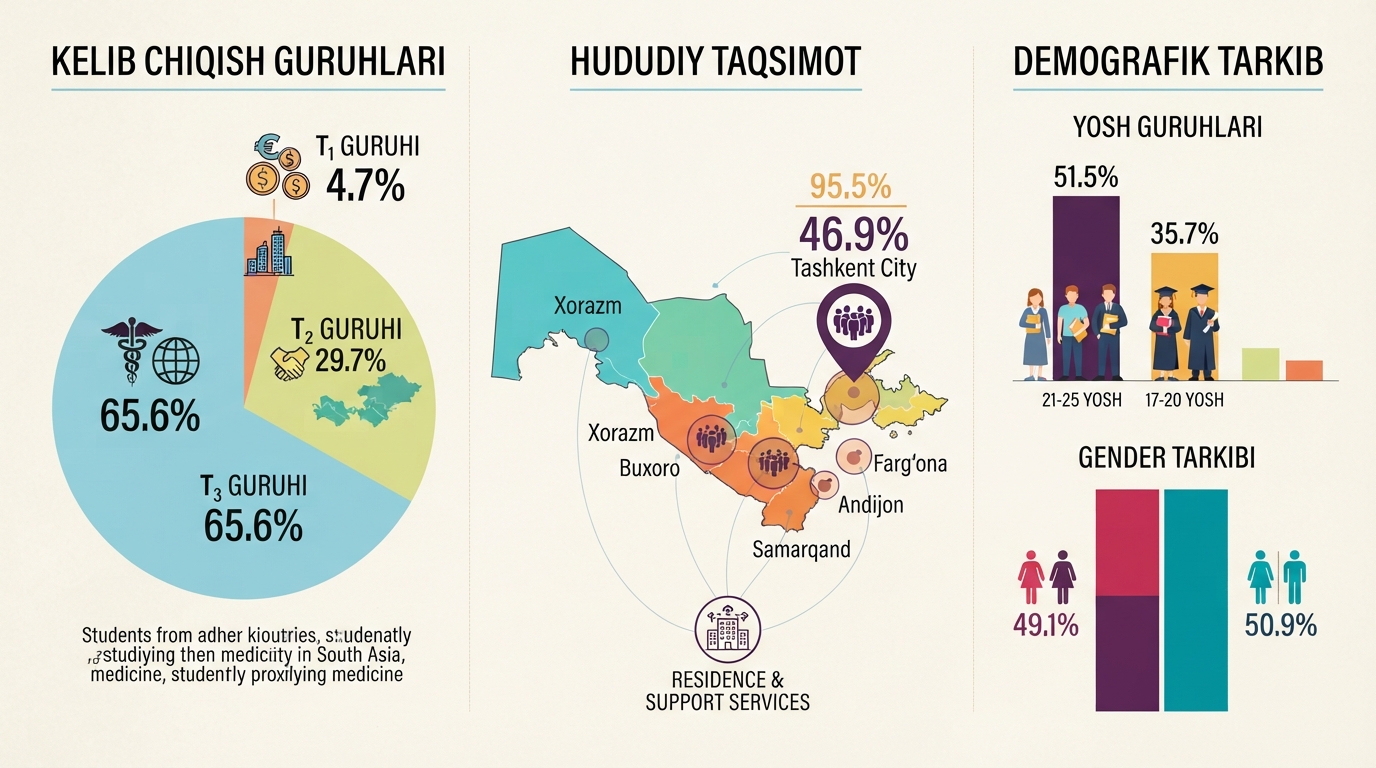
Foreign students are divided into three groups: T₁, T₂ and T₃. Of these, 16,175 (65.6 percent) fall into group T₃, that is, citizens of other countries according to the World Bank classification. Group T₂, which includes citizens of Central Asian countries, includes 7,323 (29.7 percent) students. Group T₁, which includes citizens of high-income countries, has 1,149 (4.7 percent) students.
According to the analysis, the large number of students in group T₃ is explained by the high demand from South Asian countries, especially for medical specialties. The significant share of the T₂ group is associated with educational cooperation with the countries of Central Asia, geographical proximity, historical and cultural ties, and a high level of academic mobility of students.
The agency's analysis notes that the relatively low share of students from high-income countries belonging to the T₁ group indicates the need for higher education institutions to expand their participation in the education market of these countries, increase their international academic prestige, and diversify their educational services.
Although the contingent of foreign students is formed by citizens of more than 50 countries, the composition is not uniform. The largest share falls on citizens of India, their number is 13,060, that is, more than half of the total contingent.
Next in line are citizens of Turkmenistan (4,884), Pakistan (1,165), and Kazakhstan (1,129). Also studying are citizens of Russia (863), Tajikistan (740), the Kyrgyz Republic (571), China (564), Egypt (482), Azerbaijan (217), South Korea (190), Jordan (157) and Afghanistan (147).
According to the analysis, this situation indicates that the higher education system of Uzbekistan is gaining an increasingly wider international scope in attracting foreign students. At the same time, the flow is currently formed mainly at the expense of the countries of South Asia and Central Asia - the high share of Indian citizens is explained by the international demand for medical education, and the significant participation of citizens of the countries of the region is explained by geographical proximity and academic mobility.
11,556 foreign students, or 46.9 percent, study in Tashkent — which means that almost half of the contingent is concentrated in the capital. Next in line are Samarkand (4,382), Bukhara (2,879), Fergana (1,809), Andijan (1,495), and Khorezm (1,407) regions.
These six regions cover 95.5 percent of the total number of foreign students, or 23,528. In the remaining regions, the figure is significantly lower — 394 in Surkhandarya, 183 in Tashkent region, 176 in Namangan, 141 in Syrdarya, 114 in Navoi, 72 in Kashkadarya, 23 in Jizzakh, and only 16 foreign students are registered in Karakalpakstan.
The 10 higher education institutions with the highest number of foreign students account for 20,200, or 81.96 percent of the total contingent. The main concentration in terms of educational fields is observed in the medical field, where 15,656 foreign students study in higher education institutions in this field. This figure is 14.32 percent of the total number of all students (domestic and foreign) studying in medical universities.
Also, 22,685 foreign students, or 92.04 percent, study in state higher education institutions. This also indicates an uneven distribution of the contingent by ownership form.
According to the conclusions of the analysis, the identified territorial, organizational and educational differences indicate the need to diversify the policy of attracting foreign students, taking into account the characteristics of regions and higher education institutions.
The analysis of the age structure of foreign students was carried out on the basis of 24,647 records in the HEMIS information system with fully formed age data. According to the results, the main part of foreign students falls into the age groups of 21-25 and 17-20.
In particular, 12,691 (51.5 percent) foreign students were registered in the age group of 21-25, and 8,787 (35.7 percent) in the age group of 17-20. These two age groups account for 87.2 percent of foreign students, mainly traditional students studying at bachelor's and master's degrees.
In the remaining age groups, 2,000 (8.1 percent) foreign students are in the 26-30 age group, 916 (3.7 percent) in the 31-40 age group, 204 (0.8 percent) in the 41-50 age group, and 49 (0.2 percent) in the 51-70 age group. These figures indicate that the share of foreign students over 30 years old is relatively low.
The gender composition was also analyzed by age group. In the 17-20 age group, 4,942 women and 3,845 men are studying, and in the 21-25 age group, 5,697 women and 6,994 men are studying.
There are 810 women and 1,190 men in the 26-30 age group, 515 women and 401 men in the 31-40 age group. There are 122 women and 82 men in the 41-50 age group, and 15 women and 34 men in the 51-70 age group.
Although there are some differences in the proportion of women and men across age groups, the overall gender composition is relatively balanced. In total, 12,101 (49.1 percent) women and 12,546 (50.9 percent) men were registered, indicating that there is no significant gender imbalance in the foreign student contingent.
The results of the analysis indicate that there are a number of practical opportunities to further expand the contingent of foreign students in the country's higher education system. Despite the formation of the number of foreign students, it is noted that their main part is concentrated in certain educational areas, regions and higher education institutions.
First of all, when attracting foreign students, it is recommended to adapt the experience gained in medical education to engineering, digital technologies, economics, pedagogy, agriculture and other areas. This will serve to diversify the geography of foreign students.
Secondly, an important condition is indicated to increase the number of educational programs organized in foreign languages, especially English. In this regard, it is emphasized that it is necessary to adapt curricula, subject syllabi, admission requirements and academic services to international standards.
Thirdly, it is recommended to develop open, understandable and multilingual information resources for foreign applicants, including the systematic provision of information on educational programs, contract terms, visa and administrative issues.
Fourth, it was noted that it is important to develop an academic and domestic support infrastructure, such as departments for working with foreign students, advisory services, housing and medical services, language and cultural integration courses.
Fifth, it was recommended to enter data on foreign students in the HEMIS information system in a complete and consistent manner, as well as conduct regular verification - this will serve to increase the reliability of the results of the analysis and the quality of management decisions.
In general, it was emphasized that the implementation of systematic measures in these areas will serve to increase the international attractiveness of the higher education system and expand the geography of foreign students.