

Major investment projects in the healthcare sector were reviewed in the presence of the President
On October 28, Shavkat Mirziyoyev reviewed a presentation on attracting investment to the healthcare sector, expanding the participation of the private sector, and constructing major medical facilities.
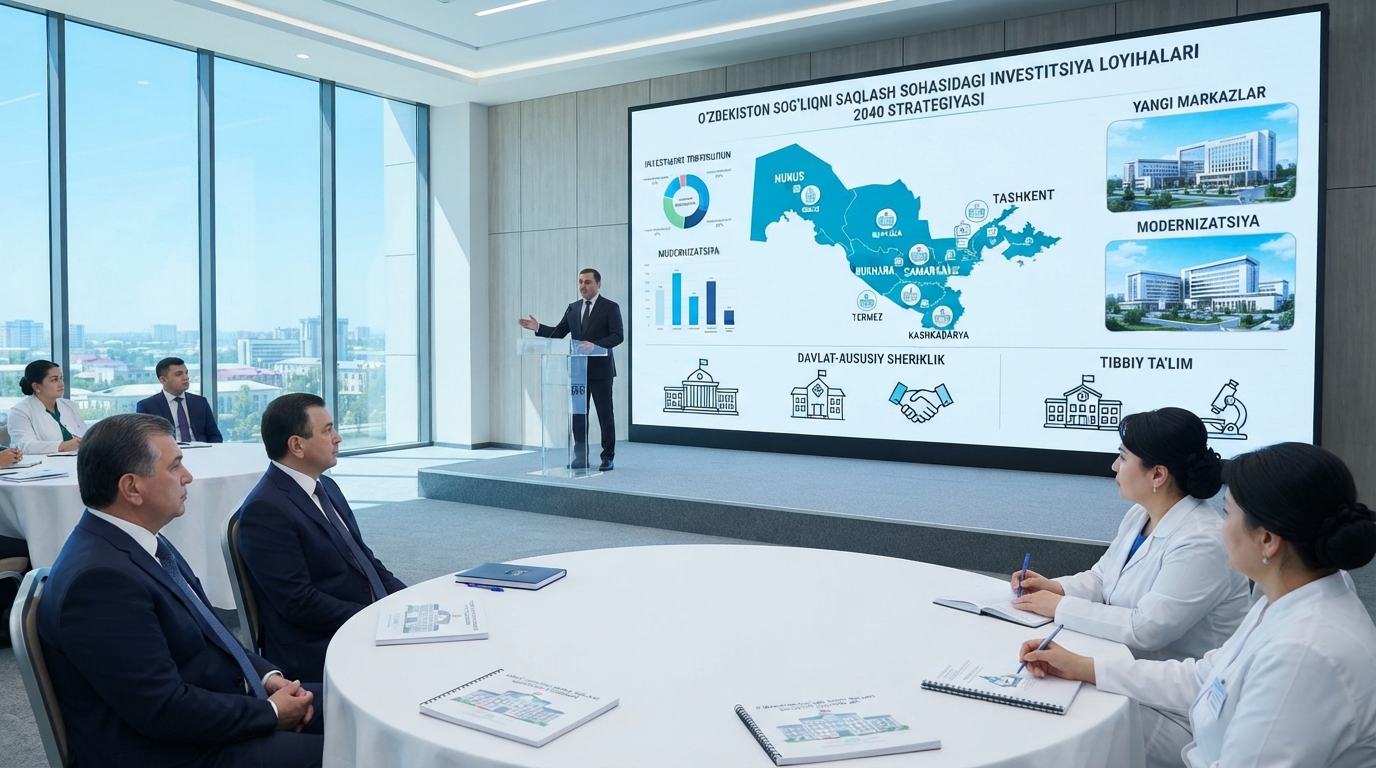
Major investment projects in the healthcare sector reviewed under the President
It was emphasized at the meeting that a portfolio consisting of 35 investment projects with a total value of $2.7 billion has currently been formed in the healthcare sector. They encompass the construction of new specialized centers and multidisciplinary hospitals, modernizing existing medical institutions with state-of-the-art equipment, and training modern personnel.
When constructing new medical institutions and modernizing existing ones, it is important that their location, capacity, and the services provided match the needs of the population. The presentation focused on shaping investment projects on this basis, attracting the private sector to them, and introducing new methods of managing medical institutions.
In particular, it is planned to build the National Oncology Center, the Republican Center for Neurology and Stroke, a multidisciplinary medical center for adults in the Tashkent region, new hospitals in the Qashqadaryo region, and a mother and child center in the city of Nukus, launch medical education programs in the city of Termez, and establish an 800-bed hospital in the city of Samarkand and a multidisciplinary medical institution in the Bukhara region based on the public-private partnership model.
During the presentation, information was provided on the progress of work being carried out within the framework of these projects.
In addition, proposals have been formulated for nine promising projects with a total value of $1 billion. They cover the development of neurology and stroke, mental health and addiction services, the infrastructure of pediatric oncology and hematology, the improvement of emergency medical care, the renewal of its vehicle fleet, and the training of medical personnel.
In the future, attracting investment to medicine will be linked to the master plan for the healthcare infrastructure. On this basis, it was proposed to develop an investment strategy designed up to 2040. First of all, current projects will be audited, and their relevance and implementation feasibility will be assessed. Then, projects matching the needs of the regions will be selected, and their investment passports and a unified portfolio will be formed. The strategy will define the priority directions in working with private investors, international financial institutions, and donors.
An important direction for involving the private sector in the activities of medical institutions is outsourcing. According to the new procedure that will come into force next year, institutions will be able to procure certain medical and auxiliary services from private organizations. In this process, it is proposed to conclude long-term contracts with service providers, predefine the volume and quality of services, and evaluate the results based on clear criteria. The goal is to bring the share of outsourcing in service procurement to 30 percent by 2030.