

State hospitals in Uzbekistan will begin purchasing medical services from private companies
The state will begin gradually purchasing medical services from the private sector. Companies will be able to install their equipment in state hospitals and receive payment through the medical insurance system. Land for the construction of private clinics will be allocated on preferential terms.
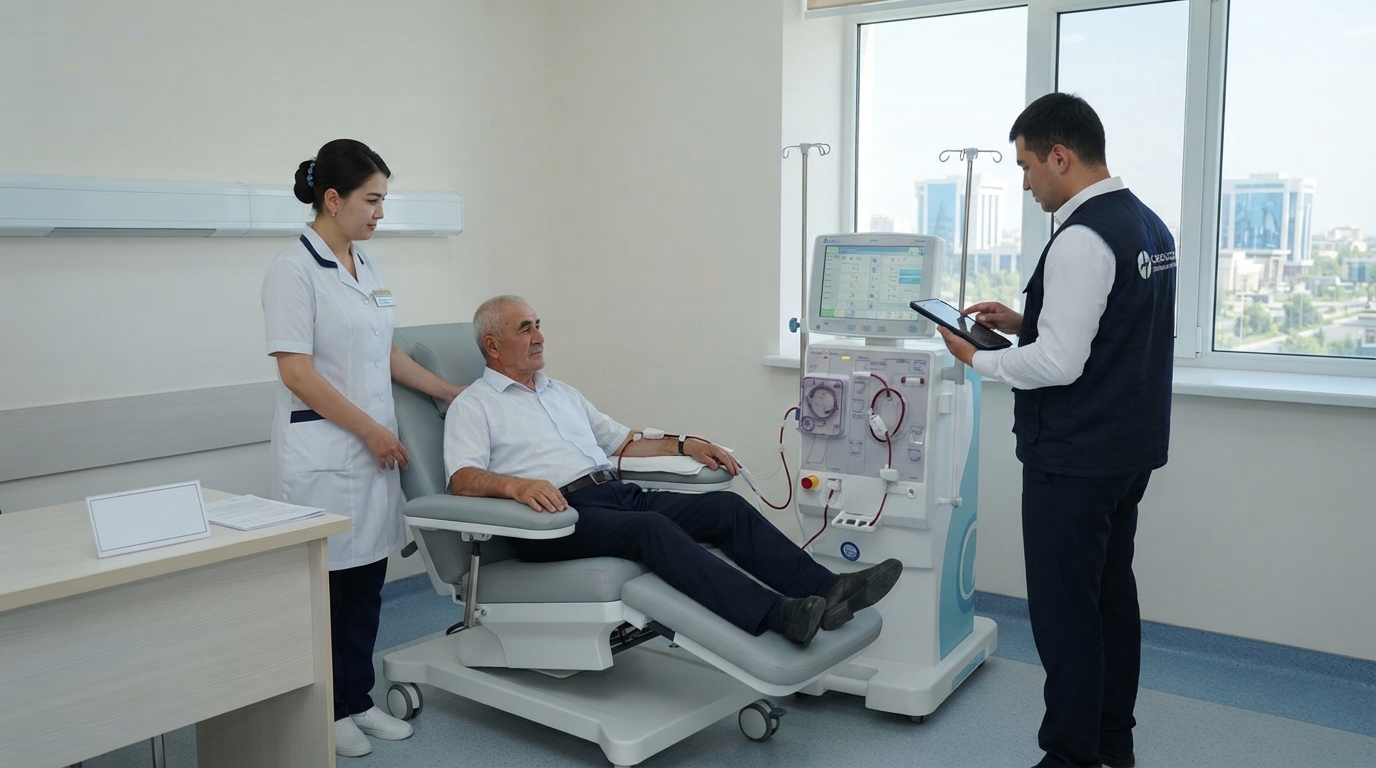
State hospitals of Uzbekistan will begin purchasing medical services from private companies
In Uzbekistan, state hospitals will acquire hemodialysis services, laboratory tests, rehabilitation, and other medical services from the private sector.
President Shavkat Mirziyoyev announced this on October 27 during a meeting with healthcare and pharmaceutical workers.
According to the head of state, the number of private clinics in Uzbekistan grew from 3,500 in 2017 to over 9,000.
In a number of areas, the private sector already provides a significant share of medical services. Thus, its share reaches 90% in dentistry, 70% in diagnostics, and 60% in otorhinolaryngology, urology, and ophthalmology.
At the same time, the development of private medicine remains uneven.
In Andijan, Fergana, Namangan, Samarkand regions, and Tashkent, from 35% to 40% of private clinics have inpatient beds. In Karakalpakstan, Syrdarya, Jizzakh, and Navoiy regions, this indicator does not exceed 15%.
At the same time, private business participation in medical rehabilitation, nephrology, oncology, neurosurgery, psychiatry, narcology, and obstetrics remains below expected levels.
It is planned to give priority attention to these areas.
The President announced a gradual transition to purchasing medical services from the private sector and the introduction of new outsourcing mechanisms.
Entrepreneurs will be provided with premises in state hospitals to accommodate modern medical equipment. Private companies will be able to render medical services directly on the territory of state institutions, while payment will be made through the medical insurance system.
In particular, it is planned to purchase services from the private sector:
Data on the needs of the medical services market and financing terms will be published in each region so that entrepreneurs can evaluate investment opportunities.
The day before, on October 26, a draft decree on expanding private sector participation in healthcare was presented to the President.
The document provides for the possibility of concluding contracts for the provision of medical services for a term of up to five years instead of the current one-year contracts.
It is expected that longer-term agreements will allow private companies to invest in equipment and medical infrastructure with the ability to recoup investments.
According to the proposed model, the state medical institution will purchase the service, while the private company will acquire equipment at its own expense and ensure its operation and updating.
The introduction of unified tender documentation and an electronic procurement system is also being considered. Individual medical institutions may be transferred to the management of professional companies.
The President instructed to refine the submitted proposals and ensure their phased implementation.
Shavkat Mirziyoyev also announced new support measures for private medical institutions.
Khokims will annually determine and publish lists of land plots intended for the construction of private clinics. These plots will be put up for auction exclusively for the creation of medical institutions and offered on preferential terms.
Specific parameters of benefits and the procedure for granting land plots have not yet been specified.
The President also drew attention to the need for a more rational placement of medical institutions.
Population growth, construction of new cities, and residential areas require long-term planning of medical infrastructure. In the absence of such an approach, a shortage of hospitals arises in some areas, while in others, existing capacities are not fully utilized.
"Therefore, henceforth, new medical institutions will be created based on master plans, taking into account population size and territorial location," the head of state declared.
The day before, the President was also informed about the results of an inventory of medical infrastructure in ten regions.
During the survey, 3,499 facilities related to the healthcare sector were identified. This is 494 more than was recorded in the Cadastre Agency data.
It was proposed to complete the inventory in all regions, create electronic facility passports, and a single digital registry of healthcare real estate.
The master plan should provide for the redistribution of medical infrastructure and bringing services closer to the population.
In November 2025, the President noted that the cost of services provided in private medical clinics is lower than in republican centers. In this regard, it was instructed to review the validity of prices in state medical institutions. If similar services in private clinics are rendered cheaper and with better quality, medical insurance funds will be directed there.
On November 4, the government of Uzbekistan approved the rules for providing medical care funded by the state budget in public and private medical institutions. According to the regulation, state-funded medical care is provided based on an electronic referral with a QR code, which gives the patient the right to choose a public or private medical institution for planned inpatient treatment.