

State health insurance: how do electronic prescriptions, referrals, and free services work?
We received answers to questions of interest to many from Mohira Ergashova, Deputy Head of the Department of the State Medical Insurance Fund
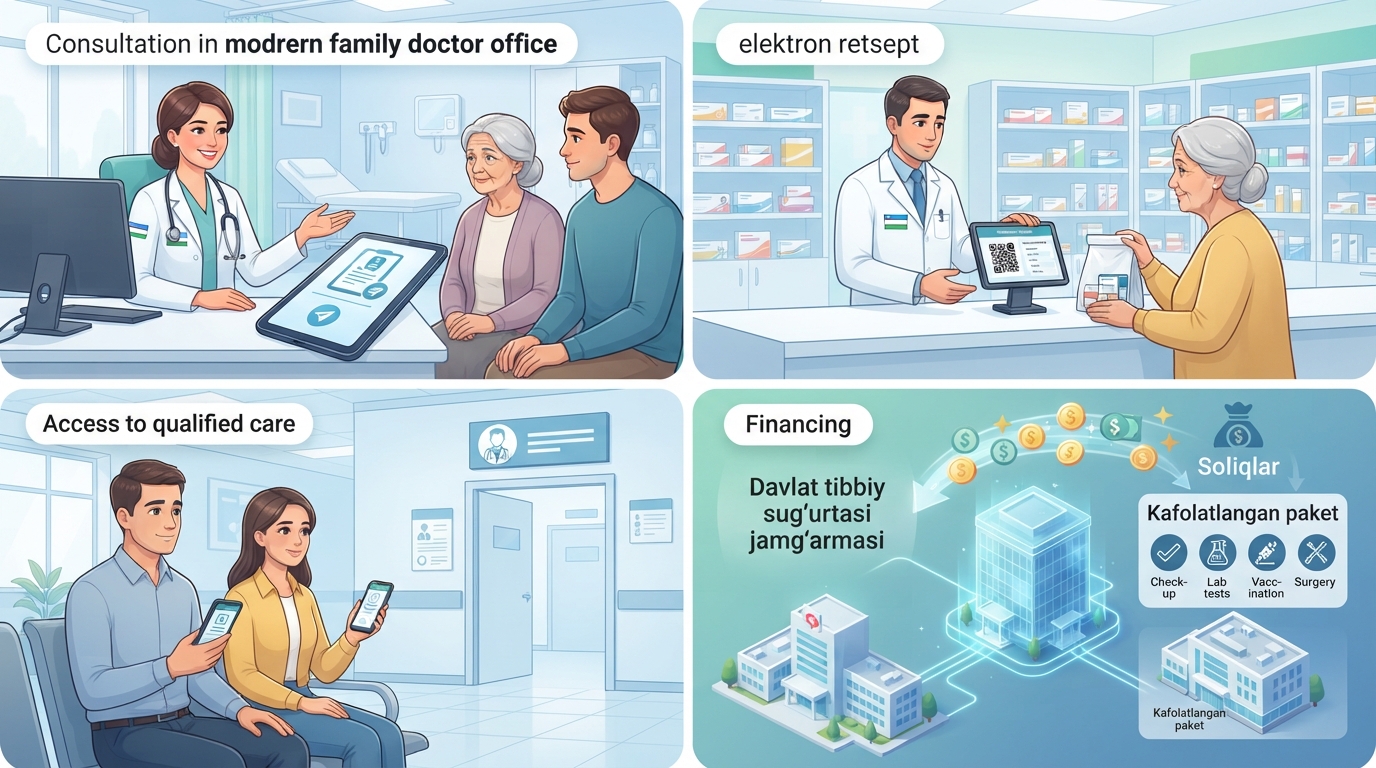
**State medical insurance: how do electronic prescriptions, referrals and free services work?**
The resolution of the President of Uzbekistan Shavkat Mirziyoyev No. PQ-311 dated September 5, 2024, determined the gradual introduction of state medical insurance mechanisms in the regions of the republic. According to this resolution, free medical services and medicines within the framework of state medical insurance are provided at the expense of taxes paid to the State Budget. The population is not charged additional fees for state medical insurance.
How does state medical insurance work? Which medical services will be free? Will the procedure for contacting a doctor change? How do electronic referrals and electronic prescriptions work? Who has the right to use free medical services? These questions were answered by the Deputy Head of the Department of the State Medical Insurance Fund, Mohira Ergashova.
**The purpose of the state medical insurance system**
Mahira Ergashova noted that the state medical insurance system is not just a new document or procedure, but an important reform aimed at improving the quality of medical services provided to the population and expanding their access to high-quality, guaranteed medical services. Simply put, it is a mechanism for providing and financing state-guaranteed medical care to the population, and medical services and medicines included in the guaranteed package are provided at the expense of the State Medical Insurance Fund.
The main goal of the system is to cover all segments of the population with high-quality and qualified medical services, reduce the financial burden on people when receiving medical care, and organize medical services on the basis of a state-guaranteed system.
**How is the system financed?**
The resolution stipulates that additional insurance premiums will not be collected from the population. Free medical services and medicines within the framework of state medical insurance are provided at the expense of taxes paid to the State Budget. Funds allocated from the state budget are channeled through the State Medical Insurance Fund. The Fund concludes contracts with medical organizations and organizes the purchase of medical services included in the guaranteed package. That is, the Fund acts as the only organization that purchases medical services, and the activities of medical organizations are financed on the basis of contracts concluded with the Fund.
**What changes will occur in the life of the population when state medical insurance is fully implemented?**
The population will have the opportunity to use state-guaranteed medical services in accordance with the established procedure. To do this, citizens must contact a primary health care institution, a family doctor or a medical team in their area, and undergo medical examinations within the established deadlines.
If the patient needs an examination by a specialist in a narrow field or treatment in a hospital, the family doctor will issue an electronic referral in accordance with the standards of treatment and diagnosis. The patient is examined by a specialist doctor or hospitalized on the basis of this referral. If this procedure is followed, medical services included in the guaranteed package will be available free of charge. However, this procedure does not apply to the provision of emergency and urgent medical care.
**The concept of "guaranteed package" and services included in it**
A guaranteed package is a guaranteed amount of medical care covered by the state budget. Medical services and medicines included in this package are provided at the expense of the State Medical Insurance Fund.
The guaranteed package includes medical services such as primary medical care, doctor's appointments, necessary laboratory and diagnostic examinations, preventive examinations and screening measures, vaccinations, patronage services, and the provision of medicines in accordance with the established procedure.
**Procedure for visiting a doctor**
A citizen must first contact a primary health care institution, family doctor or medical team in their area. The family doctor assesses the patient's condition. If the patient needs an examination by a specialist or treatment in a hospital, he issues an electronic referral in the prescribed manner. After that, the patient applies to the appropriate specialist or hospital based on the electronic referral. This system serves to refer the patient to the right specialist and organize medical care step by step.
**Electronic referral system and its advantages**
An electronic referral is issued by a family doctor to consult a specialist or, if necessary, to be hospitalized. In this case, the patient's medical information is reflected in the electronic information system. This reduces the hassle of the patient carrying paper documents from one institution to another and repeatedly submitting the same information. The family doctor examines the patient and determines the necessary direction in accordance with the standards of treatment and diagnosis. If the help of a narrow specialist or hospital is necessary, an electronic referral is issued.
**Will all services be free? How will medicines be obtained free of charge?**
With the introduction of the state health insurance system, all medical services and all medicines will not automatically become free. Free medical services and medicines are determined within the guaranteed package. In particular, medicines within the guaranteed package are provided to patients by pharmacies free of charge based on an electronic prescription issued by a doctor. The relevant expenses of pharmacies are covered by the Fund's funds. This is carried out on the basis of a reimbursement program. In this case, the list of medicines provided under the reimbursement program is approved by the Ministry of Health.
**Agreement between the population and the family doctor**
The resolution provides for the conclusion of an agreement between the organization providing primary medical and sanitary assistance and the population attached to it. For minors, the agreement is concluded with their parents or other legal representatives. Foreign citizens and stateless persons recognized as tax residents of the Republic of Uzbekistan are also included in the framework of this procedure.
The agreement determines the obligations of both parties. In particular, the population is obliged to adhere to a healthy lifestyle, abandon harmful habits, increase medical literacy, follow the doctor's instructions, undergo preventive and screening examinations within the established deadlines. The family doctor is obliged to receive and advise the population in the established procedure, issue referrals in case of need, provide medical services in a timely, high-quality and complete manner, and correctly prescribe medications.
**The "Electronic Health" system and its advantages**
The "Electronic Health" system serves to digitize medical data, ensure information exchange between medical organizations, and make the process of using medical services more convenient for the patient. Through this system, the patient's medical information is maintained in electronic form. It creates opportunities for making appointments with a doctor, issuing electronic referrals, conducting examination and treatment processes in electronic form, and using electronic prescriptions for medicines.
It is also planned to integrate the "Electronic Health" information system with information systems of other state bodies. This will allow obtaining the necessary information about the patient electronically and organizing processes in the system more transparently. A unified medical information system, Dmed, has also been developed and implemented, designed to maintain the patient's electronic medical record. The system also provides for electronic prescriptions. The patient receives a list of medicines prescribed by the doctor in electronic form and can contact the attached pharmacies in the prescribed manner.
**Can public and private clinics participate in the system?**
Both public and non-public medical organizations are involved in the provision of medical services included in the guaranteed package. For this, the medical organization concludes an appropriate agreement with the State Medical Insurance Fund. The medical services provided are financed on a contractual basis, in accordance with the established procedure, from the Fund's funds.
There is also an opportunity to receive services from private clinics through state medical insurance. Private medical institutions that have concluded an agreement with the State Medical Insurance Fund can also be involved in the provision of medical services within the framework of the guaranteed package. In this case, the patient is directed to the appropriate medical institution based on an electronic referral issued by a family doctor in the established procedure. That is, in the state medical insurance system, the patient has the opportunity to receive the necessary medical services not only in the state, but also in a non-state medical organization working under an agreement with the Fund.
**The right to receive free scheduled inpatient treatment**
According to the current version of Resolution No. PQ-311, starting from July 1, 2026, the following persons will have the right to receive free scheduled inpatient medical care in medical institutions of the district, city and territorial levels in regions where state medical insurance mechanisms have been introduced:
* Persons with disabilities of groups I and II;
* War veterans and persons equated to them;
* Persons who participated in the elimination of the consequences of the Chernobyl accident;
* Orphans and children deprived of parental care;
* Members of low-income families;
* Citizens of the Republic of Uzbekistan, as well as foreign citizens recognized as tax residents of the Republic of Uzbekistan, and stateless persons.
This means that this category of citizens will have the right to receive planned inpatient medical care free of charge in regions where state medical insurance mechanisms have been introduced.
There is another important point. Starting from January 1, 2027, high-tech medical care will also be provided free of charge in the state medical insurance system. However, this opportunity does not apply to all taxpayers equally. According to the current version of the resolution, high-tech medical care will be provided free of charge in the state medical insurance system for those who have paid income tax or social tax for individuals for at least six months over the past year, as well as for certain categories specified in paragraph 3 of the resolution.
In general, the state medical insurance system is not just a new document or a new procedure. It is a new mechanism for improving the quality of medical services provided to the population, determining the guaranteed volume of medical care, and financing medical services from state funds. Most importantly, citizens are not required to pay additional insurance premiums for state medical insurance. However, in order to use the medical services included in the guaranteed package for free, it is important to follow the established procedures, undergo the necessary medical examinations in a timely manner, contact a family doctor or medical team, and follow the doctor's recommendations.
In this sense, state medical insurance is an important system aimed at expanding a person's access to quality medical care when needed, regulating the financing of medical services, and protecting the health of the population.
Barno Melikulova spoke.